30 Jan 2016

EDO - tsujigiri killings


[ . BACK to DARUMA MUSEUM TOP . ]
. Edo bakufu 江戸幕府 The Edo Government .
::::::::::::::::::::::::::::::::::::::::::::::::::::::::::::::::::::::::::::::::::::::::::::::::::::::::::::::::::::::::::::::::::::::::::::::::::::::::::::::::::::::::::::::::::::: 
tsujigiri 辻斬り "to cut someone down at a crossroad"
"to try out one's new sword on a chance wayfarer"


. samurai, buke 侍、 武家 Samurai - Introduction .


CLICK for more books !

Tsujigiri killings are a well-loved subject of the Samurai Jidaigeki literature and films.

tameshigiri 試し切り "trying out a new sword"
usually done on the bodies of executed people

:::::::::::::::::::::::::::::::::::::::::::::::::::::::::::::::::::::::::::::::::::::::::::::::::::::::::::::::::::::::::::::::::::::::::::::::::::::::::::::::::::::::::::::::::::::

- quote
Tsujigiri (辻斬り or 辻斬 tsuji-giri, literally 'crossroads killing')
is a Japanese term for a practice when a samurai, after receiving a new katana or developing a new fighting style or weapon, tests its effectiveness by attacking a human opponent, usually a random defenseless passer-by, in many cases during nighttime. The practitioners themselves are also referred to as tsujigiri.

In the medieval era, the term referred to traditional duels between bushi, but in the Sengoku period (1467-1600), widespread anarchy caused it to degrade into indiscriminate murder, permitted by the unchecked power of the bushi. Shortly after order was restored, the Edo government prohibited the practice in 1602. Offenders would receive capital punishment. The only known incident where a very large number of people were indiscriminately killed in the Edo period was the 1696 Yoshihara spree killing (吉原百人斬), where a wealthy lord named Yoshihara had a psychotic fit and murdered dozens of prostitutes with a katana. He was treated by authorities as a spree killer and sentenced to death. Later, a kabuki play was made about the incident.
The practice of tsujigiri has been cited in the philosophical debate over moral relativism, notably by Mary Midgley in her 1989 work Can't We Make Moral Judgements?.

Kiri-sute gomen 斬捨御免 or 切捨御免,
literally, "authorization to cut and leave" - the body of the victim

is an old Japanese expression dating back to the feudal era right to strike (right of samurai to kill commoners for perceived affronts). Samurai had the right to strike with sword at anyone of a lower class who compromised their honour.
- - - - - Conditions
Because the right was defined as a part of self defense, the strike had to follow immediately after the offense, meaning that the striker could not attack someone for a past grievance. Also, due to the right being self-defense, it was not permissible to deliver a further coup de grâce. Moreover, the samurai who exercised the right had to prove the correctness of his action in court by producing a witness. Punishment for the incorrect exercise of this right was severe. An offender could be beheaded without being allowed to perform seppuku and have his house abolished, meaning that none of his sons could succeed the title. Due to the seriousness of the punishment, many performed seppuku to pre-empt the verdict. A samurai visiting a different feudal province had to be extremely careful, especially if it was in Edo, the seat of the Shogun. Wrongful executions of commoners from different feudal provinces were seen as an offense against a feudal state. It was thus advisable for samurai visiting different provinces to be accompanied by a servant, so as to provide witness.

- - - - - Right of defense

Because of the somewhat arbitrary nature of this right, anyone who was at the receiving end had the right to defend themselves by wakizashi (short sword). This situation was most common in the case of a higher samurai exercising the right against a lower ranked samurai as samurai would always carry wakizashi.
The expression is still sometimes used in modern-day as "I apologize in advance for this one" for the subtle humor in offering what amounts to an unsympathetic apology.
An instance of Kiri sute gomen is described in the story of the Hōgyū Jizō statue. A boy, whose father was killed by Kirisute gomen, made 100 stone statues in later life, in Kumamoto.
- source : wikipedia


tameshigiri (試し斬り, 試し切り, 試斬, 試切)
is the Japanese art of target test cutting. The kanji literally mean "test cut" (kun'yomi: ためし ぎり tameshi giri). This practice was popularized in the Edo period (17th century) for testing the quality of Japanese swords. It continues to the present day, but has evolved into a martial art which focuses on demonstrating the practitioner's skill with a sword.


. . . . . there were a wide variety of cuts used on cadavers and occasionally convicted criminals, from tabi-gata (ankle cut) to O-kesa (diagonal cut from shoulder to opposite hip). The names of the types of cuts on cadavers show exactly where on the body the cut was made.
- source : wikipedia


:::::::::::::::::::::::::::::::::::::::::::::::::::::::::::::::::::::::::::::::::::::::::::::::::::::::::::::::::::::::::::::::::::::::::::::::::::::::::::::::::::::::::::::::::::::

"Trying Out One's New Sword," by Mary Midgley
- - - - - Summary
Midgley argues that not only is moral isolationism – the view that one ought to respect other cultures but not judge them – incorrect, it is logically incoherent. She does so by presenting four self-contained arguments: that judgment is logically antecedent to respect, that outsiders can judge foreign cultures, if on a provisional basis, that moral isolationism leads to a complete inability to make moral judgments of any kind, and that cultures are not, as moral isolationism holds, subject to isolating barriers.
. . . . . First, she argued that
"there is a contradiction between the claim that we cannot understand these rules, and the claim we must respect them." (Midgely) This only means that we, ourselves, can understand people in other cultures. In the following paragraphs, Midgely was able to illustrate some relevant examples to explain the importance of analyzing other culture's morals in order to form educated judgments about them. She gives an example of ancient Chinese samurai warriors whom before going off to battle would test the sharpness of their swords on innocent strangers. (Midgely)
. . . . . "The Japanese custom tsujigiri involves an owner of a sword and a traveler; the situation is that this owner will have to try out his/her sword to any traveler. This is to check if the blade is really that sharp and that the sword can really kill someone in just a single blow."
source : npapadakis.wordpress.com

:::::::::::::::::::::::::::::::::::::::::::::::::::::::::::::::::::::::::::::::::::::::::::::::::::::::::::::::::::::::::::::::::::::::::::::::::::::::::::::::::::::::::::::::::::::

Kajiwara Heizô Homare no Ishikiri 梶原平三誉石切
石切梶原 ー Kabuki
first presented as a Joruri puppet theater 三浦大助紅梅靮 in 1730 at the 大阪竹本座 Takemoto-za in Osaka.
The title "Kajiwara Heizô Homare no Ishikiri" was used for the first time in June 1892, in Nagoya at the Suehiroza.


Ôba Saburô and his bombastic villainous brother Matano Gorô, who are both Heike warriors, are at a shrine in Kamakura celebrating their recent victory over the enemy general, Yoritomo, when Kajiwara Heizô, who also fought in the same battle, enters and joins them.

An elderly man and his daughter then appear and approach Ôba. Old Rokurôdayû wishes to sell a precious sword in his possession to help his daughter Kozue, and asks Ôba to buy it. Just as Ôba is about to go ahead, his brother objects and says that before anyone parts with 300 gold pieces he wants the sword examined. Kajiwara, who is known to be an outstanding swordsman, agrees to examine the sword. As he does so, he notices not only its excellence but sees something on the hilt that indicates the sword is a treasure of the enemy Genji, but he keeps that information silent. Kajiwara gives the sword his unqualified approval, and the sale is about to through again when Matano says that if it doesn't cut well it is more useless than a rusty fish knife, and insists that it is tested-by cutting two condemned prisoners in half.

The prison official reports that unfortunately there is only one prisoner currently under the death sentence, so Ôba says that he cannot buy the sword and readies himself to leave. Rokurôdayû, however, is desperate to sell the sword because he is secretly a Genji sympathizer and he needs the money to give to the Genji cause, so he offers himself as the second body, on the understanding they give the money to his daughter after his death. Matano is satisfied and plans to do the slicing himself, but Kajiwara intervenes and says he will test the sword. The condemned man is brought in and lain on top of Rokurôdayû. Kajiwara brings down the sword with precision, but only the criminal is killed. Rokurôdayû is still safely in one piece. Matano is disgusted that the sword has failed its reputation and leaves with Ôba. Kajiwara then reveals that he deliberately gauged the power of his stroke so that Rokurôdayû would not die. He, Kajiwara, recognizes the power and significance of the sword, and will buy it for himself, for he is also secretly a Genji sympathizer. And to prove the sword is in no way defective he brings it down on a stone water trough, cutting it clean in two. All three are delighted with the outcome and leave for Kajiwara's mansion to settle payment.
- reference : kabuki21.com/ishikiri -

:::::::::::::::::::::::::::::::::::::::::::::::::::::::::::::::::::::::::::::::::::::::::::::::::::::::::::::::::::::::::::::::::::::::::::::::::::::::::::::::::::::::::::::::::::::


. Legends and Tales from Japan 伝説 - Introduction .

In Kanagawa, Yokohama 横浜市, 泉区
To appease the souls of people who got killed in a hold-up (追剥ぎ oihagi) or Tsujigiri people built a 供養塔 stone memorial for prayers.
Later wild cats begun to dance around this stone.

............................................................................................................................................

Hōgyū Jizō 放牛地蔵 Hogyu Jizo, Kumamoto
are Japanese stone statues; mostly of Ksitigarbha and other kinds of stone statues made by Buddhist monk Hōgyū (around 1672-1732) between 1722 and 1732 in Kumamoto, Japan. When Hōgyū was about 14, in 1686, his father was killed by a samurai. Later he made stone statues for the repose of the soul of his father.
In January 1686,
a blacksmith called Hichizaemon, a heavy drinker, threw a bamboo blower at his son. It accidentally hit the forehead of a samurai, Ohyano Genzaemon. Despite repeated apologies, Genzaemon immediately killed Hichizaemon with a sword, that being legal at the time by kiri sute gomen. Genzaemon, the son and his sister all wrote witness statements, and the Bugyō did not punish Genzaemon.
Out of grief,
the son entered the Buddhist priesthood for the repose of his father, and offered a prayer with a vow that he would make 100 stone statues. He made 107 stone statues between 1722 and 1732. He died in 1732. The 100th statue was in Ōjō-in Temple in Kumamoto, and it was the biggest statue (186 centimetres (73 in) high) among others standing on the big stone lotus.


CLICK for more photos !

- - - - - maybe
Hideo Nagata studied every statue of Hōgyū and stated that the Hogyu was not the boy whose father was killed. The statues might be connected with the circumstances of the time such as famine.
- source : wikipedia -


放牛さんとへふり地蔵
正田吉男/文 上原恵/絵 杉山静香/絵


. Jizō - Jizo Bosatsu 地蔵菩薩 - ABC List .

:::::::::::::::::::::::::::::::::::::::::::::::::::::::::::::::::::::::::::::::::::::::::::::::::::::::::::::::::::::::::::::::::::::::::::::::::::::::::::::::::::::::::::::::::::::

michikiri, michi-kiri 道切 / 道切り "Cutting off the Road"
tsujigiri 辻切り(つじぎり) cutting off a crossroad


At the part where the main road enters a village, Dososhin deities are enshrined, sacred 注連縄 shimenawa ropes (or sometimes snakes made of straw) and other amulets are hung and 草履 zori (or waraji) straw sandals are offered to the deities in order to prevent evil spirits and monsters (or Kappa in this story) from entering and drive them away.

. Kanjonawa rope 勧請縄 sacred rope above a road .

:::::::::::::::::::::::::::::::::::::::::::::::::::::::::::::::::::::::::::::::::::::::::::::::::::::::::::::::::::::::::::::::::::::::::::::::::::::::::::::::::::::::::::::::::::::


- - - To join me on facebook, click the image !

:::::::::::::::::::::::::::::::::::::::::::::::::::::::::::::::::::::::::::::::::::::::::::::::::::::::::::::::::::::::::::::::::::::::::::::::::::::::::::::::::::::::::::::::::::::

. Edo bakufu 江戸幕府 The Edo Government .

. Famous Places and Powerspots of Edo 江戸の名所 .

. Doing Business in Edo - 商売 - Introduction .

. shokunin 職人 craftsman, craftsmen, artisan, Handwerker .

. senryu, senryū 川柳 Senryu poems in Edo .

. Legends and Tales from Japan 伝説 - Introduction .


[ . BACK to DARUMA MUSEUM TOP . ]
[ . BACK to WORLDKIGO . TOP . ]- - - - - #tsujigiri #kirisutegomen #tameshigiri #hogyujizo #ishikiri - - - -
::::::::::::::::::::::::::::::::::::::::::::::::::::::::::::::::::::::::::::::::::::::::::::::::::::::::::::::::::::::::::::::::::::::::::::::::::::::::::::::::::::::::::::::::::::

--
Posted By Gabi Greve to Edo - the EDOPEDIA - on 1/16/2016 10:53:00 am

PERSON - Edo Nakae Toju


[ . BACK to DARUMA MUSEUM TOP . ]
. Neo-Confucianism in the Edo period .
::::::::::::::::::::::::::::::::::::::::::::::::::::::::::::::::::::::::::::::::::::::::::::::::::::::::::::::::::::::::::::::::::::::::::::::::::::::::::::::::::::::::::::::::::

Nakae Tooju, Nakae Tōju 中江藤樹 Nakae Toju
(21 April 1608 – 11 October 1648)


info

- quote
a Japanese Confucian philosopher known as "the sage of Ōmi" 近江聖人.
Nakae
was a feudal retainer who lived during the Tokugawa shogunate. He taught that the highest virtue was filial piety (kō), and acted upon this, giving up his official post in 1634 in order to return to his home in Takashima, Ōmi to care of his mother. He distinguished, however, between sho-kō and dai-kō: lesser and greater filial piety.
Sho-kō involves the normal care owed by children to their parents;
dai-kō involves the notion that our human parents are themselves the children of the divine parents — thus, if one's parents are wrong, then one should encourage them to return to virtue.

He was unusual in believing that his teaching would be useful to women as well as men. While accepting the then standard view of women as usually lacking such virtues as compassion and honesty, he argued: "if a wife's disposition is healthy and pious, obedient, sympathetic and honest, then ... every member of her family will be at peace and the entire household in perfect order."

Nakae originally followed the teachings of the Chinese neo-Confucian philosopher Zhu Xi, but eventually became more influenced by Wang Yangming (1472–1529), who argued for the primacy of human intuition or conscience over intellect: moral improvement arises out of conscience-based action (compare Aristotle's ethics). Nakae added a more religious aspect to Wang's "School of Intuition of Mind", calling the human conscience the "divine light of heaven". Nakae's works also supplied his followers (such as Kumazawa Banzan [1619–1691]) with "the moral foundation for political action".

- - - - - Selected works
In a statistical overview derived from writings by and about Toju Nakae, OCLC/WorldCat encompasses roughly 130+ works in 200 publications in 5 languages and 740+ library holdings.

1650 -- Dialogue with the elder (Okina mondō 翁問答 (1831)).
藤樹遺稿 (1795)
藤樹全書: 中江藤樹先生遺稿 (1893)
中江藤樹文集 (1914)
孝經五種 (1925)
Nakae Tōju sensei zenshu (1928)
鑑草; 附・春風; 陰騭 (1939)
藤樹先生全集 (1940)
中江藤樹・熊沢蕃山集 (1966)
中江藤樹 (1974)
中江藤樹・熊沢蕃山 (1976)

© More in the WIKIPEDIA !

::::::::::::::::::::::::::::::::::::::::::::::::::::::::::::::::::::::::::::::::::::::::::::::::::::::::::::::::::::::::::::::::::::::::::::::::::::::::::::::::::::::::::::::::::


中江 藤樹とは

著書 - His Main Works
大学啓蒙(1628年)
持敬図説(1638年)
原人(1638年)
論語郷党啓蒙翼伝(1639年)
翁問答(1640年)
孝経啓蒙(1642年)
小医南針(1643年)
神方奇術(1644年)
鑑草(1647年)
大学考(1647年)
大学解(1647年)
中庸解(1647年)
中庸続解(1647年)


- - - - - A page about Nakae, including
翁問答
鑑草
教え
陽明学
藤樹神社 - Toju Jinja
中江藤樹生誕400年記念映画
大洲藩
熊沢蕃山
明徳出版社
- source : www.touju.jp -


Shrine 藤樹神社 Toju Jinja
69 Adogawacho Kamiogawa, Takashima, Shiga


He is the deity in residence 祭神.
創建
神社の創建に際しては、すべて寄附金でまかなわれ、寄附者は日本全国はもちろんのこと中国や朝鮮にまで及んだ。
おもな宝物としては久邇宮良子女王(香惇皇后)の御作文「吾が敬慕する人物中江藤樹」 藤樹直筆の書翰「送佃子」をはじめ熊沢蕃山や佐藤一斎の書。
さらに「藤樹先生全集」校正本等数多くある。


中江藤樹のことば ― 素読用 - by 中江彰

::::::::::::::::::::::::::::::::::::::::::::::::::::::::::::::::::::::::::::::::::::::::::::::::::::::::::::::::::::::::::::::::::::::::::::::::::::::::::::::::::::::::::::::::::

- quote -
The Loss of Filial Piety Led to the Bankruptcy of the Nation.
The spirit of Toju Nakae
pointed out that efforts had been made to dismantle Japanese culture after the Second World War. This included a demolition of the Japanese household system. This household system was based on the tenets of 'filial piety', and the army of the occupation eradicated the filial piety that Confucians advocated. The military also eliminated the teachings on memorial services to ancestors that have been taught by Buddhism and Shintoism.

Toju analysed the root cause of the budget deficit, which an increase in social security caused. It has become a major issue in contemporary politics, and he said that politicians currently report on the problem with pensions, healthcare, and medical treatments, but if they were all to re-establish the concept of 'filial piety', then the ultimate result would not be a national bankruptcy, which many leaders predict for the future of Japan.

- - - - - Edo Japan Surpassed China

With regard to current educational problems, he pointed out a lack of moral education. Toju said that the present-day system excessively trivializes morals, and teachers are increasingly unable to address them.

He added, moreover, that with regard to the absence of religious convictions as a basis for morality, most of society has lost their faith and spirituality. The general public has become spineless, and the country is in a miserable state now. He expressed teachers firstly need to develop their religious faith.
Toju also expressed criticism with respect to the abolition of high school tuition fees, implemented by the then ruling Democratic Party, and said what at first glance seemed like a good idea, could also be viewed as a further trivialization of the educational system. According to Toju, there is nothing worse than a free education. Even for a poor family, one of the greatest pleasures afforded to a parent once used to be the ability to spend money on tuition and get a child into a good school.

In addition, Toju elaborated on the historical significance of the popularity of Confucianism during the Edo Period. Toju emphasized how Japanese academic prowess had already surpassed that of China by the Edo Period. He remarked, "During the Edo Period, advances in Japanese scholarship surpassed those of China, Confucianism's country of origin. This cultural background supported the Meiji Restoration. Scholarship actually took the place of the Edo class system. The academics of Japan are highly advanced and surpassed that of China. And the people of the Edo period developed a culture which became a model for the world."

Toju Nakae was a pioneer in creating the advancement of Confucian culture during the Edo Period, and his spirit revealed that he was also a major player around the time of the founding of Japan (he was formerly Ame no minaka nushi no kami, the Lord of the August Center of Heaven). Furthermore, this Shinto god guided Confucius (from the spirit world). It reincarnated as Toju Nakae, the founder of the Japanese version of Neo-Confucianism, which Wang Yangming originally established in China, and Toju became a catalyst for the creation of Japan's spiritual spine. Through this lineage, the patriots of the Meiji Restoration such as Shoin Yoshida were born.
- reference source : eng.the-liberty.com -


. Yoshida Shōin 吉田松陰 Yoshida Shoin . (1830 - 1859)
"A Most Audacious Young Man"

::::::::::::::::::::::::::::::::::::::::::::::::::::::::::::::::::::::::::::::::::::::::::::::::::::::::::::::::::::::::::::::::::::::::::::::::::::::::::::::::::::::::::::::::::

Tooju shoin 藤樹書院 Toju Private School, Toju Study
滋賀県高島市安曇川町上小川 211 - Shiga, Takashima, Adogawa

Nakae Toju was born a peasant farmer's son in 1608, which was eight years after the battle of Sekigahara. At the age of nine, he was adopted by his grandfather who served under the Yonago Clan and taken to Yonago (in present Tottori Prefecture) leaving his parents. When he was eleven years old, his family moved to Ozu in Shikoku according to their lord's dominion transfer. It was the time when Toju determined his course of life to accomplish his learning.
Diligent Toju taught his theory even to his peers. While doing so, he passed no single day without turning his thoughts toward his mother living lonely in his native village. He therefore made up his mind to resign his post and return home to be with her when he was twenty-seven. Many people who adored Toju's attractive personality also moved to the village on after another being eager to learn from him.
Making every effort to make his mother relieved, he further deepened his study together with his disciples (he called them "Doshi" (Comrade) and interacted with local villagers equally to show them the right direction of life to which they should proceed. In 1648, he ended his life as young as forty-one years old.
Toju was the first Japanese who was titled as "Saint." He sympathized with Wang Yang-Ming's thoughts in the beginning, then developed it into his original way and established his own school. This is the reason why he has been respected as the founder of Japan's Yang-Ming-ism.

His family name was Nakae; original personal name was Gen; Chinese style name was Korenaga; commonly known name was Yoemon; and pseudonym was Mokken and Koken.
He set up the school regulations of Toju Shoin and named it "Toju-ki" after an old wisteria in the premises. According to this, his disciples and villagers respectfully called him "Master Toju. (Master Wisteria)"

"Ai-kei" (reverence)
Toju believed that reverence is an essential idea we should always retain inside our mind.
"Chi-Ryo-Chi"
Every man was born with a beautiful mind called "Ryo-Chi."


- - - - - History of Toju Shoin
Toju built a simple schoolhouse in the premises and instituted the school rules, "Toju-ki," when he was thirty-two years old, which was five years after his return from Ozu. His disciples built a new lecture hall afterwards, which was half a year before Toju ended his short life at the age of forty-one.
At the very time when his followers were about to succeed Toju's theory systematically, the Omizo Clan, which ruled this area, ordered them to dissolve the school and go out of the area. It was because the authorities could not permit them getting together to learn the spirit of "Chi-Ryo-Chi" before the political constitution of Japan was established.
Under the difficult condition, the followers secretly continued their meetings. It was not until about seventy years after Toju's death that their activity was publicly resumed. After this turning point, many literates from around the country visited here to give lectures, and in 1796, the Emperor Kokaku named the lecture hall "Tokuhon-do."
Many volunteers such as Kumazawa Banzan, Toju's direct disciple and a distinguished Confucian in the 17th century, had cherished Toju Shoin. In 1880, however, their effort turned out in vain as it was burnt down because of a big fire that consumed the whole village. The villagers managed to save the treasures from the fire, and two years later, they reconstructed a tentative lecture hall that has existed to this day. They abandoned their burning house and took a risk to carry out all the properties kept in Toju Shoin, such as treasures, daily necessaries, and books.
Moreover, the faithful villagers hoped to reconstruct the hall before they built their new house.

Annual events of Toju Shoin

- snip -
Bou: Appearance
Interact with others respectfully in peaceful appearance.
Gen: Speech
Speak to others in the way you are comfortably received.
Shi: Sight
Look at others and things respectfully and warmheartedly.
Cho: Hearing
Listen to others sympathetically from the speaker's point of view.
Shi: Consideration
Understand and think of others respectfully.

- source : city.takashima.shiga.jp -

:::::::::::::::::::::::::::::::::::::::::::::::::::::::::::::::::::::::::::::::::::::::::::::::::::::::::::::::::::::::::::::::::::::::::::::::::::::::::::::::::::::::::::::::::: 

- - - - - H A I K U - - - - -

鯉涼し藤樹書院の門川に
koi suzushi Tooju shoin no kadogawa ni

the carp feel so cool
at the river near the gate
of the Toju School


山方美智子 Yamagata Michiko


::::::::::::::::::::::::::::::::::::::::::::::::::::::::::::::::::::::::::::::::::::::::::::::::::::::::::::::::::::::::::::::::::::::::::::::::::::::::::::::::::::::::::::::::::


Uchimura Kanzo 内村鑑三「代表的日本人」を読む
西郷隆盛・上杉鷹山・二宮尊徳・中江藤樹・日蓮


Representative Men of Japan (English Edition)


Uchimura Kanzō 内村鑑三
(March 26, 1861 – March 28, 1930) was a Japanese author, Christian evangelist, and the founder of the Nonchurch Movement (Mukyōkai) of Christianity in the Meiji and Taishō period Japan.
He is often considered to be the most well-known Japanese pre-World War II pacifist.
- - - More in the WIKIPEDIA !

::::::::::::::::::::::::::::::::::::::::::::::::::::::::::::::::::::::::::::::::::::::::::::::::::::::::::::::::::::::::::::::::::::::::::::::::::::::::::::::::::::::::::::::::::

Adogawa town 安曇川町 Adogawa and Nakae - Photo collection
Statue of Nakae Toju expressing filial piety for his mother. and more . . .
- reference : photoguide.jp/pix -

- Reference - 中江藤樹 -
- Reference - English -


. Neo-Confucianism in the Edo period .

- - - #tojunakae #nakaetoju - - -
::::::::::::::::::::::::::::::::::::::::::::::::::::::::::::::::::::::::::::::::::::::::::::::::::::::::::::::::::::::::::::::::::::::::::::::::::::::::::::::::::::::::::::::::::


Join the friends on facebook !


. - - - PERSONS - ABC - LIST of this BLOG - - - .

[ . BACK to DARUMA MUSEUM TOP . ]
[ . BACK to WORLDKIGO . TOP . ]

::::::::::::::::::::::::::::::::::::::::::::::::::::::::::::::::::::::::::::::::::::::::::::::::::::::::::::::::::::::::::::::::::::::::::::::::::::::::::::::::::::::::::::::::::

--
Posted By Gabi Greve to PERSONS - index - PERSONEN on 1/28/2016 09:54:00 am

28 Jan 2016

SHRINE - Sarutahiko


[ . BACK to DARUMA MUSEUM TOP . ]
. Shinto Shrine (jinja 神社) - Introduction .
:::::::::::::::::::::::::::::::::::::::::::::::::::::::::::::::::::::::::::::::::::::::::::::::::::::::::::::::::::::::::::::::::::::::::::::::::::::::::::::::::::::::::::::::::::::

Sarutahiko densetsu 猿田彦伝説 Sarutahiko Legends
Sarutahiko no Ookami 猿田彦大神 the Great Deity Sarutahiko
Sarutahiko no Kami 猿田毘古神


猿田彦は天狗の祖と言われている.
Sarutahiko サルタヒコ is the ancestor of the Tengu.

He is considered the ancestor of the Ujitoko clan in Ise, and the central object of worship at the Sarutahiko Shrine located in Ise.

. 猿田彦大神 the Great Deity Sarutahiko - Introduction .

.......................................................................


. Doosojin 道祖神 Dosojin, Dososhin - Wayside Gods .

Chimatagami 岐神, the Gods of the Crossroads, is said to represent the legendary gods of Old Japan, especially
Sarutahiko no Mikoto 猿田彦神 and his fair maiden,
Ame no Uzume no Mikoto 天鈿女 / 天宇受売命 Amenouzume. Amanouzume .
(Ame-no-Uzume 天鈿女命 / アメノウズメ)

. Ame-no-Uzume-no-mikoto 天宇受売命, 天鈿女命 .
and O-Tafuku, Okame, O-Kame, Okamesan おかめ【お亀/阿亀】

..............................................................................................................................................

. Shōmen Kongō 青面金剛 Shomen Kongo .
and the Koshin Cult
. Kōshin shinkō 庚申信仰 .
Yamazaki Ansai,
drawing on the association of shin with the monkey (saru), advocated a Shintoistic kōshin cult, in which the primary object of worship was Sarutahiko. Within the Shugendō tradition as well, a unique form of the kōshin cult was propagated, so that there were three varieties of the faith: Buddhist, Shintō, and Shugendō.

:::::::::::::::::::::::::::::::::::::::::::::::::::::::::::::::::::::::::::::::::::::::::::::::::::::::::::::::::::::::::::::::::::::::::::::::::::::::::::::::::::::::::::::::::::::


. Legends and Tales from Japan 伝説 - Introduction .

. Tengu 天狗と伝説 Tengu legends "Long-nosed Goblin" .

..............................................................................................................................................
Aomori 青森県

At many entrances to villages with three roads crossing and cemeteries there are stone memorials of Koshin and
猿田彦命青面金剛 Sarutahiko Shomen Kongo
to protect the village from evil influence.


. Prayer groups for 庚申講 Koshin in Aomori .

..............................................................................................................................................
Fukui 福井県 福井市 Fukui town

shishigashira 獅子頭 lion head mask
During winter time, a Shishigashira is offered to the Sarutahiko shrine.
At the 今市 Imaichi district of Fukui town, once upon a time, chilren had been picking up dried wood and whilst playing around put the lion head mask on and danced around. But then one could not get his head out any more. The head priest came to help and perform ritals, but it did not have any effect. So they called a 仏師 Buddhist Master Carver, who cut it off with his 鑿 chisel. But the child developed a high fever and died soon afterwards.

. Shishigashira 獅子頭 lion head mask .


- quote -
猿田彦神社の春祭り Spring Festival at Sarutahiko Shrine
猿田彦神社の春祭りは毎年恒例4月15日に執り行われる。前日に冬野町城山の中腹にある猿田彦御神の宝物として安置してある天狗の面、獅子の頭、鉾が春祭りに神社より下りてきて宿の役割の家にお泊りになる。宿は二軒の家が一年おきにお世話し、一晩中灯火の光をつけ、数百年前の御膳には甘酒、赤飯、ぼたもちなどをお供えする。
翌日の午後には氏子民総出で、「お獅子、鼻長な亦来年ござれの」と声たからかに叫びながら、鉾、獅子頭、天狗の面の順にお帰えりになるという一連の儀式が今も続いている。
- source : -
福井県福井市冬野町29-2 - Sarutahiko Jinja 猿田彦神社

..............................................................................................................................................
Mie 三重県 二見町 Futami

Amenouzume no Mikoto 天宇受売命
The deities in residence at 興玉神社 Okitama Jinja are Sarutahiko and Amenouzume no Mikoto.
Sarutahiko once caught the aura of tenson koorin (tenson kōrin 天孫降臨 tenson orin, descent of Ninigi to Ashihara no Nakatsukuni), so he went up to heaven to meet Ninigi half-way. At that time Tenson (Ninigi) introduced him to Amenouzume. At that point Sarutahiko became a Tengu and Amenouzume became O-Kame.
To pray to these two deities at the shrine will bring good fortune and a long family line.

Shrine Futami Okitama Jinja 二見興玉神社
三重県伊勢市二見町江575
- - - More in the WIKIPEDIA !

- - - - - Enshrined kami:
Sarutahiko no okami, Uganomitama no okami (Ama no iwato), and Watatsumi no okami (in the Ryugusha).
The main deity enshrined here is Sarutahiko no okami, who guided Ninigi no mikoto in his descent from heaven to Mount Takachiho in Kyushu. Sarutahiko no okami is thought by many scholars to be originally a local kami of the region around Ise.
The most important physical feature of the shrine is located a short distance offshore. The meoto iwa 夫婦岩 ("husband and wife rocks," or "wedded rocks") are two famous large rocks, said to be husband and wife. The larger (male) o-iwa rock is about 30 feet tall by 131 feet around, while the smaller (female) me-iwa rock is about 13 feet tall by 30 feet around. The distance between the rocks is also about 30 feet at the base, which is traversed by thick straw ropes (shimenawa) hung around the peaks of both rocks.
- snip -
The kami Sarutahiko is considered by some scholars to come from the toyoko no kuni or the ne no kuni, both believed to be lands across or under the sea, and the okimitama is said to be the place he first alighted. Sarutahiko is also thought by some to be a solar deity. Okitama was thought to be the gate to the palace of the sea god and a kind of yorishiro, or place for the sun kami to enter the world. Scholars have speculated that the original location of Ise Jingu was near the beach and that Okitama served as a yorishiro for Amaterasu's descent, when the first saigu (shrine princess) Yamatohime no mikoto came looking for a place to enshrine the sacred mirror. It is recorded that she found the land here so beautiful that she had to "look back twice" (futami ura).
- source : shintoshrinesofjapanblogguide.blogspot -

.......................................................................

蛤のふたみにわかれ行く秋ぞ
hamaguri no futami ni wakare yuku aki zo


FUTAMI interpreted as a place name in Ise, 伊勢の二見.
. Matsuo Basho and Futami .

..............................................................................................................................................
Niigata 新潟県, Sado, 相川町 Aikawa

Happyaku Bikuni 八百比丘尼 / ハッピャクビクニ nun for 800 years
A poor grandfather's home had become the seasonal quarters of the 庚申講 Koshin Prayer Group and all members came to his house.
When they peeked into the kitchen, they saw a young girl cutting the fish. Only grandmother had eaten the fish, and she was a "young nun for 800 years".
Grandfather was in fact Sarutahiko - they say.

. yao bikuni 八百比丘尼(やおびくに)nun for 800 years .

At 南魚沼郡 Minami Uonuma people make sure to offer fish for the Sarutahiko festival.

.......................................................................
Niigata 能生町 Noo town

Tenguyama 天狗山 Mount Tenguyama
At the shrine at the top Sarutahiko is worshipped, at the shrine at the bottom of the mountain the deity 此花咲爺姫 / コノハナノサクヤビメ Konohana Sakuyabime is worshipped.
She is seen as a deity to get pregnant and provide easy childbirth. When women from 藤崎 Tozaki village come here to pray, they will give birth to a boy.

. Konohanasakuyahime / Konoha Sakuyabime 咲耶姫 .


..............................................................................................................................................
Shizuoka 静岡県

Konjinsama 金神様 Konjin sama
金神様は荒い神様で様々な祟りを為す。屋敷や畑地の土を動かす場合には、必ず禰宜を頼んで拝んでもらう。金神除けは庚申の日に行なう。金神様を確かめずに不用意に杭を打ったりすると、歯痛や病気になったりする。そういうときは御嶽行者に頼む。伊勢猿田彦神社のお砂は金神除けに効果がある。

. Konjin, Konjin Sama  金神, 金神様 deity of metal .

..............................................................................................................................................
Tochigi 栃木県 足利市 Ashikaga

Kannon 観音
猿田彦が唐の力持ちのところへ力比べに行ったが、敵いそうになく、やっとの事で日本に逃げ帰ってきた。唐の男は日本まで追いかけてきたので猿田彦は観音さんにすがって唐の男を殺した。
.
神社の祭礼で、天狗の面をつけた人が、猿田彦の面をつけた人に案内されて行列を組んで歩く。この行列を見下ろすことは絶対に許されない。

..............................................................................................................................................
Tokushima 徳島県 三好市 Miyoshi

yama no kami 山の神
木地屋が山の神を祀っている場所に、一般人が手を出したり、火をかけたりすると若死するという。しかも、山の神は猿田彦なので、山にいくと「サル」という言葉をいってはならないという。

..............................................................................................................................................
Tokyo 東京都

Toogesama トウゲサマ
昭和30年頃、土木工事をしていた人が道路工事の際に猿田彦のトウゲサマの土手を崩し、祠を動かした。家に帰り風呂から上がると彼は急に気がおかしくなり、部屋中を飛び跳ねたりした。翌朝トウゲサマを動かしたためと気付き三嶋神社の神主にお祓いをしてもらい、トウゲサマを元通りにしたところ、すぐに良くなったという。

..............................................................................................................................................
Tottori 島根県 知夫村 Chibu

猿田彦は61日目の庚申の夜に、人の寝ている間に天に上り、人民の善悪を全て天に告げ、鶏が鳴くと下ってくるという神である。

..............................................................................................................................................
Yamanashi 山梨県 千代田村 Chiyoda

Tengu 天狗
Once a roof is finished thatching, Tengu is invited and worshipped. He is seen as a deity of water and should help to protect the home from fires.
The roof makers 屋根屋 have since olden times prayed to Sarutahiko as the deity of their profession.

.......................................................................

- source : nichibun yokai database -
15 to explore (10)

:::::::::::::::::::::::::::::::::::::::::::::::::::::::::::::::::::::::::::::::::::::::::::::::::::::::::::::::::::::::::::::::::::::::::::::::::::::::::::::::::::::::::::::::::::::

Sarutahiko Jinja 猿田彦神社 Sarutahiko Shrines

There are various shrines with this name in Japan.

- reference - 猿田彦神社 -

..............................................................................................................................................

- quote -
Monkey Year 2016 (Sarutahiko Jinja)
The small shrine of Sarutahiko Jinja is not very well known and its set in the north-west in an unprepossessing part of Kyoto, sadly surrounded by some of the city's uglier urban conglomeration. Nonetheless it possesses one of the most striking features in this year of the monkey, namely a statue of a white monkey carved in 1989 from a branch of the shrine's sacred tree (shinboku).


. . . . . The shrine's ema shows the three wise monkeys - – speak no evil, see no evil, hear no evil.
- source : greenshinto.com -


. Saru 申 / 猿 monkey talismans .

..............................................................................................................................................

Ise Sarutahiko Jinja 伊勢猿田彦神社
Sarutahiko Ōkami is seen as a symbol of Misogi, strength and guidance, which is why he is the patron of martial arts such as aikido. He enshrined at Tsubaki Grand Shrine in Mie Prefecture, first among the 2000 shrines of Sarutahiko Ōkami, Sarutahiko Jinja in Ise, Mie and Ōasahiko Shrine in Tokushima Prefecture.
Sarume no Kimi (猿女の君) clan

2-1-10 Ujiurata, Ise, Mie Prefecture 516-0026
- source : sarutahiko shrine ise -

:::::::::::::::::::::::::::::::::::::::::::::::::::::::::::::::::::::::::::::::::::::::::::::::::::::::::::::::::::::::::::::::::::::::::::::::::::::::::::::::::::::::::::::::::::::


猿田彦珈琲 Sarutahiko Coffee


:::::::::::::::::::::::::::::::::::::::::::::::::::::::::::::::::::::::::::::::::::::::::::::::::::::::::::::::::::::::::::::::::::::::::::::::::::::::::::::::::::::::::::::::::::::

- Reference : 猿田彦 / サルタヒコ
- Reference : English


. Shrine, Shinto Shrine (jinja 神社) - Introduction .

. kami 神 Shinto deities - ABC-LIST - .

- #sarutahiko -
:::::::::::::::::::::::::::::::::::::::::::::::::::::::::::::::::::::::::::::::::::::::::::::::::::::::::::::::::::::::::::::::::::::::::::::::::::::::::::::::::::::::::::::::::::::

- - - - -  H A I K U  - - - - -

枯杉の上にしばらく猿田彦
karesugi no ue ni shibaraku Sarutahiko

for a short time
above the withered cedar tree
Sarutahiko

Tr. Gabi Greve

Hirai Shoobin 平井照敏 Hirai Shobin (1931- 2003)

..............................................................................................................................................

祠より代田見張れる猿田彦
原裕

神還るその大股は猿田彦
今瀬剛一

猿田彦大神がこぼす椎の花
久米正雄

この綱や猿田彦神引きし綱
広江八重桜

猿女舞ひ猿田彦酌む島の初春
文挾夫佐恵

:::::::::::::::::::::::::::::::::::::::::::::::::::::::::::::::::::::::::::::::::::::::::::::::::::::::::::::::::::::::::::::::::::::::::::::::::::::::::::::::::::::::::::::::::::::

[ . BACK to DARUMA MUSEUM TOP . ]
[ . BACK to WORLDKIGO . TOP . ]

:::::::::::::::::::::::::::::::::::::::::::::::::::::::::::::::::::::::::::::::::::::::::::::::::::::::::::::::::::::::::::::::::::::::::::::::::::::::::::::::::::::::::::::::::::::

--
Posted By Gabi Greve to Japan - Shrines and Temples on 1/18/2016 09:46:00 am

27 Jan 2016

EDO - Tokugawa Ieyasu Legends

[ . BACK to DARUMA MUSEUM TOP . ]
. Edo bakufu 江戸幕府 The Edo Government .
::::::::::::::::::::::::::::::::::::::::::::::::::::::::::::::::::::::::::::::::::::::::::::::::::::::::::::::::::::::::::::::::::::::::::::::::::::::::::::::::::::::::::::::::::::: 
Tokugawa Ieyasu 徳川家康 . (1543 - 1616)
born as 松平竹千代 Matsudaira Takechiyo, Iyeyasu,
Naifu Dono ナイフどの / 内府(ないふ)
Taijukoo, 大樹公(徳川家康) Taiju Ko ("The Big Tree", name for a great general)


Tokugawa Ieyasu is the founder of the Edo Shogunate, he was the first shogun and posthumously became some kind of protecting deity with his own shrine in the Nikko Mountains, north of Tokyo (an auspicious place to protect his city according to Chinese Feng-Shui Geomantic lore).
日光の東照宮 Nikko no Tosho-Gu

Here is the famous story to shed light on the temperament of the three rivaling warlords of their time:
When confronted with a nightingale in a cage, which would not sing, each had his own approach to this situation:

-- Nobunaga --
If the bird does not sing, kill it!
-- Hideyoshi --
If the bird does not sing, I will make it sing!
--- Ieyasu ---
If the bird does not sing, I will wait until it sings!


As you might imagine from the above episode, Ieyasu outlived and out-waited his opponents and then took over power, like a ripe apple falling into his hands.

Tokugawa Ieyasu was obsessed with food and medicine to prolong his life. But he also liked to try new things, like the "tempora", tempura introduced by the Portugese missionaries.

. Ieyasu and 日光の東照宮 Nikko no Tosho-Gu .


- - - under construction
..............................................................................................................................................

- - - Tokugawa Ieyasu in the WIKIPEDIA !

:::::::::::::::::::::::::::::::::::::::::::::::::::::::::::::::::::::::::::::::::::::::::::::::::::::::::::::::::::::::::::::::::::::::::::::::::::::::::::::::::::::::::::::::::::::


shikami 顰 "Grimacing Face"

- quote
Tokugawa Ieyasu (1543-1616) attacked the army of Takeda Shingen in the Battle of Mikatagahara against the advice of his vassals and suffered a great defeat.
It is believed that Ieyasu, who narrowly escaped to his castle, had a portrait of himself in fear made to remember that he must always listen to the comments of his vassals, as a lesson learned in this battle.


The statue in this photo is based on the portrait in this story.
- source : samuraistyle.jp facebook


- - - - - and on Jeans !
a combination of the Fudo Myo-O favored by Takeda Shingen and his enemy Tokugawa Ieyasu

信玄の守護神 武田不動尊像と家康の顰(しかみ)像


. Denim Jeans and Fudo Myo-O 不動明王 .

:::::::::::::::::::::::::::::::::::::::::::::::::::::::::::::::::::::::::::::::::::::::::::::::::::::::::::::::::::::::::::::::::::::::::::::::::::::::::::::::::::::::::::::::::::::

. Legends and Tales from Japan 伝説 - Introduction .

.......................................................................
kaibutsu 怪物 monster HOO 封(ほう)Ho Yokai


source : tyz-yokai.blog.jp/archives

When Ieyasu was still in 駿河 Suruga in the year 1609 on the fourth day of the fourth month, there appeared a strange being, a thick child, in the morning in the garden of 駿府城 Sunpu Castle. It had no fingers at his hands, pointing his arms toward heaven.
Ieyasu advised his men to chase it away to a place where humans would not see it any more, in a far away mountain forest.
Some people say this was a HOO 封(ほう)Ho Yokai and if you eat its flesh, it was a special elixir 仙薬 and you would become super-strong and fearless.


.......................................................................
Ise odori 伊勢踊 the Dance of Ise

This dance became quite popular after 1624. Farmers would just take off and go dancing around Japan, leaving for the Ise shrine.
Legend knows that bad things happened after such a bout of Ise Odori Dance, for example an uprising in Osaka and the death of Tokugawa Ieyasu.

The okage-mairi pilgrimage to Ise was accompanied by ecstatic dances, such as Ise-odori, okage-odori and ee-ja-nai-ka (ain't it hunky-dory) that disrupted daily life
- reference -

. hatsu Ise odori 初伊勢踊 first Ise dance .
and . Hatsu Ise 初伊勢 First visit to the Ise Shrine  
as season words for the New Year

.......................................................................
Taroo inari 太郎稲荷 the Deity Taro Inari

Tachibana Sakon no Shogen 立花左近将監 with his soldiers was on his way to Korea, but ended up in 江戸の浅草観音 Edo, near the Asakusa Kannon for about 8 years.
Then one night an old man with white hair appeared in his dream and gave him an amulet, 白木の三方に祇園守. The old man was the deity 太郎稲荷 Taro Inari.
On the next day there came a messenger of Ieyasu telling him that he could go back to his homeland.

. Legends about the Asakusa 浅草 district in Edo .
太郎稲荷神社 Shrine Taro Inari Jinja and Tachibana Sakon

.......................................................................
Tooshooguu 東照宮の神勅 Tosho-Gu no chinshoku

Once there lived a farmer called 半七 Hanshichi in 三河国の小笠原家領内 the district of Ogasawara in Mikawa no Kuni. Many years ago he had been selling oil in the district. He had a divine message from the Tosho-Gu (Tokugawa Ieyasu), changed his name to Genseki 玄碩 and became a doctor. He prepared medicine according to the needs of each individual patient and healed many. Later when he walked around in Ise, where he had another revelation from heaven, telling him that since his own heart was pure he could heal patients so well.


source : aki-yoshida.co.jp/

Habu Genseki 土生玄碩 (1762 - 1848)
..... the Shogun's personal physician and a man celebrated for his skill in treating diseases of the eye,
and Philipp Franz von Siebold (1796-1868), a German doctor, . . . physician at the Dutch East India Company Dejima Factory. . . .
His belongings became wet dampened during a storm, and when laid out on the deck for drying, discovery was made by a Nagasaki Magistrate official of banned maps of Japan drawn by Tadataka Ino, and a Haori jacket with a hollyhock crest of the Tokugawa family, etc. During the intensive investigation that followed, Kageyasu Takahashi of the Nagasaki Magistrate, who had given the maps to Siebold, was sentenced for capital punishment.
Genseki Habu, the Shogunate doctor responsible for the Shogunate Haori, was deprived of his post, and Siebold was exiled for life out of Japan.
- source : Rio Imamura -

- - - - - the ophthalmologist Habu Genseki
- reference -

..........................................................................................
Kanagawa 神奈川県 大和市 Yamato

Fukuda village 福田村 was under the direct governance of the Tokugawa clan.

yamanba 山姥 the old mountain hag
Once there lived an old mountain hag in the village, almost like a demon (oni 鬼). People feared her and once when the cherry blossoms were in full bloom, they invited her for a party, gave her poisoned Sake and killed her.
But now she became a vengefull soul and appeared almost every night as a flickering monster light (鬼火) on the road and soon nobody passed this mountain path any more.
When Tokugawa Ieyasu came to this region, he wrote a Waka poem to appease her soul and all was good.

さがみなる 福田の里の やまんばは
いつのいつまで 夫を待つらむ


In Sagami at the village Fukuda this old woman
waiting for her husband for ever and ever


The "old mountain hag" was Ito, 小林大玄の妻(イト) the wife of Kobayashi Daigen (a doctor and mountain priest)
of a special group of nine people to develop the area of Fukuda, 福田開拓九人衆 . He had wandered off to see more of Japan and his wife was left all alone in Yamato in great dispair.
She was later appeased at the temple 建長寺 Kencho-Ji in Kamakura
この‘山姥’とは . . .
- reference source : blog.ap.teacup.com/hazuki69 -


Yamato, Fukuda district, temple 蓮慶寺 Renkei-Ji
The statue 木造優婆尊尼座像 represents Ito from the Yamanba legend. Now she is venerated as a deity to help bring up healthy children.
- reference source : blogs.yahoo.co.jp/pokochino6324 -


The story of Kobayashi Ito 小林糸
who liked to drink Sake quite a lot and waited for her husband.


- source : c-yanagibashi/index -

...........................................................................................
Nagano 長野県

hakuba no tatari 白馬の祟り the curse of the White Horse
Once there was a dappled gray horse with four white spots, called ソウゼン Sozen.
When the horse turned 8 years, its hair became all white and it seemed cursed. The warlord who had fought with a minister of Ieyasu was defeated and lost his life, together with the white horse, in battle.
Since then a white horse was feared in the village. To appease its soul a stone memorial was put up and regular rituals held there.


...........................................................................................
Shizuoka 静岡県  両河内村

.......................................................................
Shizuoka, 安倍川 River Abekawa


Abekawa Mochi 安倍川餅 rice cakes from Abekawa river, sprinkled with white sugar (a rarity in the Edo period) and with kinako 黄粉 soy bean flour
Once eaten by Tokugawa Ieyasu, after he had retired as Shogun. The local producers told him the yellow kinako was really gold powder.

.......................................................................
Shizuoka, Ryoogoochi 両河内村 Ryogochi Mura in Yoshiwara district, Shimizu 清水市吉原地区

Yoshiwaraji 善原寺 Yoshiwara-Ji
925 Yoshiwara, Shimizu Ward, Shizuoka

Yakushi san 薬師さん - 吉原の薬師堂 Yoshiwara no Yakushi-Do
This temple is famous for its Yakushi Nyorai, healing eye disease.
And in the Yoshiwara district are various tales about Ieyasu.

徳川家康が大平の薬師様に参って目が治った。もっと人里に祀ろうとしたが、吉原まで来たら動かなくなった。薬師様は大平が見えない所に行きたくなかった。
---
地元の善原寺には家康の娘・萬姫の眼病平癒の信仰譚も伝わる。家康が萬姫のために大平の薬師如来に参詣しようとしたが、日が暮れたので、ここ吉原にとどまって住職に祈祷を依頼したというものである。
- - - - -
吉原や平山の家康伝説 Legends about Yoshiwara and Ieyasu at Hirayama
ところで吉原地区には徳川家康にまつわる伝説が多い。曵尾 (hikyoo) という地名は、家康が「比興な奴」(hikyoo) といったことから生まれたという話である。
また、鉄砲の上手な人がいて、家康の狩の勢子をしたという。ほかにも家康が身を清めて祈願したという清水があった庄司沢や権現様などの地名が残る。
もっとも家康伝説は吉原地区のみではない。静岡市の平山地区や瀬名地区にもいくつかある。たとえば、平山には家康が狩に来たという話がある。
また、歩けなくなるまで歩いた範囲の土地を与えるといった家康の言葉を信じて、そのとおりに首尾よく広い土地を得た地元民の話もある。これは瀬名地区の話だが、トルストイの民話に似ている。
平山地区では駿府城の石垣に組む石は長尾川から運び出したといわれている。家康伝説は、この事実と関連があるのかとも考えられる。
=
吉原の薬師堂にまつわる多くの疑問 About the Yakushi Hall in Yoshiwara
だが吉原地区の場合にはやや異質である。平山や瀬名のような単純な家康伝説ではないのだ。
善原寺のかたわらに建つ薬師堂の本尊・薬師如来は、全国的に広がる薬師信仰とどう重なるのか、あるいは萬姫(家康にこのような名の娘がいたという史料はない)の眼病治癒の伝説も、眼の仏としてこれまた日本の広い範囲に分布する薬師信仰とどう結びつくのか。
そして何よりも、これらが家康の薬師如来説や申し子説と関わりはないのか、など疑問は尽きないのである。
善原寺の山門をくぐると階段があり、これを登り詰めたところに薬師堂が建つ。いわば山門から一直線の位置に薬師堂があるのだ。そして寺の本堂は階段の右手にあたる位置にある。見方によっては、山門と薬師堂とが一体の伽藍配置なのである。
ふつう、山門の後方には本堂があるというのが、我々が歴史で得た寺の建物配置についての知識である。四天王寺式とか法隆寺式というのがそれである。
ところがその本堂にあたる位置に薬師堂が建っている。これはどう考えるべきなのだろう。
薬師堂の偏額には「瑠璃界」と書かれている。朝鮮通信使の筆という。瑠璃界とは薬師如来の住む浄土である。
そういえば、善原寺は清水市興津の臨済宗清見寺の未である。その清見寺には江戸時代、朝鮮通信使がしばしば立ち寄っている。ここには戦国時代に人質の身だった家康が住んでいた。そして、寛文縁起と樽系図は家康に忠誠を誓った書という一面を持っているのである。
私にはこれら一連の疑問に答える能力はまったくない。速断が許されるべき問題ではない。だからこれからの課題として残しておくことにしよう。
- reference : diycc.info/taki -

. Yakushipedia ABC-Index 薬師如来 Yakushi Nyorai Bhaisajyaguru .

- - - - -

ten yori kuru to iu mono 天より来ると云ふ者 Someone coming from Heaven
In the garden of 駿府城 Sunpu Castle
駿府城の庭に、四肢に指がなく破れた衣を着て青蛙を食べる乱髪の者がどこからともなくやってきた。どこから来たのか尋ねると、天から来たと言った。家来が殺そうとしたが、徳川家康の命令により、城外に放った。


...........................................................................................
Tokyo 東京都

sennin no moji 仙人の文字 letters of Saint Torakichi
In the year 1580 Ieyasu went hunting. He found four letters on the back of a feather of a crane he had shot down. When he showed them to 虎吉 Saint Torakichi, he told them they were four letters of a spell he used to chant constantly.


.......................................................................
Tokyo, 渋谷区 Setagaya

Oman enoki おまん榎 hackberry tree of Lady O-Man
The wife of Ieyasu, O-Man no Kata おまんの方 (お万の方), once suffered from a toothache. The priest from temple 千寿院 Senju-In took a branch from the enoki 榎 Chinese hackberry tree and made a toothpick out of it. When she put that toothpick in her mouth, she was cured very fast.
The tree is now one of the 千駄ヶ谷の七不思議 seven wonders of Sandagaya .

Senjuuin 仙寿院(せんじゅいん、法霊山仙寿院東漸寺)
- source : wikipedia -

. Edo Nana Fushigi 江戸七不思議 The Seven Wonders of Edo .

.......................................................................

- reference : nichibun yokai database -

:::::::::::::::::::::::::::::::::::::::::::::::::::::::::::::::::::::::::::::::::::::::::::::::::::::::::::::::::::::::::::::::::::::::::::::::::::::::::::::::::::::::::::::::::::::


"Tiger Daruma" 寅童子の化身、徳川家康 with reference to Ieyasu
Ieyasu was born in the year of the tiger, on the day of the tiger and in the hour of the tiger.

- - - - - Read the story here in my blog :
. Hooraiji 鳳来寺 Horai-Ji, Aichi .


:::::::::::::::::::::::::::::::::::::::::::::::::::::::::::::::::::::::::::::::::::::::::::::::::::::::::::::::::::::::::::::::::::::::::::::::::::::::::::::::::::::::::::::::::::::

- - - - - H A I K U and S E N R Y U - - - - -

Ieyasu Ki 家康忌 Ieyasu Memorial Day
元和2年4月17日(1616年6月1日)June 1

Nikkoo Tooshooguu sai
日光東照宮祭 (にっこうとうしょうぐうさい)
Festival at Toshogu in Nikko
Nikkoo sai 日光祭(にっこうさい)Nikko festival
Tooshooguu sai 東照宮祭(とうしょうぐうさい)Toshogu festisval
yoinarisai 宵成祭(よいなりさい)"coming on the night before"
togyosai 渡御祭(とぎょさい)"honorable parade of the main deity"
May 17, 18

. WKD : Tokugawa Ieyasu .

.............................................................................................................................................

家康忌老歯さながら城の石
百合山羽公

久能山に雲こそかかれ家康忌
鳥羽しのぶ

家康の魂ひやゝかに杉木立
正岡子規 Masaoka Shiki

:::::::::::::::::::::::::::::::::::::::::::::::::::::::::::::::::::::::::::::::::::::::::::::::::::::::::::::::::::::::::::::::::::::::::::::::::::::::::::::::::::::::::::::::::::::


- - - To join me on facebook, click the image !

:::::::::::::::::::::::::::::::::::::::::::::::::::::::::::::::::::::::::::::::::::::::::::::::::::::::::::::::::::::::::::::::::::::::::::::::::::::::::::::::::::::::::::::::::::::

. Edo bakufu 江戸幕府 The Edo Government .

. Famous Places and Powerspots of Edo 江戸の名所 .

. Legends and Tales from Japan 伝説 - Introduction .


[ . BACK to DARUMA MUSEUM TOP . ]
[ . BACK to WORLDKIGO . TOP . ]- - - - - #tokugawaieyasu #ieyasu - - - -
::::::::::::::::::::::::::::::::::::::::::::::::::::::::::::::::::::::::::::::::::::::::::::::::::::::::::::::::::::::::::::::::::::::::::::::::::::::::::::::::::::::::::::::::::::

24 Jan 2016

EDO Sotobori

[ . BACK to DARUMA MUSEUM TOP . ]
. Famous Places of Edo and the Edo period .
::::::::::::::::::::::::::::::::::::::::::::::::::::::::::::::::::::::::::::::::::::::::::::::::::::::::::::::::::::::::::::::::::::::::::::::::::::::::::::::::::::::::::::::::::::: 
Sotobori 外堀 / そとぼり / 外濠 - The outer moat of Edo Castle


© More in the WIKIPEDIA !


- quote
Sotobori street between Akasakamitsuke - Toranomon goes along Sotobori of Edo-jo Castle and trace of reservoir.
Reservoir was used as water supply in the beginning in the early modern times. A part of the Sotobori stone wall is left in front of the Ministry of Education, Culture, Sports, Science and Technology yard and Toranomon Mitsui Building. Stone wall in front of Mitsui Building in particular is the only oar stand in Edo-jo Castle Sotobori. Stone wall left in the Ministry of Education, Culture, Sports, Science and Technology yard was copy of Sotobori which surrounded Edo-jo Castle and the Edo Shogunate mobilized daimyos of the whole country and built in (1636) for Kanei era 13 years.
In Ministry of Education, Culture, Sports, Science and Technology, we stored stone wall based on excavation result with construction of central joint Government building Building No. 7 and established display corner where the total picture of stone wall found in in front of Ministry of Education, Culture, Sports, Science and Technology yard lounge and new Government building connecting walkway of subway Ginza Line Toranomon Station was seen.
- source : kanko-chiyoda.jp.e.ie.


. Edo Castle, Edo joo 江戸城 Edo-jo Castle .

. Famous Places of Edo and the Edo period .


- quote
Most of the outer moats, Sotobori, were reclaimed by civil engineers of Tokyo local government after the Pacific war ended. They reclaimed the moats with debris of air raids piled up everywhere in Tokyo after the war and built highways or other facilities over them..


A part of the moat remains today between Ichigaya and Iidabashi and a road called Sotobori-dori runs along the moat with cherry trees planted along the roadside. In mid spring, you can see through the window of Chuo-sen train the cherry blossoms in full bloom and reflecting their images on the water of the moat.
- source : hix05.com/english/Street

..............................................................................................................................................

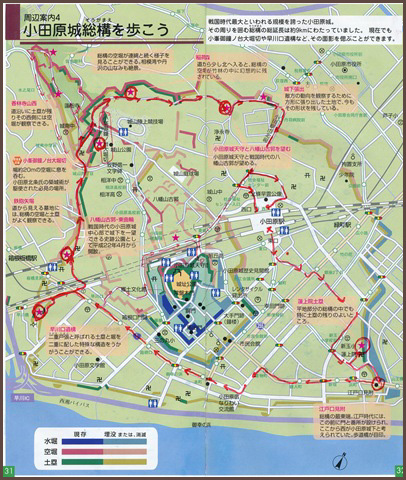
Tokugawa Ieyasu had learned about the importance of an outer moat during the siege of Odawara castle.
He later applied this knowledge to the fortification of his own castle and town, Edo.

- quote -
Odawara Castle (小田原城 Odawara-jō)
. . . . . During the Muromachi period, Odawara Castle had very strong defenses, as it was situated on a hill, surrounded by moats with water on the low side, and karahori 空堀 dry ditches on the hill side, with banks, walls and cliffs located all around the castle, enabling the defenders to repel attacks by the great warriors Uesugi Kenshin in 1561 and Takeda Shingen in 1569.
However, during the Battle of Odawara in 1590, Toyotomi Hideyoshi forced the surrender of the Late Hōjō clan through a combination of a three-month siege and bluff. After ordering most of the fortifications destroyed, he awarded the holdings of the Late Hōjō to Tokugawa Ieyasu.
- - - More in the WIKIPEDIA !


Walking along the Sogamae fortifications !
About 9 kilometers !
小田原城の大外郭巡り
In the direction of Edo : 江戸口見附跡
- reference andl photos : dakusai.wordpress.com -


soogamae 総構え / 総構 total structure
soogamae (そうがまえ) 惣構 、sooguruwa 総曲輪(そうぐるわ), sooguruwa 総郭(そうぐるわ)

The most outside moat or protection around a toride 砦 fort, castle or castle town


..............................................................................................................................................

- quote -
Edo Castle Moat Tour by Boat
When Edo Castle was built, the Tokugawa made use of the natural riverways to create part of the Outer Moat (sotobori). The Outer Moat begins around the Kiji Bridge in central Tokyo (Chiyoda-ku), follows part of the Nihonbashi River before cutting west and creating a spiral around to Iidabashi where it continues East until dumping into the Sumida RIver which finishes off the Sotobori when it flows into Tokyo Bay.

Today the Kanda River flows from the northwest of Tokyo into the outer moat around Iidbashi and then on into the Sumida River. This section of the river from Iidabashi to the Sumida River is completely man made. The course of the river was redirected to create the outer moat. The original river flowed down past the castle to a point farther downriver on the Sumida River. This river is now called the Nihonbashi River and corresponds to the beginning of the Outer Moat spiral. Today it is actually connected to the Sotobori (Kanda River) at the original area in Iidabashi. That also makes it possible to travel from the Nihonbashi River to the Kanda River into the Sumida River and back again.


Thanks to the Consortium of Rediscovery Edo-Tokyo Walk you can take a cruise in a boat around these 3 sections of the former Sotobori. Along the way you can get some great close up views of the stone walls that are difficult to see from outside as they're hidden under the Shuto Expressway. You can find many kokuin (insignias) carved into the stones that are very difficult to see from outside without binoculars. Along the way the guide will show you Edo Period ukiyo-e prints to show what the river was like and talk about the Edo Period river culture.
The tours are in Japanese only, but the cruise is enjoyable for anyone to view Tokyo from the waterways.
- reference source : jcastle.info 2013 -

:::::::::::::::::::::::::::::::::::::::::::::::::::::::::::::::::::::::::::::::::::::::::::::::::::::::::::::::::::::::::::::::::::::::::::::::::::::::::::::::::::::::::::::::::::::

- - - - - H A I K U - - - - -

外堀の割るる音あり冬の月
sotobori no waruru oto ari fuyu no tsuki

the outer moat
makes a cracking sound -
moon in winter

Tr. Gabi Greve


cracking sounds
in the outer moat --
winter moon

Tr. Chris Drake

This hokku is from the winter of 1792. Edo castle was renovated and expanded considerably after it was chosen as the site of the shogunate in the early 17th century. It already had a complex network of inner moats running through the core areas of the castle grounds, but to ensure safety the shogunate decided to add an outer moat as well and forced daimyo domain lords around the country to contribute the money, building materials, and workers the shogunate needed to construct the outer moat, which was 15 km (9.3 miles) long. The spacious area between the inner moats around the castle proper and the outer moat was used mainly for the mansions of various daimyo lords, who were required to stay in Edo in attendance on the shogun every other year. The moat itself, like the rest of the castle, was walled with massive pieces of carefully cut granite brought from great distances. The outer moat walls were so strong that some of them remain in fairly good condition even today after surviving US air raids in WW II and postwar city planning.

In Issa's time commoners were allowed to go only as far as the outer side of the outer moat, part of which ran along the edge of a large park, so this is presumably where Issa is standing and looking at the clear, bright winter moon above. Its bright, hard light throws sharp shadows everywhere, and when the ice in the moat makes cracking sounds, moonlight, too, may synesthetically seem to be breaking up into solid pieces. In the silence the sounds of cracking ice must seem rather loud and penetrating to those near the moat. Is the moon's reflection dully visible on the ice on the moat, as if it had something to do with the cracking? Is Issa suggesting the shogunate itself, like the ice, is cracking apart (something that didn't finally happen until 1867)? There's nothing definite in the hokku to support these interpretations, but there's also nothing to rule them out.

The photo at this link shows a portion of the outer moat that still remains in Hibiya Park near downtown Tokyo. In Issa's time the water level was of course much higher.
http://www.jcastle.info/photos/view/2287

Chris Drake


外堀にりんとゐのこのかがりかな
sotobori ni rin to inoko no kagari kana

by the outer moat
bonfires strong and forceful --
night of the wild boar

Tr. Chris Drake

The hokku is from the 10th month (November) of 1815, when Issa, living in his hometown, is back in greater Edo on a three-month visit. The hokku evokes the night of the first Day of the Wild Boar in the 10th month, the month governed by the wild boar according to Sino-Japanese zodiacal calendrical thought.

On this day people of all classes eat special rice cakes believed to increase fertility and protect against disease. They also light hearths, ovens, leg and hand warmers, and other fires for winter and spring use. Edo castle uses the occasion to display of its power and magnificence by lighting large, bright bonfires in iron baskets hanging at key points in and around the castle and at the gates in the wall at the inner ends of two bridges that cross the outer moat. On a practical level, the bonfires are used to light the way for daimyo domain lords and shogunal officials who live outside the moat as they arrive at around sundown to attend an obligatory celebration in the castle on the night of the first Day of the Wild Boar.

All daimyo lords and shogunal officials, including those who live inside the outer moat, are required to attend this celebration, during which they symbolically acknowledge their subservience and pledge once more their fealty to the shogun by accepting fancy rice cakes made from newly harvested rice. The lords and officials and their men are in their most formal clothes and closely follow strict protocol as they go through the gate. Both the lords and the hanging bonfires are imposing, yet there is something utterly serious and as cold as the November night about the whole scene. Issa, who must be standing outside the outer moat, seems to realize that the bonfires are as much for spectacle and for use in identifying each attendee at this mandatory event as they are for simple illumination and that this gravitas and well-lit formal precision are a consciously used image of power itself.

Chris Drake

. Kobayashi Issa 小林一茶 in Edo .


Boar, the Twelfth Month
Ishikawa Toyomasa 石川豊雅 (act. 1770–1790)

:::::::::::::::::::::::::::::::::::::::::::::::::::::::::::::::::::::::::::::::::::::::::::::::::::::::::::::::::::::::::::::::::::::::::::::::::::::::::::::::::::::::::::::::::::::

. Japanese Architecture - cultural keywords used in haiku .


[ . BACK to DARUMA MUSEUM TOP . ]
[ . BACK to WORLDKIGO . TOP . ]
- #sotobori #odawaracastle #sogamae -
:::::::::::::::::::::::::::::::::::::::::::::::::::::::::::::::::::::::::::::::::::::::::::::::::::::::::::::::::::::::::::::::::::::::::::::::::::::::::::::::::::::::::::::::::::::