19 May 2015

TEMPLE- Sakurado Yakushi Gifu


[http://gokurakuparadies.blogspot.jp/2015/04/yakushipedia-abc-index.html]
[ . BACK to DARUMA MUSEUM TOP . ]
. Yakushipedia - ABC-Index 薬師如来 .
::::::::::::::::::::::::::::::::::::::::::::::::::::::::::::::::::::::::::::::::::::::::::::::::::::::::::::::::::::::::::::::::::::::::::::::::::::::::::::::::::::::::::::::

Sakurado Yakushi 桜堂薬師 / 櫻堂薬師
佐久羅宮神社(櫻宮神社) Sakuramiya Jinja


source : 瑞浪.com/sakuradoureitaisai

瑞浪市土岐町桜堂 / Sakuradō Tokichō Mizunami-shi, Gifu

This hall is one of the Three Great Temples (Mountains日本三山) next to 比叡山 Hieizan and 高野山 Koyasan.
It used to be called 瑞櫻山 Suio-San 法妙寺 Homyo-Ji 薬師堂 Yakushi-Do

It was founded in 710 on request of the empress Gensho Tenno 元正天皇 (680 - 748). One one of his family members was ill and in a dream vision he had the inspiration to pray to Yakushi Nyorai for healing. So he had temples erected to this deity in many parts of Japan.
There is also a famous bridge where the envoy of the emperor passed when delivering a thank-you message to the temple - 勅使橋 chokushibashi.

In 812 嵯峨天皇 Saga Tenno ordered Saint 三諦上人 Santai Shonin to make a statue of Yakushi and pray for his healing, since he had fallen ill. When he was healed he made more donations to the temple to have more buildings and statues. It was then when it was called one of the "Three Great Temples" with prayer rituals held every day.
It later declined and fell under the governance of the Kamakura government, when it regained power had had more than 24 sub-temples.

In 1571, the temple  was burned down by the forces of 織田信長 Oda Nobunaga.

In the early Edo period the local Lord of the Matsudaira clan became ill three times and recovered three times thanks to prayer rituals at the feet of this Yakushi.
After another period of decline (the Matsudaira clan had to move to Shizuoka) it was re-build again thanks to the effort of the Tendai monk 永秀 Nagahide.
Nagahide tried to revive the temple, but fell ill himself. In a dream he had the vision to call his disciple 賢秀 Katahide from Kyoto. Katahide asked the local lord 丹羽 Niwa for financial support to built a new temple hall in 1667.


Next to the statue of Yakushi Nyorai there is now the statue of Saint Santai.

In the main hall there are statues of Yakushi Nyorai, the 四天王像 Four Tenno and the 十二神将像 12 Heavenly generals.

In the year 2012 there were many rituals, festivals and exhibitions to celebrate 1200 years of this temple.


. Empress Gensho Tenno 元正天皇 and Yakushi Nyorai 薬師如来 .
- Temples related to Empress Gensho Tenno -

..............................................................................................................................................


The temple is famous for its ritual Bugaku dance masks 能楽面 / 舞楽面 handed down from China in the Nara period.


奈良時代中国の唐から伝来した舞楽に使う面だそうです
- source and photos : taka_san_daikichi -


.......................................................................


櫻堂薬師舞楽面 Bugaku dance masks


「羅陵王」Raryo-O and 「納曽利」Nasori with movable lower joint
「拔頭」Bato


..............................................................................................................................................


In the compound of the temple there is a large pond, where once a dreadful dragon lived.
He swallowed people trying to cross over in small boats and devastated the fields of the farmers nearby.
In the nearby village lived two young men, 月吉 Tsukiyoshi and 日吉 Hiyoshi who both had the same strange dream.
"Please go and drive the dragon away soon, to help the village. Tomorrow morning the two of you should go to the pond first thing you wake up!"

When they went to the pond they saw the encouraging figure of Yakushi Nyorai sama.
They hurried to make two strong bows and arrows and stood by the side of the pond ready to shoot. Then suddenly the sky cleared, thunder roared and the dragon came toward them, spraying fire out of his huge mouth.
When he was quite close, they sent their arrows right into his mouth. The dragon roared in pain and blood came out of his mouth, into the pond. The pond rose high up and the two built the 薬師堂 Yakushi Hall next to the 桜堂 Sakurado to honor Yakushi Nyorai.

Until our times, the hamlets of Tsukiyoshi, Hiyoshi and Toki are flourishing.


- Homepage of the temple
- source : 瑞浪.com/reijo08


..............................................................................................................................................

- - - - - Yearly Festivals - - - - -

1月 1日       新春篝火(かがり火)
3月15日       釈迦涅槃会

4月第2日曜日     薬師例大祭 Great Yakushi Festival

(12名の住職による大般若と約30~40桶の餅投げが行われます)
4月第3日曜日     佐久羅宮神社春祭り
5月 8日       お釈迦様花祭り(甘茶)
9月(旧暦7月22日) 二十二夜様
10月第2日曜日     佐久羅宮神社秋祭り
11月23日       新穀感謝祭(新嘗祭)

12月 7日       七薬師 "Seven Yakushi" Ritual

◎毎月15日 観音講


::::::::::::::::::::::::::::::::::::::::::::::::::::::::::::::::::::::::::::::::::::::::::::::::::::::::::::::::::::::::::::::::::::::::::::::::::::::::::::::::::::::::::::::


初春や古刹に眠る舞楽面
hatsu haru ya kosatsu ni nemuru bugaku men

first spring -
ritual dance masks sleeping
in the old temple


Gabi Greve


. Kagura Dance 日本の神楽 and 舞楽 Bugaku .


::::::::::::::::::::::::::::::::::::::::::::::::::::::::::::::::::::::::::::::::::::::::::::::::::::::::::::::::::::::::::::::::::::::::::::::::::::::::::::::::::::::::::::::


. O-Mamori お守り Amulets and Talismans .

. Japan - Shrines and Temples - ABC .


[ . BACK to DARUMA MUSEUM . TOP . ]
[ . BACK to WORLDKIGO . TOP . ]
- - #gokurakusakurado #sakurado -
::::::::::::::::::::::::::::::::::::::::::::::::::::::::::::::::::::::::::::::::::::::::::::::::::::::::::::::::::::::::::::::::::::::::::::::::::::::::::::::::::::::::::::::

--
Posted By Gabi Greve to Gokuraku - Jigoku on 5/14/2015 02:03:00 p.m.

TEMPLE - Henro Tama list


[http://gokurakuparadies.blogspot.jp/2014/10/shikoku-henro-temple-list.html]
[ . BACK to DARUMA MUSEUM TOP . ]
. Shikoku Henro Temple List .
::::::::::::::::::::::::::::::::::::::::::::::::::::::::::::::::::::::::::::::::::::::::::::::::::::::::::::::::::::::::::::::::::::::::::::::::::::::::::::::::::::::::::::::

Tama Shikoku Henro 多摩四国八十八箇所 Pilgrimage

. 四国お遍路さん Henro Pilgrims in Shikoku . - General Information -

. Shikoku Henro Temple List .

::::::::::::::::::::::::::::::::::::::::::::::::::::::::::::::::::::::::::::::::::::::::::::::::::::::::::::::::::::::::::::::::::::::::::::::::::::::::::::::::::::::::::::::


- source : kushikey1941.at.webry. -

::::::::::::::::::::::::::::::::::::::::::::::::::::::::::::::::::::::::::::::::::::::::::::::::::::::::::::::::::::::::::::::::::::::::::::::::::::::::::::::::::::::::::::::

1 岸光山 安養寺 あんようじ 真言宗豊山派 不動明王 武蔵野市
2 八幡山 延命寺 えんめいじ 真言宗智山派 文殊菩薩 武蔵野市
3 神龍山 井口院(三鷹不動尊) いこういん 新義真言宗 薬師如 三鷹市
4 応神山 長久寺 ちょうきゅうじ 新義真言宗 大日如来 三鷹市
5 三栄山 大正寺 たいしょうじ 新義真言宗 大日如来 調布市
6 医王山 常性寺 じょうしょうじ 真言宗豊山派 薬師如来 調布市
7 草香山 威光寺 いこうじ 真言宗豊山派 金胎両部大日如来 稲城市
8 岩船山 高勝寺 こうしょうじ 真言宗豊山派 胎蔵界大日如来 稲城市
9 権現山 宝蔵院 ほうぞういん 真言宗豊山派 不動明王 稲城市

10 見星山 高蔵寺 こうそうじ 真言宗豊山派 大日如来 町田市
11 瀧本山 慶性寺 けいしょうじ 新義真言宗 大日如来 町田市
12 岩子山 千手院 せんじゅいん 真言宗豊山派 千手千眼観世音菩薩 町田市
13 青木山 東福寺 とうふくじ 真言宗智山派 不動明王 多摩市
14 唐沢山 吉祥院 きちじょういん 真言宗智山派 不動明王 多摩市
15 和中山 高蔵院 こうぞういん 真言宗智山派 大聖不動明王 多摩市
16 慈眼山 観音寺 かんのんじ 真言宗豊山派 聖観世音菩薩 多摩市
17 清谷山 真照寺 しんしょうじ 真言宗智山派 大日如来 日野市
18 神秀山 法音寺 ほうおんじ 真言宗豊山派 不動明王 府中市
19 八幡山 最照寺 さいしょうじ 真言宗智山派 不動明王 八王子市

20 吟松山 正光院 しょうこういん 真言宗豊山派 不動明王 府中市
21 梅華山 光明院 こうみょういん 真言宗豊山派 不動明王 府中市
22 大悲山 普門寺 ふもんじ 新義真言宗 正観世音菩薩 薬師如来 府中市
23 本覚山 妙光院 みょうこういん 真言宗豊山派 延命地蔵菩薩 府中市
24 是政山 西蔵院 さいぞういん 真言宗豊山派 金剛界大日如来 府中市
25 泰明山 宝性院 ほうしょういん 真言宗豊山派 薬師瑠璃光如来 府中市
26 立川山 正楽院 しょうらくいん 真言宗智山派 大日如来 立川市
27 福寿山 観音寺 かんのんじ 新義真言宗 聖観世音菩薩 国分寺市
28 武野山 東福寺 とうふくじ 真言宗豊山派 大日如来 国分寺市
29 医王山 国分寺 こくぶんじ 真言宗豊山派 薬師如来 国分寺市

30 貫井山 真明寺 しんみょうじ 真言宗豊山派 胎蔵界大日如来 小金井市
31 天神山 金蔵院 こんぞういん 真言宗豊山派 十一面観世音菩薩 小金井市
32 鈴木山 宝寿院 ほうじゅいん 真言宗豊山派 不動明王 小平市
33 田無山 総持寺 そうじじ 真言宗智山派 不動明王 西東京市
34 慈光山 宝樹院 ほうじゅいん 真言宗智山派 薬師如来 西東京市
35 光明山 如意輪寺 にょいりんじ 真言宗智山派 大日如来 西東京市
36 金輪山 寳晃院 ほうこういん 真言宗智山派 大聖不動明王 西東京市
37 宝塔山 多聞寺 たもんじ 真言宗智山派 毘沙門天 東久留米市
38 愛宕山 圓乘院 えんじょういん 真言宗智山派 錐鑚不動明王 東大和市
39 輪王山 三光院 さんこういん 真言宗豊山派 阿弥陀如来 東大和市

40 石澤山 蓮華寺 れんげじ 真言宗豊山派 不動明王 東大和市
41 白部山 慶性院 けんしょういん 真言宗豊山派 不動明王 東大和市
42 龍華山 真福寺 しんぷくじ 真言宗豊山派 薬師如来 武蔵村山市
43 七国山 薬王寺 やくおういん 真言宗豊山派 薬師如来 青梅市
44 星谷山 真浄寺 しんじょうじ 真言宗豊山派 虚空蔵菩薩 青梅市
45 成木山 安楽寺 あんらくじ 真言宗 愛染明王 青梅市
46 龍光山 梅岩寺 ばいがんじ 真言宗豊山派 虚空蔵菩薩 青梅市
47 青梅山 金剛寺 こんごうじ 真言宗豊山派 白不動明王 青梅市
48 大柳山 東光寺 とうこうじ 真言宗豊山派 地蔵菩薩 青梅市
49 高水山 常福院 じょうふくじ 真言宗豊山派 浪切白不動明王 青梅市

50 金剛山 宝蔵寺 ほうぞうじ 真言宗豊山派 不動明王 西多摩郡檜原村
51 愛宕山 即清寺 そくせいじ 真言宗豊山派 不空羂索大忿怒明王 青梅市
52 友田山 花蔵院 かぞういん 真言宗豊山派 十一面観世音菩薩 青梅市
53 登覚山 西福寺 さいふくじ 真言宗豊山派 不動明王 西多摩郡日の出町
54 登学山 光明寺 こうみょうじ 真言宗豊山派 不動明王 西多摩郡日の出町
55 仏石山 西光寺 さいこうじ 真言宗豊山派 不動明王 西多摩郡日の出町
56 月向山 常福寺 じょうふくじ 真言宗豊山派 不動明王 西多摩郡日の出町
57 鎮守山 大行寺 だいぎょうじ 真言宗豊山派 不動明王 あきる野市
58 引田山 真照寺 しんしょうじ 真言宗豊山派 不動明王 あきる野市
59 金色山 大悲願寺 だいひがんじ 真言宗豊山派 大日如来 あきる野市

60 宝生山 大光寺 だいこうじ 真言宗豊山派 十一面観世音菩薩 あきる野市
61 今熊山 正福寺 しょうふくじ 真言宗豊山派 薬師如来 八王子
62 田守山 大仙寺 だいせんじ 真言宗豊山派 不動明王 八王子市
63 犬目山 安養寺 あんようじ 真言宗智山派 不動明王 八王子市
64 凉水山 西蓮寺 さいれんじ 真言宗智山派 不動明王 八王子市
65 大幡山 宝生寺 ほうしょうじ 真言宗智山派 不動明王 八王子市
66 千手山 浄福寺 じょうふくじ 真言宗智山派 大日如来 八王子市
67 一乗山 吉祥院 きちじょういん 真言宗智山派 金剛界大日如来 八王子市
68 高尾山 高尾山薬王院(高尾山) やくおういん 真言宗智山派 飯縄権現 八王子市
69 宝生山 金南寺 こんなんじ 真言宗智山派 阿弥陀如来 八王子市

70 正名山 大光寺 だいこうじ 真言宗 阿弥陀如来 八王子市
71 常光山 真覚寺 しんかくじ 真言宗智山派 不動明王 八王子市
72 摩尼山 萬福寺 まんぷくじ 真言宗智山派 大日如来 八王子市
73 慈高山 金剛院 こんごういん 高野山真言宗 不動明王 八王子市
74 南清山 観音寺 かんのんじ 真言宗智山派 十一面観世音菩薩 八王子市
75 醫王山 妙藥寺 みょうやくじ 真言宗 不動明王 八王子市
76 龍華山 大義寺 たいぎじ 真言宗智山派 薬師如来 八王子
77 安榮山 福傳寺 ふくでんじ 真言宗智山派 十一面観世音菩薩 八王子市
78 鳥栖山 長福寺 ちょうふくじ 真言宗智山派 不動明王 八王子市
79 増寶山 龍光寺 りゅうこうじ 真言宗智山派 胎蔵界大日如来 八王子市

80 宮沢山 阿弥陀寺 あみだじ 真言宗智山派 阿弥陀如来 昭島市
81 金東山 西蓮寺 さいれんじ 真言宗智山派 大日如来 八王子市
82 清満山 天龍寺 てんりゅうじ 真言宗智山派 不動明王 八王子市
83 有王山 延命寺 えんめいじ 真言宗智山派 延命地蔵菩薩 日野市
84 土淵山 普門寺 ふもんじ 真言宗智山派 大日如来 日野市
85 田村山 安養寺 あんようじ 真言宗智山派 阿弥陀如来 日野市
86 愛宕山 石田寺 せきでんじ 真言宗智山派 延命地蔵菩薩 日野市
87 平水山 寿徳寺 じゅとくじ 真言宗智山派 金剛界大日如来 日野市
88 高幡山 金剛寺(高幡不動) こんごうじ 真言宗智山派 不動明王 日野市


Many of the temples are in 八王子市 Hachioji.
- reference : Wikipedia -


::::::::::::::::::::::::::::::::::::::::::::::::::::::::::::::::::::::::::::::::::::::::::::::::::::::::::::::::::::::::::::::::::::::::::::::::::::::::::::::::::::::::::::::


. Yakushi Nyorai Pilgrimages - 薬師霊場巡り Introduction 薬師如来 .

03 神龍山 Ikooin 井口院 Iko-In
新義真言宗 三鷹市

.......................................................................

06 医王山 Jooshooji 常性寺 Josho-Ji
真言宗豊山派 調布市


The seated statue of Yakushi is 二尺五寸 high.
also called Yakuo Nyorai 医王如来.

本堂には、薬師如来(金剛仏・丈二尺五寸)座像が安置されています。
薬師如来は、別名「医王如来」ともいい、医薬を司る仏様として仏の教えを聞き、悟りの道を実践することができるように、多くの人々のさまざまな心身の病を癒してきました。

- source : www.josyoji.jp -

.......................................................................

22 大悲山 Fumonji 普門寺 Fumon-Ji 新義真言宗 府中市

25 泰明山 Hooshooin 宝性院 Hosho-In 真言宗豊山派 府中市

29 医王山 Kokubunji 国分寺 Kokubun-Ji 真言宗豊山派 国分寺市

34 慈光山 Hoojuin 宝樹院 Hoju-In 真言宗智山派 西東京市

42 龍華山 Shinpukuji 真福寺 Shinpuku-Ji 真言宗豊山派 武蔵村山市

43 七国山 Yakuooji 薬王寺 Yakuo-Ji 真言宗豊山派 青梅市

61 今熊山 Shoofukuji 正福寺 Shofuku-Ji 真言宗豊山派 八王子

.......................................................................


76 龍華山 Daigiji 大義寺 Daigi-Ji / Taigi-Ji
真言宗智山派 八王子


Founded in 1336 by 徳翁法印 Tokuo Hoin .
- source : hachibutu.com/daigiji.html -

::::::::::::::::::::::::::::::::::::::::::::::::::::::::::::::::::::::::::::::::::::::::::::::::::::::::::::::::::::::::::::::::::::::::::::::::::::::::::::::::::::::::::::::


. Gyoki Bosatsu 行基菩薩 (668 - 749) Saint Gyōki .


. Fudō Myō-ō, Fudoo Myoo-Oo 不動明王 Fudo Myo-O
Acala Vidyârâja - Vidyaraja – Fudo Myoo .


. . Pilgrimages to Fudo Temples 不動明王巡礼
Fudo Myo-O Junrei - Introduction - .


The Five Great Wisdom Kings, Godai Myo-O - 五大明王
. The Five Great Elements of the Universe - 地水火風空の五大 .

::::::::::::::::::::::::::::::::::::::::::::::::::::::::::::::::::::::::::::::::::::::::::::::::::::::::::::::::::::::::::::::::::::::::::::::::::::::::::::::::::::::::::::::


- Two short Haiku Henro Trips, Summer 2005


. 四国お遍路さん Pilgrims in Shikoku . - General Information

Koya San in Wakayama

Kobo Daishi Kukai 弘法大師 空海
(Kooboo Daishi, Kuukai )

Haiku and Henro:
.... . The Haiku Henro Pilgrimage  

::::::::::::::::::::::::::::::::::::::::::::::::::::::::::::::::::::::::::::::::::::::::::::::::::::::::::::::::::::::::::::::::::::::::::::::::::::::::::::::::::::::::::::::


. Japan - Shrines and Temples - ABC .


[ . BACK to DARUMA MUSEUM . TOP . ]
[ . BACK to WORLDKIGO . TOP . ] - - - - - #henrotama #henroyakushitama - - - - -
::::::::::::::::::::::::::::::::::::::::::::::::::::::::::::::::::::::::::::::::::::::::::::::::::::::::::::::::::::::::::::::::::::::::::::::::::::::::::::::::::::::::::::::

--
Posted By Gabi Greve to Gokuraku - Jigoku on 5/18/2015 01:19:00 p.m.

TEMPLE - Hoko-Ji Kyoto


[http://darumasan.blogspot.jp/]
[ . BACK to DARUMA MUSEUM TOP . ]
::::::::::::::::::::::::::::::::::::::::::::::::::::::::::::::::::::::::::::::::::::::::::::::::::::::::::::::::::::::::::::::::::::::::::::::::::::::::::::::::::::::::::::::

Hookooji, Hōkō-ji 方広寺 Hoko-Ji, Kyoto

Kyoto Daibutsu no Nanafushigi 京都大仏の七不思議
The seven wonders of the Daibutsu in Kyoto


Hoko-Ji no kane 方広寺の鐘 the Bell of Hoko-Ji
Karasudera no karasu 鳥寺の鳥 the Karasu of Karasu temple
Mimizuka 耳塚 "Ear mound"
Goemon no 五右衛門の衡器窓 ?window
santoo no yane 三棟の屋根 roof over three ridges
soba kui Jizo そば喰地蔵 Jizo eating Buckwheat noodles
Daibutsu mochi 大仏餅の看板 The shop sign of Daibutsu Mochi - Big Buddha Cakes


..............................................................................................................................................


京都府京都市東山区正面通大和大路東入茶屋町

- quote
Hōkō-ji (方広寺) is a temple in Kyoto, Japan, dating from the 16th century. Toyotomi Hideyoshi determined that the capital city should have a Daibutsu temple to surpass that of Nara. He is reputed to have claimed at the outset that he would complete construction in half the time it took Emperor Shōmu to complete the Great Buddha of Nara. The project during Emperor Shomū's reign took ten years. Hideyoshi would complete the initial phase of his project in only three years.The architects for this project were Nakamura Masakiyo and Heinouchi Yoshimasa.
- snip -
Keichō 19 (August 24, 1614):
A new bronze bell for the Hōkō-ji was cast successfully
- snip -
Kanbun 2 (June 16, 1662):
An earthquake destroys the temple, the great statue, and the Daibutsu-den; and some accounts say that Shogun Ietsuna used the metal to coin sen.
- snip -
Meiji 3 (1870): Hōkō-ji belfry (Shōrō) which had been added in 1614 was pulled down and re-erected in a nearby location. The multi-ton bell had not been part of original construction, but over time, it has become irretrievably linked with the history of the temple.
- more in the wikipedia


- quote -
Toyokuni Jinja and Hokoji Temple
The shrine was reconstructed during Meiji Period in 1880 at the current site, where Daibutsuden Hall of a temple named Hokoji had previously stood.
Hokoji Temple was erected by Toyotomi Hideyoshi in order to build a huge image of Buddha which would outclass the Great Buddha Daibutsu of Nara. It is a Tendai sect temple founded in 1586. The original temple grounds covered an area 238 meters from east to west by 250 meters north to south. Hideyoshi's vassals furnished the funds and the workers needed to construct the temple. An 18-meters tall image of Buddha was cast in wood and lacquered. Construction of the giant statue reportedly took only three years. A large Daibutsuden Hall was built in 1587 to house this image. In 1596, a great earthquake damaged much of Kyoto area and the image of the Great Buddha was destroyed. Rebuilding of the image of Buddha and the hall began in 1598 but within a month Hideyoshi passed away.
Dissention among various lords who had pledged to support Hideyoshi's five year old son Hideyori as the next political ruler when he came of age, enabled Tokugawa Ieyasu to gain control of the government by 1603. Ieyasu was determined to get rid of Hideyori. So in order to weaken Hideyori financially as the years went by, Ieyasu encouraged him and his mother Yodo-dono to use gold coins from Hideyoshi's estate to fund the replacement of the Great Buddha. The rebuilding was already underway for a few years but a fire in 1603 destroyed the almost completed bronze statue as well as the main hall. Ieyasu convinced Hideyori and his mother once more that the project had to be completed using the Toyotomi family finances.

By 1609 the image of Buddha was recreated in bronze, and by 1612 the temple was restored. However, this new hall and the image of Buddha were destroyed by an earthquake in 1662, and the wooden replacements were lost in a fire in 1798. The new image of 1843, which replaced the previous Buddha, was destroyed in a 1973 fire. Thus, the existing halls of this once spectacular landmark temple are not very important since all that was of consequence has been consumed by many fires. In addition, the reconstruction of Toyokuni Shrine in 1880 was carried out where Daibutsuden Hall of Hokoji once stood. Many of the buildings of Hokoji Temple were moved to the north thereby restricting the temple to but a corner of its original site.

Hokoji Temple today is a rather nondescript complex. The present temple complex is located on the east side of Yamato-oji dori just north of Toyokuni Jinja. We could directly enter the temple grounds from the shrine premises itself as the temple grounds begin at the end of the shrine property. We saw Hondo Main Hall of the temple but it was closed.
Eastern part of Hondo Main Hall as viewed from the south

The temple has a bell which has important historical value. In 1614, to mark the completion of rebuilding the temple and the Great Buddha, a huge bronze bell was cast and mounted in its own structure. It still stands in the temple complex and is 4.3 meters tall, 2.7 meters in diameter, 23 centimeters thick, and weighs 82000 kilograms. Toyotomi Hideyori asked a priest of another temple to write an inscription for this bell. Among numerous Chinese characters, there are words that read as 'kokka anko kunshin horaku'. It literally means 'peace of the nation and prosperity of the lord and retainers'. However, Tokugawa Shogunate maliciously contorted these Chinese characters, and Tokugawa Ieyasu affected to take umbrage alleging that it was intended as a curse on him. This is because the second and fourth characters of 'kokka anko' are the characters of his name 'Ieyasu' which means 'ka-ko' or 'house tranquility'.

By placing the character 'an' or 'peace' in between the two characters of his own name, he claimed that the words in the inscription can be interpreted as: 'if the body of Ieyasu can be gently lacerated, people would live happily and richly with Toyotomi family'. Although Hideyori apologized profusely, Ieyasu refused to be placated and resorted to armed force. In 1615 he besieged Hideyori in Osaka Castle, a castle Hideyori had inherited from his father. The Toyotomi family was exterminated. Although the bell of this temple was to herald an era of peace but it led to the downfall of Hideyoshi's son, eradication of Toyotomi line, and strengthening of Tokugawa Edo period for the next 265 years.

Inside the temple complex, the bell stands in Shoro belfry that was rebuilt in 1884. The bell is huge and there are beautiful paintings on the ceiling of Shoro. We took several photos of the bell and Shoro from various positions and angles. This bell is of immense historical significance as it changed the history of Japan.
- source and photos : lipikazuo.blogspot.jp -

..............................................................................................................................................


- Homepage of the temple
- source : everkyoto.web.fc2.com


::::::::::::::::::::::::::::::::::::::::::::::::::::::::::::::::::::::::::::::::::::::::::::::::::::::::::::::::::::::::::::::::::::::::::::::::::::::::::::::::::::::::::::::

Hookooji no kane 方広寺の鐘 the Bell of Hoko-Ji


CLICK for more photos !

- quote -
Hokoji Temple and its Fatal Bell
The tragic Kyoto bell that led to fall of Osaka Castle

- Background
As you may remember from one of the history classes you took as a child, Tokugawa Ieyasu, the first Shogun (king) of the Tokugawa Shogunate who ended the long war period and created a peaceful Edo Era which lasted 265 long years, destroyed the Toyotomi Clan in 1615. After the Battle of Sekigahara (1600) in which he won, he started the Tokugawa Bakufu (government) right away. Then, why did it take him so long to 'take care of' the Toyotomi Clan?
Well, it's simple.
He fought the Battle of Sekigahara under the pretext of protecting the Toyotomi Kingdom! Under this pretext many powerful subordinates of Toyotomi Hideyoshi, the previous ruler of Japan, fought on Ieyasu's side. How then, could he possibly exterminate Hideyoshi's heir, Toyotomi Hideyori, age five, in that situation? So, he had to wait and think how to seize total control over Japan without seeming to be a treacherous thief (he was one of Hideyoshi's subordinates, though the most powerful).

How Ieyasu waited
He is renowned for his unbelievable patience. He was a powerful samurai and lord, but unfortunately, wasn't powerful enough to conquer both Oda Nobunaga (1534-1582) and Toyotomi Hideyoshi (1537-1598) when they reigned over Japan respectively, so he had no choice but became their subordinate. When Oda Nobunaga ordered Ieyasu to kill his own wife and first son (1579) to show his loyalty to Nobunaga (there was a reason for it, of course), he even complied and killed them both, his own wife and son! That shows how patient he was.
So, this time, too, he waited.
In my opinion, I don't think he planned to 'exterminate' the Toyotomi Clan at the beginning. He even followed Hideyoshi's will and made his own grandchild marry Hideyoshi's heir, Toyotomi Hideyori. So, if they were just happy being one of many daimyos (feudal lords) under the Tokugawa Bakufu (government), he would have let them live. But even after the Battle of Sekigahara and after Ieyasu started his own government and became Shogun, the heir of the late king, Toyotomi Hideyori, as one of Ieyasu's daimyos, stayed inside the most formidable fortress in Japan, Osaka Castle. That was a threat to Ieyasu. There were still some powerful daimyos who were loyal to Hideyori, they could fight against Tokugawa behind that kind of powerful castle and even win! Think! Ieyasu think!

How Ieyasu tried
He suggested that they leave Osaka Castle and move to some area in Kanto (Tokyo area) as a daimyo. They said, 'No!'... Nene, the wife of Hideyoshi, now retired to Kodaiji Temple in Kyoto as a nun, tried to persuade them but they said, 'No!'. I say 'they', but in this case, Hideyori was still a child, so the one who said 'No' was his mother, the mistress of Hideyoshi, Yodo. She adamantly refused to leave Osaka Castle. She thought as soon as they left the castle, they would be confined to a small castle somewhere in Kanto and be killed. Well, maybe, maybe not.

Cornered Ieyasu
He was old (when he destroyed the Toyotomi Clan finally, he was 73!), his days were numbered, and his heir was mediocre without leadership. He had to concrete a foundation for his Tokugawa government before he died. Any threat should be removed. So, first he tried to decrease their fortunes. Even though Toyotomi Hideyori became one of his daimyos and his revenue decreased, they were tremendously wealthy. His father Hideyoshi left him tons of gold piled up inside the vault of Osaka Castle. Let them spend! So he suggested that they donate, build, restore temples and shrines to 'pray for his father's soul and commemorate his greatness). They took his suggestion and started to have many temples and shrines built or restored, which include
Kitano Tenmangu, Yuki Shrine, Hokoji Temple (this one!), Konkai Komyoji, Anraku Juin, Kondo of Toji, Seiryoji, Daigoji, Shokokuji, etc. etc. Wow, we can enjoy beauty of those temples and shrines now because of his generous donations! though I have a mixed feeling when I think of the fate he and his family led after this...

Fatal Bell
Then Ieyasu moved in for the kill. One of the temples Hideyori was having built was Hokoji, this temple. When it was almost completed and waiting to be opened to the public, Ieyasu stopped them. Why? Because, there was something ominous, which could be interpreted as a curse upon Ieyasu, was written on the bell. His name is Ieyasu, in Chinese characters, 家康. On the bell, these two characters were used to describe the wish for the peace of a country as 国家安康. But his name 家康 was separated by one word 安. Dismemberment! That's what he said, and pretended to take offense by it. Well...what a lame pretext... But he was desperate, his days were numbered, remember?

What happened?
Now that he had a good excuse to attack Hideyori, he did as he planned, and his subordinates followed suit, to perish Toyotomi Hideyori, the late-king's only heir, their former master's only son, from the earth. They attacked Osaka Castle twice, in 1614 and 1615, and the castle was burnt to the ground, with Hideyori and his mother, Yodo. For your information, Yodo released Hideyori's wife, Ieyasu's grandchild, Senhime (princess Sen) before the castle was burnt down. She was returned to Ieyasu safely. Well, how about that! (FYI, Ieyasu had Hideyori's son (age 8) by his mistress beheaded after the war, thus the Toyotomi Clan perished from the earth.)

P.S.,
Hokoji Temple and its bell are located beside Toyokuni Shrine, in which Hideyori's father, Toyotomi Hideyoshi, is enshrined.
- source : Takako Sakamoto -


. Bell, temple bell (kane 鐘, tsurigane 釣鐘) .

..............................................................................................................................................

Mimizuka 耳塚 "Ear mound"


- quote -
The Mimizuka (耳塚, literally "Ear Mound", often translated as "Ear Tomb"),
an alteration of the original Hanazuka (鼻塚, literally "Nose Mound") is a monument in Kyoto, Japan, dedicated to the sliced noses of killed Korean soldiers and civilians as well as Ming Chinese troops taken as war trophies during the Japanese invasions of Korea from 1592 to 1598. The monument enshrines the severed noses of at least 38,000 Koreans killed during Toyotomi Hideyoshi's invasions.The shrine is located just to the west of Toyokuni Shrine, the Shinto shrine honoring Hideyoshi in Kyoto.
- snip -
Traditionally, Japanese warriors would bring back the heads of enemies slain on the battlefield as proof of their deeds, however, the process of nose collection in lieu of heads became the feature of the second Korean invasion. Remuneration was paid to soldiers by their daimyo commanders based on the severed heads upon submission to collection stations, where inspectors meticulously counted, recorded, salted and packed the noses bound for Japan.However, because of the number of civilians killed along with soldiers, and crowded conditions on the ships that transported troops, it was far easier to just bring back noses instead of whole heads.
- snip -
The Mimizuka is almost unknown to the Japanese public unlike to the Korean.
- source : wikipedia -


. kubizuka, memorial stone pagodas and mounds
for the beheaded ... 首塚 .


..............................................................................................................................................

五右衛門の衡器窓

..............................................................................................................................................

三棟の屋根

..............................................................................................................................................

鳥寺の鳥

専 定 寺 (烏 寺) (東山区)
- source : everkyoto.web.fc2.com -

..............................................................................................................................................


. soba kui Jizo そば喰地蔵 Jizo eating Buckwheat noodles .

and more legends about Jizo eating Mochi 餅 rice cakes

..............................................................................................................................................


大仏餅の看板 The shop sign of Daibutsu Mochi - Big Buddha Cakes
京都 方広寺の門前名物 菓子 大仏餅

The store is located in front of the temple Hoko-Ji, the Big Buddha Temple in Kyoto build by Toyohomi Hideyoshi in 1595.
- source : www.kanshundo.co.jp -


::::::::::::::::::::::::::::::::::::::::::::::::::::::::::::::::::::::::::::::::::::::::::::::::::::::::::::::::::::::::::::::::::::::::::::::::::::::::::::::::::::::::::::::

. Jizo Bosatsu, Soba and Mochi 地蔵に蕎麦と餅 .

. Japan - Shrines and Temples - ABC .


[ . BACK to DARUMA MUSEUM . TOP . ]
[ . BACK to WORLDKIGO . TOP . ]
- - #gokurakuhokoji #nanafushigi -
::::::::::::::::::::::::::::::::::::::::::::::::::::::::::::::::::::::::::::::::::::::::::::::::::::::::::::::::::::::::::::::::::::::::::::::::::::::::::::::::::::::::::::::

--
Posted By Gabi Greve to Gokuraku - Jigoku on 5/12/2015 01:41:00 p.m.

DARUMA - Jizo Mochi Legends


[http://darumasan.blogspot.jp/]
[ . BACK to DARUMA MUSEUM TOP . ]
. Legends about Jizo Bosatsu - 地蔵菩薩 - 01 .
::::::::::::::::::::::::::::::::::::::::::::::::::::::::::::::::::::::::::::::::::::::::::::::::::::::::::::::::::::::::::::::::::::::::::::::::::::::::::::::::::::::::::::::

Legends about Jizo Bosatsu and mochi rice cakes - 地蔵と餅

. Jizō - Jizo Bosatsu 地蔵菩薩 - ABC List .
- Introduction -


. Join the Jizo Bosatsu Gallery - Facebook .


Jizomochi 地蔵餅 the name of sweet shops
- reference -


. Botamochi Jizo ぼた餅地蔵 .
legends from various parts of Japan


In some legends, Jizo eats the Mochi offerings, in others they are made in greatfulness.


Jizomochi 地蔵餅 the real thing

::::::::::::::::::::::::::::::::::::::::::::::::::::::::::::::::::::::::::::::::::::::::::::::::::::::::::::::::::::::::::::::::::::::::::::::::::::::::::::::::::::::::::::::

..................................................... Aomori 青森県 .....................................................

クニチ,シトギマワシ Kunichi September 9
shitogi mawashi シトギマワシ

On the days with nine in the ninth lunar month (09, 19 and 29) it is customary to prepare Mochi with the newly harvested rice and offer them to the deity.
The last one of these days, shime kunichi シメクニチ 29, is also called
shitogi mawashi シトギマワシ.
The old ladies and housewifes offer three each to Inari, 月山様 Gassan, 日月様 Deities of Sun and Moon, Jizo, 馬の神様 the Deity of horses, Fudo Myo-O, 金精様 Konsei sama (Deity of the Male Symbol) and 権現様Gongen sama.

「クニヂにの、餅食わねばホイド抜げネ」


. shitogi mochi しとぎもち / しとぎ餅 fried or uncooked rice cakes .
First made as offerings for the deities, later eaten by the family.


..................................................... Hyogo 兵庫県 .....................................................

氷上郡 Hikami gun

天神,地蔵,川の主

男が、嫁が産気づいたので産婆を呼びに行ったが、その途中で天神さんが地蔵さんに今度生まれるのが男の子で15歳で大井川の主の餌食になるというのを聞いた。子供が15歳になったとき、江戸へ行く用事ができたが、父の言うとおり大井川に1升3合の餅を播いたら83までの寿命を与えられた。


..................................................... Ibaraki 栃木県 .....................................................

芳賀郡 茂木町

昔、お婆さんが座敷の真中で白く光る変なものを見つけた。それは1粒の米で、餅について食べることになったが、団子にしたら転がっていって地蔵さんに食べられた。そのかわりに地蔵から搗いても搗いても搗ききれない米をもらい、餅を搗くとたくさん出来たので村の人にわけてやったという。


..................................................... Iwate 岩手県 .....................................................

tanaka no Jizo 田中の地蔵 Jizo in the fields

There was a stone statue of Jizo. This Jizo would become the play companion for children. And sometimes it would eat azuki mochi 小豆餅 red bean mochi .

.......................................................................

- another legend with azuki mochi 小豆餅

Yamagata 山形県, Asahimachi 朝日町


yodare Jizo よだれ地蔵
よだれ地蔵様は、よだれや疳を治してくれる子育て地蔵です。今でも遠くから参拝に来る人が大勢います。祈願の時は小豆餅を供え、地蔵様の口元にあんこを塗り、小豆餅断ちを約束し、治った時は地蔵様に帽子やよだれかけ、鐘の緒とともにお菓子を供えてお礼参りをします。
江戸時代の中頃、楯岡から運ばれていた地蔵様の荷車が突然動かなくなり、地蔵様が「私はこの美しい地にとどまり、民衆を救いたい」と言いました。村人達は大喜びし、お堂を建てて祭ったのだそうです。
- source : asahi-ecom.jp -

. yodarekake よだれ掛け - 涎掛け bib, baby bib .
Jizo with a red bib


..................................................... Miyagi 宮城県 .....................................................

awamochi 粟餅を食った地蔵様 Jizo Bosatsu eating Millet Mochi


Once upon a time,
the kind and honest 正兵衛 Shobei and the greedy 慾兵衛 Yokubei lived in a village. The poor Shobei, who could not afford Mochi made from white rice, pounded some of millet and offered it to the deities.
His neighbour Yokubei was quite rich and pounded white Mochi.
Shobei wanted to make some offerings to the Jizo statue by the river, so he put some Millet Mochi in his bag and took a bucket to get New Year's Water by the river. He walked along the river, but when he wanted to put the Mochi up as an offering for Jizo, he could not find them any more. They must have slipped out of his pocket somehow, so he apologized profoundly to Jizo.
And well, Jizo answered:
"I just ate your Mochi which have come floating past. They were quite delicious!"
When Shobei looked more closely, he could see some powder around the mouth of the Jizo statue.
So Shobei thanked Jizo with all his heart and went home.
On the way home his bucked suddenly felt very heavy and when he looked inside at his home, he found that it was filled with small and large gold coins.
When Yokubei heard the story from Shobei, he got all envious and went down to the river himself. He stuffed some of his white Mochi into the mouth of the statue and then hurried home.
But his bucket was filled with heavy stones and horse excrements . . .


..................................................... Niigata 新潟県 .....................................................

kasa Jizo 笠地蔵 Six Jizo with straw hats

冬の夜、山奥でお婆さんと二人で暮らしていたお爺さんが、菅笠を売りに町へ行ったおり、雪をかぶっていたお地蔵さんに笠をかぶせたところ、そのお地蔵さんが恩返しに餅をついてくれた。

To thank Jizo, Grandfather made some Mochi for him.

- quote from the end of the story -
Since there was more food than the old couple could eat, they had the mice invite their animal friends over, and everybody prepared the food together. Then the old man stacked the boxes of special New Year's food and rice cakes that they had made and took them to the Jizo-sama statues.
"Jizo-sama. Now I can make you an offering. Thank you."


One of the most popular legends, look here for translations:
- reference -


..................................................... Shizuoka 静岡県 .....................................................

引佐郡 Inasa gun

粟餅地蔵 Awamochi Jizo

南北朝時代、毎夜火を灯して奥山城の前に立っている者がいて、不思議に思った家来が見に行ったが、待っているうちに眠ってしまった。ふと目を覚ますと目の前に立っていて、家来は忍び寄り、切り下げて逃げ帰った。翌日その場所に行くと、地蔵が方から切り下げられ、二つになっていた。この地蔵は猪を防ぐために建てられたものだが、家来が切って以来、火を灯して辻に立つことはなかった。奥山六郎次郎朝藤は地蔵尊を新しく作ったが、また同じように二つになってしまった。それ以来、何回作り変えても同じようになるという。


..................................................... Toyama 富山県 .....................................................

昔、
富山湾の海辺の町に、お花という十ほどの娘がまま母と住んでおった。
お花は毎日、寺の地蔵堂の前でもちを売っておった。まま母はいつも、
「売れ残ったら、家には入れんよ」
ときつく言っておったもんで、お花は一つでもようけ売ろうとがんばった。
けれど、きょうのようにてんで運のない日もある。日も暮れようというのに、もち箱はまだズシリと重たいのだ。腹が減り、疲れて肩も首も痛くて、お花はもち箱の上に頭をたれた。小さな鼻先にもち粉がつき、ほわん、とよいにおいがする。お花は思わず、もちをぱくり、ぱくりとほおばった。
ああ、とためいきをついたそのときじゃ。
「こら、お花! 売り物に手を出すとは盗人と同じ。いつも盗み食いしておったな!」
まま母はお花にかけ寄り、お花の頭といい背中といい、めちゃくちゃに打ち据えた。


「ちがいます! お地蔵さんにちこうて初めてです。もう二度とせんから、堪忍して」
「ほぅ。ほんなら、お地蔵さんが手を出してそのもちを食べなさったら、許してやってもいいがねぇ」
お花は、お地蔵さんの胸にかじりついた。
「お地蔵さん、お助けくださいませ」
すると、うす笑いをしたお地蔵さんの手がにゅうっとのびて、箱の中のもちをひとつとり、むしゃむしゃとたいらげたんじゃ。
まま母の驚いたのなんのったら。口をあんぐり開けて腰を抜かしたまま手を合わせ、
「お、お許しくだされ。もうまま子いじめはいたしません。おらが悪うございました」
と謝った。以来、まま母は人が変わったようにやさしくなったとさ。

source : www.cocolotus.com/item/

::::::::::::::::::::::::::::::::::::::::::::::::::::::::::::::::::::::::::::::::::::::::::::::::::::::::::::::::::::::::::::::::::::::::::::::::::::::::::::::::::::::::::::::


soba kui Jizo そば喰地蔵 Jizo eating Buckwheat noodles
tba

The seven wonders of the Daibutsu in Kyoto 京都大仏の七不思議 Temple 方広寺Hoko-Ji

. - Mochi 餅 rice cakes and 妖怪 Yokai monsters - .


::::::::::::::::::::::::::::::::::::::::::::::::::::::::::::::::::::::::::::::::::::::::::::::::::::::::::::::::::::::::::::::::::::::::::::::::::::::::::::::::::::::::::::::

- - - - - reference - - - - -

yokai database - Jizo and Mochi -
- source : www.nichibun.ac.jp -

- reference - google -

::::::::::::::::::::::::::::::::::::::::::::::::::::::::::::::::::::::::::::::::::::::::::::::::::::::::::::::::::::::::::::::::::::::::::::::::::::::::::::::::::::::::::::::

. Legends about Jizo Bosatsu - 地蔵菩薩 - 01 .


. Japanese Legends and Folktales .
- Introduction -


. Japan - Shrines and Temples - ABC .


[ . BACK to DARUMA MUSEUM . TOP . ]
[ . BACK to WORLDKIGO . TOP . ]
- - #gokurakujizolegendsmochi #jizolegendsmochi #jizomochi #mochijizo #jizosoba -
::::::::::::::::::::::::::::::::::::::::::::::::::::::::::::::::::::::::::::::::::::::::::::::::::::::::::::::::::::::::::::::::::::::::::::::::::::::::::::::::::::::::::::::

--
Posted By Gabi Greve to Gokuraku - Jigoku on 5/12/2015 09:47:00 a.m.

SHRINES - Sake Legends Shrines


[http://japanshrinestemples.blogspot.jp/2015/04/sake-yokai-legends.html]
[ . BACK to DARUMA MUSEUM TOP . ]
. Japanese Legends and Folktales - Introduction - .
:::::::::::::::::::::::::::::::::::::::::::::::::::::::::::::::::::::::::::::::::::::::::::::::::::::::::::::::::::::::::::::::::::::::::::::::::::::::::::::::::::::::::::::::::::::

Sake Legends and Shinto Shrines 酒と神社

. Sake 酒 and local (monster) legends 妖怪伝説 .
- Introduction -


. - yookai, yōkai 妖怪 Yokai monsters - .

:::::::::::::::::::::::::::::::::::::::::::::::::::::::::::::::::::::::::::::::::::::::::::::::::::::::::::::::::::::::::::::::::::::::::::::::::::::::::::::::::::::::::::::::::::::
- ABC List of the Prefectures -


Akita 秋田県

. 大威徳神社 Daiitoku Jinja 大威徳山神社 Daiitokusan Jinja .
大威徳明王 Daiitoku Myo-O

..............................................................................................................................................

Chiba 千葉県

大鷲神社 Otori Jinja "Eagle Shrine"
3620 安食町 Ajiki, 栄町 Sakae, Inba District, Chiba
and
Ryuukakuji 龍角寺 Temple Ryukaku-Ji

deidaarabochi デエダラボッチ, ダイダラボッチ Daidarabotchi monster
デーデッポ Deedeppo


Some of his 足跡 footprints in Chiba, later turned ponds:
- between 根郷村寺崎 Negomura Terasaki and 太田 Ota
- on the road from 根郷村城 Negormura Castle toward 大篠塚 Oshinozuka
- at 酒々井町酒々井の西井戸 Nishi Ido in Shisui village
- at 酒々井町の下台の谷上り Shisui village
- at 成田町論田 Naritamachi, Ronden

The one at temple 安食町の龍角寺 Ryukaku-Ji in Ajiki village is between 印西 Inzai and 印東 Into, where the monster used to pee.
The swamp 印旛沼 Inbanuma is a left-over from his pee.

The mountain behind the shrine 大鷲神社 was left there when it fell from his back while he was carrying it to a different place.


- quote -
Daidarabotchi (ダイダラボッチ, literally "Giant")
was a gigantic yōkai in Japanese mythology, sometime said to pose as a mountain range when sleeping.


Daidarabotchi's size was so great that his footprints were said to have created innumerable lakes and ponds. In one legend, a Daidarabotchi weighed Mount Fuji and Mount Tsukuba to see which was heavier. But he accidentally split Tsukuba's peak after he was finished with it. The Hitachi no Kuni Fudoki, a recording of the imperial customs in the Hitachi Province compiled in the 8th century, also told of a Daidarabotchi living on a hill west of a post office of Hiratsu Ogushi who fed on giant clams from the beach, piling the shells on top of a hill.

Izumo no Kuni Fudoki also mentions a legendary king of Izumo, Ōmitsunu, who was the grandson of Susano'o and a demi-god. Having the strength of a giant, he performed Kuni-biki, pulling land from Silla with ropes, to increase the size of his territory.
- source : wikipedia


「大鷲神社」and 魂生神社(魂生大明神 Konsei Daimyojin)
- source : sjtsunoda/kisai

..............................................................................................................................................

Fukushima 福島県

檜枝岐村 Hinoemata

Yama no Shinkoo 山の神講 The Mountain Deity prayer group
All male villagers of Hinoemata
join this group from the age of 18 to about 30.
Twice a year, in Spring and Autumn, they assemble at the home of the village chief, bringing food for a feast. In the tokonoma alcove they hang a scroll of Yama no Kami 山の神 God of the Mountain and stay up all night with lantern light.
Eating the special bandei mochi with a prayer for safety during the work in the mountains, they drink and dance all night. Two special representatives have to stand before the God of the Mountains to perform prayers in the evening and morning, so these two take a seat at the top of the table.
Since the God of the Mountains must be kept pure without ritual pollution, the sake for the god must be served by a woman not married (a virgin).


bandeimochi ばんでい餅 Bandei rice cakes

. Food specialities from Fukushima 福島 .

. yama no kami 山の神 god of the mountains - in winter .
ta no kami 田の神 god of the rice fields - in summer


..............................................................................................................................................

Ibaraki 茨城県

江戸崎町 Edosaki

鹿島神社 Kashima Jinja

Yashinboo Doosojin やしんぼ道祖神 Yashinbo Dosojin, "Malicious Dosojin"
yashinbo卑しん坊 means someone who wants anything around him.
Near the Shrine 鹿島神社 Kashima Jinja there are three small stone sanctuaries for these wayside gods.
They offer their help and grant a wish if you bring some o-sake whilst making a wish.
On the other hand, if you take away just one stem of the wild sasa bamboo around, they will get angry and bring harm.
Most farmers who come to worship here bring offerings and clean the place carefully.

. doosojin 道祖神 Dosojin - "wayside gods" .

.......................................................................

酒門町 Sakado

鹿島神社 Kashima Jinja

握り飯はふたつに割って食べなければ罰があたる。それは鹿島神社の神は、片手で地震を起こすナマズを抑えているので両手で食べられない。だから人もそうするのだという。

..............................................................................................................................................

Iwate 岩手県

石浜神社 Ishihama Jinja

各家にはエビス・大黒を祀り、石浜神社の境内には竜神様を祀っている。この場所は、昔、定置網に入っていた死んだ亀を埋めたところだという。進水式の時には、船が3回まわって、「竜神様と石浜の神様へ」と言いながらお神酒を海に注ぐ。船霊としては、女の髪の毛やその他のものを船の中に入れたという。

..............................................................................................................................................

Kyoto 京都府

福知山市 Fukuchiyama

大江山鬼嶽稲荷神社 Oeyama Onitake Inari Jinja

oni 鬼 Oni, the Monster
一条天皇の頃、大江山に妖賊がでるので退治を命じられた源頼光が、山伏に姿を変えて和田街道へ進み、上川口村宇野花の孫八という農夫孫八に山の案内を頼み鬼の棲家を探す途中三貴神に出遭って道を教えられ、鬼獄稲荷神社で鬼毒酒を賜って鬼降伏祈願をして、やがて首尾よく鬼を退治することができた。

.......................................................................

亀岡市 Kameoka

河河神社 ?

.- Hihi 狒々/ 狒狒 / 比々 Hihi Baboon Monster - .
岩見重太郎 Iwami Jutaro
薄田兼相 Susukida Kanesuke (Susukita) (? - 1615)


..............................................................................................................................................

Niigata 新潟県

相川町 Aikawa

北野神社 Kitano Jinja

9月25日の「天神さんの神送り」の日には、鎮守北野神社の祭神天神は、酒を造るために一足先に出雲にたたれるというので、甘酒を供え、赤飯を焚く。


..............................................................................................................................................

Tochigi 栃木県

粟野町 Awano

星の宮神社 Hoshinomiya Jinja

Once a man took three barrels of sake away from the Shrine, but after that he became very sick. When he brought them back, he was healed.


:::::::::::::::::::::::::::::::::::::::::::::::::::::::::::::::::::::::::::::::::::::::::::::::::::::::::::::::::::::::::::::::::::::::::::::::::::::::::::::::::::::::::::::::::::::

- reference -

yokai database : 酒 神社
- source : www.nichibun.ac.jp (11)


. Sake 酒 and local (monster) legends 妖怪伝説 .

. Shrine, Shinto Shrine (jinja 神社) - Introduction .

- #shrinelegendssake #sakelegendshrines -
:::::::::::::::::::::::::::::::::::::::::::::::::::::::::::::::::::::::::::::::::::::::::::::::::::::::::::::::::::::::::::::::::::::::::::::::::::::::::::::::::::::::::::::::::::::

[ . BACK to DARUMA MUSEUM TOP . ]
[ . BACK to WORLDKIGO . TOP . ]

:::::::::::::::::::::::::::::::::::::::::::::::::::::::::::::::::::::::::::::::::::::::::::::::::::::::::::::::::::::::::::::::::::::::::::::::::::::::::::::::::::::::::::::::::::::

--
Posted By Gabi Greve to Japan - Shrines and Temples on 5/01/2015 01:53:00 p.m.

DARUMA - Gensho Tenno and Yakushi

[http://darumasan.blogspot.jp/]
[ . BACK to DARUMA MUSEUM TOP . ]
. Yakushipedia - ABC-Index 薬師如来 .
::::::::::::::::::::::::::::::::::::::::::::::::::::::::::::::::::::::::::::::::::::::::::::::::::::::::::::::::::::::::::::::::::::::::::::::::::::::::::::::::::::::::::::::

Empress Gensho Tenno 元正天皇 and Yakushi Nyorai 薬師如来

::::::::::::::::::::::::::::::::::::::::::::::::::::::::::::::::::::::::::::::::::::::::::::::::::::::::::::::::::::::::::::::::::::::::::::::::::::::::::::::::::::::::::::::

- quote -
Empress Genshō. Genshō Tennō 元正天皇 Genshō-tennō
(683 – May 22, 748)
was the 44th monarch of Japan, according to the traditional order of succession.
Genshō's reign spanned the years 715 through 724.


In the history of Japan, Genshō was the fifth of eight women to take on the role of empress regnant. The four female monarchs before Genshō were: (a) Suiko, (b) Kōgyoku, (c) Jitō and (d) Gemmei (Genmei). The three women sovereigns reigning after Genshō were (e) Kōken, (f) Meishō, and (g) Go-Sakuramachi.

Genshō was the only Japanese empress regnant to inherit her title from another empress regnant, her mother Genmei, rather than a male predecessor.

- - - Traditional narrative
Before her ascension to the Chrysanthemum Throne, her personal name (imina) was Hidaka-hime 氷高皇女 Hitaka no Hime Miko.
日本根子高瑞浄足姫天皇(やまとねこたまみずきよたらしひめのすめらみこと)

Genshō was an elder sister of Emperor Mommu and daughter of Prince Kusakabe 草壁皇子 and his wife 阿陪皇女(元明天皇) who later became Empress Gemmei. Therefore she was a granddaughter of Emperor Temmu and Empress Jitō by her father and a granddaughter of Emperor Tenji through her mother.

- - - Events of Genshō's life
Empress Gensho's succession to the throne was intended as a regency until Prince Obito 首(おびと)皇子, the son of her deceased younger brother Mommu, was mature enough to ascend the throne.
Obito would later become the Emperor Shōmu 聖武天皇 Shomu Tenno.
Obito was appointed Crown Prince in 714 by Empress Gemmei. In the next year, 715, Empress Gemmei, then in her fifties, abdicated in favor of her daughter Gensho. Obito was then 14 years old.

-- 715 (Reiki 1, 9th month):
In the 7th year of Gemmei-tennō 's reign (元明天皇7年), the empress abdicated; and the succession (senso) was received by her daughter, who held the throne in trust for her younger brother. Shortly thereafter, Empress Genshō acceded to the throne (sokui) as Empress Regnant.

Obito remained the crown prince, heir to the new empress. Fujiwara no Fuhito, the most powerful courtier in Gemmei's court, remained at his post until his death in 720. After his death, Prince Nagaya, a grandson of Temmu and the Empress Gensho's cousin, seized power. This power shift was a background for later conflicts between Nagaya and Fuhito's four sons during the reign of Emperor Shōmu (Shomu) 聖武天皇 (formerly Prince Obito).

Under Gensho's reign, the Nihonshoki was finished in 720. This was the first Japanese history book. Organization of the law system known as the ritsuryo was continued under the initiatives of Fuhito until his death. These laws and codes were edited and enacted by Fujiwara no Nakamaro, a grandson of Fuhito, and published as Yoro ritsuryo under the name of Fuhito. The taxation system which had been introduced by Empress Jitō in the late 7th century began to malfunction. To compensate for the decreased tax revenue, the "Act of possession in three generations", an initiative of Prince Nagaya, was enacted in 723. Under this act, people were allowed to possess a newly cultivated field once every three generations. In the fourth generation, the right of possession would revert to the national government. This act was intended to motivate new cultivation, but it only remained in effect for about 20 years.

Empress Genshō reigned for nine years.
Although there were seven other reigning empresses, their successors were most often selected from amongst the males of the paternal Imperial bloodline, which is why some conservative scholars argue that the women's reigns were temporary and that male-only succession tradition must be maintained in the 21st century. Empress Gemmei, who was succeeded by her daughter, remains the sole exception to this conventional argument.

In 724, Gensho abdicated in favor of her nephew, who would be known as Emperor Shōmu. Genshō lived for 25 years after she stepped down from the throne. She never married and had no children. She died at age 65.

Empress Genshō's grave is located in Nara. misasagi 陵(みささぎ)
This empress is traditionally venerated at a memorial Shinto shrine (misasagi), also in Nara. The Imperial Household Agency has designated this location as Mommu's mausoleum, and has been formally named Nahoyama no nishi no misasagi. The Imperial tomb can be visited today in Narazaka-cho, Nara City.

- - - The years of Genshō's reign (717 - 729)
are more specifically identified by more than one era name or nengō period:

Reiki 霊亀 (715–717)
Yōrō 養老 (717–724) Yoro
Jinki 神亀 (724–729)


- source : wikipedia -

..............................................................................................................................................

- quote -
707-15 - - Genmei Tennō of Japan 元明天皇
She lived (661-722).
also known as Gemmyo, she was daughter of Tenji Tennō (622-673-686) and succeeded her son Mommu as the 43rd imperial ruler. She proved an unusually able ruler. She coined the first copper money and caused scribes to write down the ancient traditions lest they be lost, and in 708 she moved the capital city of Japan from Fujiwara to Heijo-Kyo, thus giving the Nara period of Japanese history its name. Married to her first cousin and nephew, Kusakabe no miko, the son of Emperor Temmu of Japan and Empress Jito of Japan,
she abdicated in favour of her daughter, Empress Gensho-Tennō.
- source : www.guide2womenleaders.com -

::::::::::::::::::::::::::::::::::::::::::::::::::::::::::::::::::::::::::::::::::::::::::::::::::::::::::::::::::::::::::::::::::::::::::::::::::::::::::::::::::::::::::::::

- Temples related to Empress Gensho Tenno -

. Chokuganji 勅願寺 Chokugan-Ji, "Imperial Temples" .

One of them is

Taisanji 太山寺 Taisan-Ji

三身山 太山寺 Taisan-Ji - Hyogo (天台宗、兵庫県神戸市)
Built on request of Gensho in 716.
Now it is temple Nr. 1 on the Pilgrimage to Yakushi temples in Harima.
播州薬師霊場 Banshu Harima Yakushi Reijo


source and photos : mariaguri.exblog.jp

薬師如来は、ここより東北の地に定恵和尚結縁の地があり定恵和尚は願望を果 たせず寂したと示現したところ、宇合はその教示に従い七堂伽藍を整備し ... 元正天皇(715~723在位)の勅願寺として、歴代天皇をはじめ一般民衆にいたるまで広く信仰を集めた。
- source : www.do-main.co.jp -


. 播州薬師霊場 Yakushi pilgrim temples in Banshu / Harima / Hyogo .

::::::::::::::::::::::::::::::::::::::::::::::::::::::::::::::::::::::::::::::::::::::::::::::::::::::::::::::::::::::::::::::::::::::::::::::::::::::::::::::::::::::::::::::


Choorinji 長林寺 Chorin-Ji - 龍王山 Ryuozan

975 Goshikicho Tsushimanzai, Sumoto, Hyogo


Founded by 藤原宇合 Fujiwara no Umakai.
When Gyoki Bosatsu passed the area, he found seven large branches of a pine tree and carved seven statues of Yakushi Nyorai out of them 松の梢に七体の薬師如来. One of them is still preserved to our day.

- reference : hyogotendai-yb.net tyourinji -

..............................................................................................................................................

Fukooji 普光寺 Fuko-Ji

武蔵国多摩郡野津田郷普光寺 Nozutamachi, Tama

The seated wooden statue of Yakushi Nyorai is about 85 cm high.
It is most probably a statue from the Heian period.

このお寺は天台宗に属し、享保4年(1719)の記録に、山王社・稲荷社・鬼子母神・観音堂再建とあるそうですが、後に観音堂を除き、塚田の三島神社に移されとあります。埼玉県教育委員会の歴史の道調査が行われた頃(昭和56~58年)にはこの寺は無住だったそうです。
普光寺には町指定文化財の木造薬師如来座像があり、座高85.5センチメートルで、後世の手が加えられているものの、定朝様といわれる平安仏の特徴を一部に残していることから、制作は平安時代末期と考えられています。

普光山畧縁起(元亀四年 1573年)Engi legend
- source : history/yakushidohengi -

..............................................................................................................................................


Hinata Yakushi 日向薬師 - Hinatasan Ryosen-Ji 日向山霊山寺
神奈川県伊勢原市日向1644 / 1644 Hinata Isehara-shi, Kanagawa

One of the three great Yakushi statues 日本三薬師.
Made by 行基 GyokiBosatsu.


Click for more photos !

かって日向山霊山寺といわれ、元正天皇のころ(716年)、僧行基によって開創されたと伝えられる、日本三薬師の一つ。
本尊薬師如来三尊像を始め、薬師如来像、四天王、十二神将など国の重要文化財 も多い。 また樹齢八百年と言われる、境内の幡かけ杉は、県の天然記念物に指定されている。
現在、本堂(国指定重要文化財)は、平成23年から350年ぶりの大修理を行っている。 (完成は平成28年の予定)稲穂が黄金色に色づく9月中旬頃、田のあぜや野辺のあちこちに真紅の彼岸花が咲き始め、日向路一帯に群生する彼岸花は、山の緑 と稲穂の黄色に映え、見事のコントラストを見せます。
- source : sports.geocities.jp/kanagawa_walk -


This temple is situated quite far in the mountains. It is usually very quiet with few tourists. I visited this place frequently for its quietude and spiritual atmosphere.
Gabi Greve, 1980

Look at some photos of the area.

- reference -

.......................................................................

At Hinata Yakushi Temple, Kanagawa 日向薬師

薬師堂雨の桜に御開帳
Yakushidoo ame no sakura ni go-kaichoo

this Yakushi Hall -
cherry blossoms in the rain
when the statue is shown
Tr. Gabi Greve

Kobayashi Aiko 小林愛子


CLICK for more sakura photos !


..............................................................................................................................................


Kankaiji 観海寺 - Kankai-Ji 清寧山 Seineizan
Onsen Yakushi 温泉薬師 "Yakushi of the Hot Spring


大分県別府市観海寺4 / Beppu, Oita Prefecture 874-0822


Kankai Temple in Beppu - Kawase Hasui

The temple has been founded by Saint Ninmon Bosatsu 仁聞菩薩, who founded about 28 temples in the Rokugo Manzan district of Oita more that 1280 years ago.

The Yakushi Statue was probably made by Ninmon himself

九州四十九院薬師霊場会 Kyushu Yakushi Pilgrimage Temple Nr. 12

The present-day temple was rebuilt in 1938 and is now a Zen temple of the Soto sect.

- reference -


- - - Homepage of the temple - 曹洞宗清寧山観海禅寺
- source : kankaizenji.com -


- - - - - Ninmon Bosatsu and temples in Kyushu

Rurikoo-ji 瑠璃光寺 Ruriko-Ji - Rokugomanzan "六郷満山"in the Kunisaki Peninsula 国東半島, Oita Prefecture
Futago-ji 両子寺 - Kunisaki Peninsula in Oita Prefecture
built in the second year of the Yoro period (718) by Ninmon-bosatsu, the incarnation of the deity Usa-hachiman.
In the Heian period, a unique religion mixing local gods and Buddhism developed in the Rokugomanzan Buddhist area and many temples were founded along the Kunisaki Peninsula.
- source : nippon-kichi.jp -

. Futagoji 両子寺 Futago-Ji - Oita Kyushu .
Founded by Ninmon.

..............................................................................................................................................


CLICK for Japanese LINK
statue by Gyoki Bosatsu, 723

. Kiyotakiji 清瀧寺 / 清滝寺 Kiyotaki-Ji .
Nr. 35 of the Shikoku Henro Pilgrimage 四国八十八ヶ所.


..............................................................................................................................................


. Sakurado Yakushi 桜堂薬師 / 櫻堂薬師
佐久羅宮神社(櫻宮神社) Sakuramiya Jinja .

瑞浪市土岐町桜堂 / Sakuradō Tokichō Mizunami-shi, Gifu
Statue of Yakushi by Saint 三諦上人 Santai Shonin


..............................................................................................................................................


Tookondoo 東金堂 Tokon-Do "Eastern Golden Hall"
at temple Kofuku-Ji 興福寺 - Nara

Genshoo Daijoo Tennoo 元正太上天皇 Gensho Daijo Tenno - Ex-Empress Gensho

There are three"Golden Halls"at Kofukuji, all of which take their names according to their location in the temple complex.
The original structure was built at the request of Emperor Shomu in 726 to speed the recovery of his aunt, the ailing Empress Gensho. The current building dates to 1415.
Enshrined within are Yakushi Nyorai (Bhaisajyaguru, the main alter piece, and an Important Cultural Property),
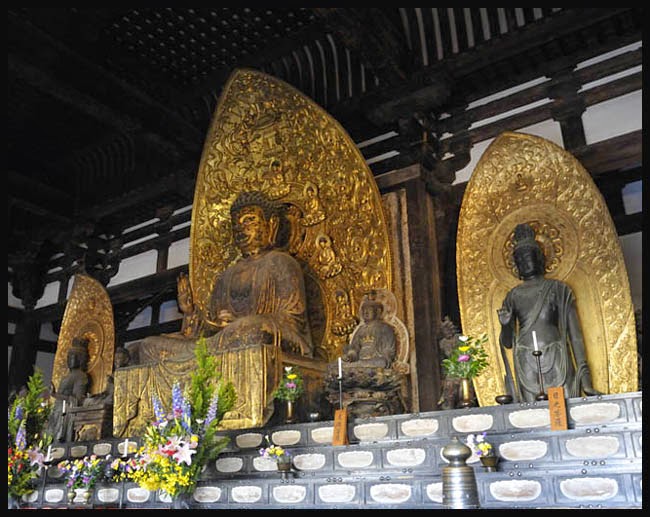

CLICK for more photos !

Nikko Bosatsu and Gakko Bosatsu (Suryaprabha and Candraprabha, both important Cultural Properties), Monju Bosatsu (Manjusri, a National Treasure), Yuima Koji (the Layman Vimalakirti, a National Treasure), Shi Tenno (Four Deva Kings, National Treasures), and Juni Shinsho (Twelve Heavenly Generals, National Treasures).
- source : www.kohfukuji.com -


. Koofukuji, Kōfuku-ji 興福寺 Kofuku-Ji .


::::::::::::::::::::::::::::::::::::::::::::::::::::::::::::::::::::::::::::::::::::::::::::::::::::::::::::::::::::::::::::::::::::::::::::::::::::::::::::::::::::::::::::::


Another deity associated to Gensho Tenno is Kannon Bosatsu 観音菩薩..


Myoorakuji 妙楽寺 Myoraku-Ji - 岩屋山 Iwayazan
Wakasa, Obama, Fukui 福井県小浜市

The temple has been founded by Gyoki Bosatsu in 718/719.
It has been revitalized by Kobo Daishi in 797 and is now a famous temple with a cherryblossom alley leading to the main entrance gate.
The main hall has been built in the Kamakura period and is the oldest hall in Wakasa.


source : www.wakasa-obama.jp

The main statue of 十一面観世音菩薩 Juichimen Kannon Bosatsu is said to look like Gensho Tenno.
It has a special head with 24 faces 24面 and 1000 arms carved from one piece of wood.
It has long been a secret statue for very long, but has now been restored and is shown to the public.

This temple belongs to some pilgrimages of Kannon Bosatsu:
北陸観音霊場第03番礼所 - Hokuriku Kannon Nr. 03
若狭観音霊場第19番礼所 - Wakasa Kannon Nr. 19


. Kannon Bosatsu 観音菩薩 Avalokiteshvara - ABC List .

元正天皇の御影を写したといわれる観世音菩薩 Kannon with a face resembling Gosho Tenno:


- source and photos : onmyojitatsuya.seesaa.net -

Hagaji 羽賀寺 Haga-Ji
福井県小浜市羽賀82-2 - 82-2 Haga, Obama, Fukui
Founded on request of Gosho Tenno (Chokugan-Ji)


CLICK for more photos !


This temple 羽賀寺 is also on the Hokuriku Fudo pilgrimage
北陸三十六不動尊霊場 - Hokuriku - 36 Fudo Myo-O Temples
. 36/羽賀寺 福井県小浜市羽賀82-2 .


..............................................................................................................................................

This Kannon has saved three emperors from eye disease,
Gensho, 桓武 Kanmu and Ichijō 一条天皇 Ichijo Tenno.

Minami Hokkeji 南法華寺 Minamihokke-Ji
3 Tsubosaka, Takatori, Takaichi District, Nara
神佛霊場 奈良11番 壺阪寺(南法華寺)


十一面千手観音菩薩像が 元正、桓武、一条天皇の眼病を治したと言う由緒から、
眼病に霊験があらたかなお寺として広く信仰を集め、お里・沢市の物語も生まれた。
- source : -

::::::::::::::::::::::::::::::::::::::::::::::::::::::::::::::::::::::::::::::::::::::::::::::::::::::::::::::::::::::::::::::::::::::::::::::::::::::::::::::::::::::::::::::

- - - - - reference - - - - -

Ancient Buddhism in Japan - By Marinus Willem de Visser
Six quotes about Gensho

- source : books.google.co.jp -


::::::::::::::::::::::::::::::::::::::::::::::::::::::::::::::::::::::::::::::::::::::::::::::::::::::::::::::::::::::::::::::::::::::::::::::::::::::::::::::::::::::::::::::

. Gyooki Bosatsu 行基菩薩 Gyoki Bosatsu and Yakushi Nyorai .
(668-749 AD) Gyōki, Gyōgi

The Gyooki Memorial Hall at Temple Koyadera

Konyooji 昆陽寺 Konyo-Ji
(兵摩県伊丹市)2 Chome-169 Teramoto, Itami, Hyogo
Gyooki founded this tempel and made the statue of the healing Buddha, Yakushi Nyorai, by himself.

Rendaiji 蓮台寺 Rendai-Ji
Yugasan Rendaiji 瑜伽山(ゆがさん)由加山
In 733, priest Gyoki began to worship the two statues of Amida Nyorai and Yakushi Nyorai here as "Yuga Daigongen" 瑜伽大権現 .

::::::::::::::::::::::::::::::::::::::::::::::::::::::::::::::::::::::::::::::::::::::::::::::::::::::::::::::::::::::::::::::::::::::::::::::::::::::::::::::::::::::::::::::

. Yakushipedia - ABC-Index 薬師如来 .

. Yakushi Nyorai Pilgrimages - Introduction .


. Japan - Shrines and Temples - ABC .


[ . BACK to DARUMA MUSEUM . TOP . ]
[ . BACK to WORLDKIGO . TOP . ]
- - #gokurakugensho #genshotenno #genshoyakushi -
::::::::::::::::::::::::::::::::::::::::::::::::::::::::::::::::::::::::::::::::::::::::::::::::::::::::::::::::::::::::::::::::::::::::::::::::::::::::::::::::::::::::::::::

--
Posted By Gabi Greve to Gokuraku - Jigoku on 5/17/2015 09:39:00 a.m.

18 May 2015

DARUMA Henro 35

LINK
http://darumapilgrim.blogspot.jp/2005/10/henro-35.html

::::::::::::::::::::::::::::::::::::::::::::::::::::::::::::::::::::::::::::::::::::::::::::::::::::: 

Temple 35 . Kiyotaki-Ji 清瀧寺 / 清滝寺
きよたきじ

CLICK for more photos
. . . CLICK here for Photos !

高知県土佐市高岡町568-1
電話  088-852-0316

Temple Song:
すむみづを くめばこころの きよたきじ
なみのはなちる いわのはごろも


Iozan 医王山(いおうざん) Mountain of the Medicine Deity
Yakushi Nyorai

CLICK for Japanese LINK
Photo: 青木淳

The Statue of Yakushi Nyorai had been carved by 行基菩薩 Gyoki Bosatsu in 723.
He called the temple 影山密院釈本寺.
The founding was on behalf of Emperess Gensho.

. Empress Gensho Tenno 元正天皇
and Yakushi Nyorai 薬師如来 .


:::::::::::::::::::::::::::::::::::::::::::::::::::::::::::::::::::::::::::::::::::::::::::::::::::::


source : 中国地方の仏閣  


- quote -
Kiyotakiji - Clean Waterfall Temple
The temple was founded by Gyōgi (Gyoki) in the early 8th century and originally named Keizan-mitsuin Taku-mokuji 影山密院釈本寺. Gyōgi is also credited with carving the honzon and it is now considered a National Treasure. A century later Kōbō Daishi visited the temple and after seven days of austerities brought forth a clear stream of water from the ground. The water formed a mirror-like pond so the temple's name was changed to Kyōchiin Kiyotakiji (Mirror-like Clear Waterfall Temple).

Prince Takaoka (Shinyo Shinnō), one of Kōbō Daishi's ten disciples and the 3rd son of Emperor Heizei, came here and stayed more than a year. Takoaka had been expelled from the palace and cut off from royal privileges. Not waiting for the inevitable banishment, he came to Shikoku, made the temple his ancestral temple (Bodaisho), and built the 5 foot, five story pagoda.

During this time he also prayed for success in a trip he was planning to India. Unfortunately, he died in Indochina on his way to India, without ever reaching there. (Legend says that he was eaten by a tiger in Laos but that his soul remains in the pagoda and protects the temple from misfortune.)

- source : www.shikokuhenrotrail.com -


:::::::::::::::::::::::::::::::::::::::::::::::::::::::::::::::::::::::::::::::::::::::::::::::::::::

. Gyooki Bosatsu 行基菩薩 Gyoki Bosatsu .
(668-749 AD) Gyōki

Shikoku Henro 88 Temples 四国遍路88札所


Two short Haiku Henro Trips, Summer 2005


:::::::::::::::::::::::::::::::::::::::::::::::::::::::::::::::::::::::::::::::::::::::::::::::::::::::::::::::::::::::::::

[ . BACK to DARUMA MUSEUM TOP . ]
[ . BACK to WORLDKIGO . TOP . ]

:::::::::::::::::::::::::::::::::::::::::::::::::::::::::::::::::::::::::::::::::::::::::::::::::::::::::::::::::::::::::::