
http://darumamuseumgallery.blogspot.jp/2010/04/shomen-kongo.html
.
[ . BACK to DARUMA MUSEUM TOP . ]
. kooshin 庚申 Kōshin, the Koshin belief .
:::::::::::::::::::::::::::::::::::::::::::::::::::::::::::::::::::::::::::::::::::::::::::::::::::::
Fudo Myo-O Gallery
:::::::::::::::::::::::::::::::::::::::::::::::::::::::::::::::::::::::::::::::::::::::::::::::::::::
Shōmen Kongō 青面金剛 Shomen Kongo,
Seimen Kongo セイメンコンゴウ
Kongo Diamant Deity with a blue face

- quote -
In the Kamakura period, the Kōshin cult was popularized by the Japanese Tendai sect, and became closely associated with the Tantric deity named Shōmen Kongō (Shomen Kongo). This link between Kōshin and Shōmen Kongō depends largely on the healing powers of the latter, including Shōmen's powers against various illnesses and demons, against attacks by strange creatures, eye diseases, breathing disorders, and many other ailments.
. Tenbu ... Celestial Beings, Deva
English introduction see : Mark Schumacher
.......................................................................

source : blog.canpan.info/dandan-minoh
- quote -
Shoumen Kongou 青面金剛
Also known as Seishoku Daikongou Yasha 青色大金剛薬叉. A deity who protects against diseases believed to be caused by demons. Shoumen Kongou is one of the raksasa Yasha lords and rules the east.
In Buddhist texts he is sometimes said to have been a demon who originally caused disease but who was then conquered and re-dedicated himself as a protector against disease. Shoumen Kongou often appears as an angry deity with a blue body and four arms. He carries a three pronged vajra kongousho 金剛杵 (kongosho) in his upper right hand, a staff shakujou 錫杖 in his lower right hand, a cakra rinpou 輪宝 (rinpo) in his upper left hand, and a noose in his lower left hand.
These various implements are symbolic within Esoteric Buddhism.
He may also be shown with two arms, six arms, or in other forms . He may be accompanied by two boys douji 童子 (doji) or by four demons. The benefits to be obtained by worshipping Shoumen Kongou closely resembled those of worshipping Koushin 庚申 Koshin (also read kanoe-saru, the fifth monkey day of the Chinese calendar).
Since the Kamakura period Shoumen Kongou, being mixed with Taoism, became a deity of the cult of Koushin. This cult believed that on the eve of fifth monkey day it was particularly easy to have your life shortened. In order to counteract this danger believers stayed awake through the night and on the koshin day gathered before scrolls of Shoumen Kongou and Sarutahiko 猿田彦 to hold a devotional celebration.
They also held festivities before carvings of the set of three monkeys,
"See no evil, speak no evil, hear no evil," mizaru, kikazaru, iwazaru 見ざる, 聞かざる,言わざる, who are believed to be related to
the sacred monkey of Hie Jinja 日吉神社, Shiga prefecture .
- source : JAANUS -
.......................................................................

. The three wise monkeys .
三猿, san'en or sanzaru, or 三匹の猿 - sanbiki no saru, literally "three monkeys"
.......................................................................

. Otsu-e 大津絵 paintings from Otsu .
:::::::::::::::::::::::::::::::::::::::::::::::::::::::::::::::::::::::::::::::::::::::::::::::::::::
. Kooshin 庚申 Koshin, ka no e saru
Day of the element metal and the Monkey
hatsu Kooshin 初庚申 first Koshin ceremony
Kooshin machi 庚申待 "waiting for Koshin",
waiting for the sun
kigo for the New Year
- - - - - and
- Information and Legends about Kooshin 庚申 the Koshin belief -
Certain days and years of the Asian Zodiac Calendar named 庚申 Koshin are related to great misfortune and disaster.
In the cosmic circle of 60 signs, it is Number 57.
Koo 庚 is the zodiac part associated with metal and the planet Venus.
Shin 申, the ninth branch symbol, is the character for monkey.
:::::::::::::::::::::::::::::::::::::::::::::::::::::::::::::::::::::::::::::::::::::::::::::::::::::

椎の花青面金剛へ石を踏む
shii no hana Shoomen Kongoo e ishi o fumu
blossoms of chinquapin -
on the way to Shomen Kongo
I step on stones
Kume Masao 久米正雄
:::::::::::::::::::::::::::::::::::::::::::::::::::::::::::::::::::::::::::::::::::::::::::::::::::::::::::::::::::::::::::
. Enkuu 円空 Enku, Master Carver Enku .
[1632? - 1695]

source : pref.gifu.lg.jp/kyoiku
Shomen Kongoo Shin 青面金剛神
Statue of Gero town, Gifu 岐阜県下呂市, 1691
:::::::::::::::::::::::::::::::::::::::::::::::::::::::::::::::::::::::::::::::::::::::::::::::::::::::::::::::::::::::::::
. Legends and Tales from Japan 伝説 - Introduction .
.......................................................................
Aomori 青森県
At many entrances to villages with three roads crossing and cemeteries there are stone memorials of Koshin and
猿田彦命青面金剛 Sarutahiko Shomen Kongo
to protect the village from evil influence.

- - - - -
In many villages people have prayer groups for 庚申講 Koshin
and 稲荷講 Inari (the Fox Deity).
For the Koshin prayer groups, regular festival days come in the cosmic circle, every 60 days (Koshin no hi 庚申の日). People come together in the evening of the day before and wait, praying to the sun and the moon, Shomen Kongo and a few more related deities.
On these special days they hang two scrolls in the tokonoma alcove,
one of Shomen Kongo and one of Inari.
In some 稲荷神社 Inari shrines there are also stone memorials for Koshin.

source : sadisticyuki10
Inari Jinja 稲荷神社 Inari Shrine
(三戸郡五戸町野月)Nozuki, Gonohe, Sannohe District
.......................................................................
Ehime 愛媛県 祝森 Iwainomori
地蔵菩薩 Jizo Bosatsu and 青面金剛 Seimen Kongo
In the hamlet 柿の木部落 Kakinoki (Persimmon Tree) there were two brothers.
The elder brother believed in 地蔵菩薩 Jizo Bosatsu,
the younger one in 青面金剛 Seimem Kongo.
When 弘法大師 Kobo Daishi Kukai passed the village, he was touched by their piety and carved a statue for each one of them.
Later a hall for Jizo was erected in 松が鼻 Matsugahana and a hall for Seimen Kongo at the foot of the slope 松尾坂 Matsuozaka. But later the statues were lost during the civil wars.
Years later the village headman had a dream about two monkeys showing him the statues and indeed, digging there they found it and built the Kooshindoo Hall庚申堂 Koshin-Do in Iwainomori.

source : blog.goo.ne.jp/karekusa_2005
柿の木庚申堂 Kakinoki Koshindo
.......................................................................
Miyagi 宮城県 鳴瀬町 Naruse
katakiuchizaka 敵討坂 Slope of the Revenge Killing
A silk merchant from 上州 Joshu was killed during his travels by the owner of a lodging in 小野 Ono and all his money stolen.
His wife had a dream about it. So she made her only son 幸太郎 Kotaro go to Ono and live as a servant in the lodging to check out his chance of killing him in revenge. He could finally kill him on the Northern Slope out of the village, because suddenly an old man appeared with a sword and helped him.
Now Kotaro understood that it was his protector deity Shomen Kongo who had helped him and he built a 庚申塔 Koshin-Do Hall for the deity at the top of the slope.
.......................................................................
Nara 奈良県 天理市 Tenri
amanojaku アマンジャク Amanojaku
When 釈迦 Shakyamuni Buddha was practising austerities in the Himalayan Mountains, the deity Taishaku-Ten appeared and received his teaching. Next came Shomen Kongo and his four child-attendants (dooji 童子 Doji), in red, green, yellow and blue (or red, yellow, white and black) colors.
On many scrolls of this event, beside the three monkeys, there is also an Amanjaku (自在天 Jizai-Ten).

. Amanojaku 天邪鬼 Heavenly Evil Spirit .
.......................................................................
Oita 大分県 国東町 Kunisaki
The Nio from India (唐天竺 Kara Tenjiku, China and India ) wanted to compare this powers with Shomen Kongo and went over to China for a match. But he could not win and had to flee further, until he finally came to Japan. Kongo came after him and Nio had to hide somewhere in Japan, so he made it to a temple and stayed at the gate.
. Nioo, Niō 仁王 Nio, Deva King .
.......................................................................
Tokushima 徳島県 日和佐町 Hiwasa
青面金剛童子 Shomen Kongo Doji, child-attendants
During an epidemy, many villagers died. After each death the Buddhist priests pray for 7 days.
Then a child-attendant of Shomen Kongo appeared and told them the reason for the epidemy was sandoku goyoku 三毒五欲 the three poisons and five passions.
He himself was a messenger of the Deities 梵天帝釈 Bonten and Taishaku, the protectors of the Land of Japan.
. Bonten 梵天 .
. Taishakuten 帝釈天 .
. sandoku 三毒 "three poisons" .

source : ameblo.jp/chupa-0119
庚申様『青面金剛童子』
.......................................................................
- source : nichibun yokai database -
:::::::::::::::::::::::::::::::::::::::::::::::::::::::::::::::::::::::::::::::::::::::::::::::::::::
:::::::::::::::::::::::::::::::::::::::::::::::::::::::::::::::::::::::::::::::::::::::::::::::::::::
Shoomen Kongoo 青面金剛 (しょうめんこんごう)

"Grüngesichtige Diamant-Gottheit". Auch Shootei Yasha-Shin genannt.
Chinesische Gottheit des Taoismus. Im japanischen Volksglauben im Zusammenhang mit den Wegegottheiten (Kooshin-Glauben) und mit Taishakuten als Schützer der nördlichen Regionen verehrt.
Seine Boten sind Bergaffen, später die berühmten drei Affen, die böse Taten nicht sehen, nicht hören und nicht darüber reden. Andere Boten sind die Hähne.
Er war zunächst ein Dämon, der die Pest brachte. Nach seiner Bekehrung zum Buddhismus bewahrt er als gütiger Schutzgott die Menschen vor wilden Tieren, Krankheits- und Liebesdämonen und den wilden Wettergottheiten. In der Edo-Zeit besonderer Schutzgott bei Tuberkulose.
Häufiger auf Bildern oder als Steinfigur am Wegesrand.
Ikonografie:
Mit zwei, vier, sechs oder acht Armen. In der rechten erhobenen Hand einen Dreizack, in der unteren Hand einen Stab, in der linken erhobenen Hand das Rad der Lehre und in der unteren Hand ein Seil. Körperfarbe Grün. Mund geöffnet mit herausragenden Eckzähnen. Haare flammenartig nach oben abstehend. Um den Hals eine große Schlange oder Totenschädel, um beide Arme je einen Drachen, um die Hüften und beide Beine Schlangen. Eine Tigerhaut um die Hüften.
Trampelt mit beiden Beinen auf zwei Dämonen, die auf einem flachen Felssockel liegen.
Manchmal als weibliche Figur, auch mit sechs Armen und drei Augen. Rechts und links steht jeweils eine Kinderfigur, ähnlich wie bei Myo-O-Figuren.
:::::::::::::::::::::::::::::::::::::::::::::::::::::::::::::::::::::::::::::::::::::::::::::::::::::
.Buddhastatuen ... Who is Who
Ten 天 (Devas)
.Buddhastatuen ... Who is Who
Ein Wegweiser zur Ikonografie
von japanischen Buddhastatuen
Gabi Greve, 1994
:::::::::::::::::::::::::::::::::::::::::::::::::::::::::::::::::::::::::::::::::::::::::::::::::::::::::::::::::::::::::::
Daruma Pilgrims in Japan
O-Fudo Sama Gallery
:::::::::::::::::::::::::::::::::::::::::::::::::::::::::::::::::::::::::::::::::::::::::::::::::::::::::::::::::::::::::::
[ . BACK to DARUMA MUSEUM TOP . ]
[ . BACK to WORLDKIGO . TOP . ]
- #shomenkongo #kongoshomen -
:::::::::::::::::::::::::::::::::::::::::::::::::::::::::::::::::::::::::::::::::::::::::::::::::::::::::::::::::::::::::::
.
[ . BACK to DARUMA MUSEUM TOP . ]
. kooshin 庚申 Kōshin, the Koshin belief .
:::::::::::::::::::::::::::::::::::::::::::::::::::::::::::::::::::::::::::::::::::::::::::::::::::::
Fudo Myo-O Gallery
:::::::::::::::::::::::::::::::::::::::::::::::::::::::::::::::::::::::::::::::::::::::::::::::::::::
Shōmen Kongō 青面金剛 Shomen Kongo,
Seimen Kongo セイメンコンゴウ
Kongo Diamant Deity with a blue face
- quote -
In the Kamakura period, the Kōshin cult was popularized by the Japanese Tendai sect, and became closely associated with the Tantric deity named Shōmen Kongō (Shomen Kongo). This link between Kōshin and Shōmen Kongō depends largely on the healing powers of the latter, including Shōmen's powers against various illnesses and demons, against attacks by strange creatures, eye diseases, breathing disorders, and many other ailments.
. Tenbu ... Celestial Beings, Deva
English introduction see : Mark Schumacher
.......................................................................
source : blog.canpan.info/dandan-minoh
- quote -
Shoumen Kongou 青面金剛
Also known as Seishoku Daikongou Yasha 青色大金剛薬叉. A deity who protects against diseases believed to be caused by demons. Shoumen Kongou is one of the raksasa Yasha lords and rules the east.
In Buddhist texts he is sometimes said to have been a demon who originally caused disease but who was then conquered and re-dedicated himself as a protector against disease. Shoumen Kongou often appears as an angry deity with a blue body and four arms. He carries a three pronged vajra kongousho 金剛杵 (kongosho) in his upper right hand, a staff shakujou 錫杖 in his lower right hand, a cakra rinpou 輪宝 (rinpo) in his upper left hand, and a noose in his lower left hand.
These various implements are symbolic within Esoteric Buddhism.
He may also be shown with two arms, six arms, or in other forms . He may be accompanied by two boys douji 童子 (doji) or by four demons. The benefits to be obtained by worshipping Shoumen Kongou closely resembled those of worshipping Koushin 庚申 Koshin (also read kanoe-saru, the fifth monkey day of the Chinese calendar).
Since the Kamakura period Shoumen Kongou, being mixed with Taoism, became a deity of the cult of Koushin. This cult believed that on the eve of fifth monkey day it was particularly easy to have your life shortened. In order to counteract this danger believers stayed awake through the night and on the koshin day gathered before scrolls of Shoumen Kongou and Sarutahiko 猿田彦 to hold a devotional celebration.
They also held festivities before carvings of the set of three monkeys,
"See no evil, speak no evil, hear no evil," mizaru, kikazaru, iwazaru 見ざる, 聞かざる,言わざる, who are believed to be related to
the sacred monkey of Hie Jinja 日吉神社, Shiga prefecture .
- source : JAANUS -
.......................................................................
. The three wise monkeys .
三猿, san'en or sanzaru, or 三匹の猿 - sanbiki no saru, literally "three monkeys"
.......................................................................
. Otsu-e 大津絵 paintings from Otsu .
:::::::::::::::::::::::::::::::::::::::::::::::::::::::::::::::::::::::::::::::::::::::::::::::::::::
. Kooshin 庚申 Koshin, ka no e saru
Day of the element metal and the Monkey
hatsu Kooshin 初庚申 first Koshin ceremony
Kooshin machi 庚申待 "waiting for Koshin",
waiting for the sun
kigo for the New Year
- - - - - and
- Information and Legends about Kooshin 庚申 the Koshin belief -
Certain days and years of the Asian Zodiac Calendar named 庚申 Koshin are related to great misfortune and disaster.
In the cosmic circle of 60 signs, it is Number 57.
Koo 庚 is the zodiac part associated with metal and the planet Venus.
Shin 申, the ninth branch symbol, is the character for monkey.
:::::::::::::::::::::::::::::::::::::::::::::::::::::::::::::::::::::::::::::::::::::::::::::::::::::
椎の花青面金剛へ石を踏む
shii no hana Shoomen Kongoo e ishi o fumu
blossoms of chinquapin -
on the way to Shomen Kongo
I step on stones
Kume Masao 久米正雄
:::::::::::::::::::::::::::::::::::::::::::::::::::::::::::::::::::::::::::::::::::::::::::::::::::::::::::::::::::::::::::
. Enkuu 円空 Enku, Master Carver Enku .
[1632? - 1695]
source : pref.gifu.lg.jp/kyoiku
Shomen Kongoo Shin 青面金剛神
Statue of Gero town, Gifu 岐阜県下呂市, 1691
:::::::::::::::::::::::::::::::::::::::::::::::::::::::::::::::::::::::::::::::::::::::::::::::::::::::::::::::::::::::::::
. Legends and Tales from Japan 伝説 - Introduction .
.......................................................................
Aomori 青森県
At many entrances to villages with three roads crossing and cemeteries there are stone memorials of Koshin and
猿田彦命青面金剛 Sarutahiko Shomen Kongo
to protect the village from evil influence.
- - - - -
In many villages people have prayer groups for 庚申講 Koshin
and 稲荷講 Inari (the Fox Deity).
For the Koshin prayer groups, regular festival days come in the cosmic circle, every 60 days (Koshin no hi 庚申の日). People come together in the evening of the day before and wait, praying to the sun and the moon, Shomen Kongo and a few more related deities.
On these special days they hang two scrolls in the tokonoma alcove,
one of Shomen Kongo and one of Inari.
In some 稲荷神社 Inari shrines there are also stone memorials for Koshin.
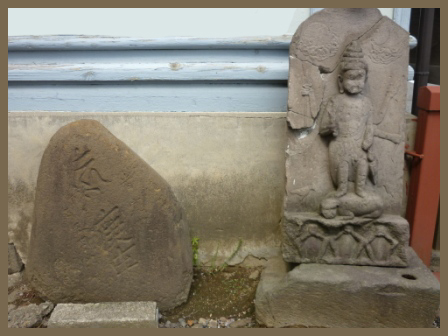
source : sadisticyuki10
Inari Jinja 稲荷神社 Inari Shrine
(三戸郡五戸町野月)Nozuki, Gonohe, Sannohe District
.......................................................................
Ehime 愛媛県 祝森 Iwainomori
地蔵菩薩 Jizo Bosatsu and 青面金剛 Seimen Kongo
In the hamlet 柿の木部落 Kakinoki (Persimmon Tree) there were two brothers.
The elder brother believed in 地蔵菩薩 Jizo Bosatsu,
the younger one in 青面金剛 Seimem Kongo.
When 弘法大師 Kobo Daishi Kukai passed the village, he was touched by their piety and carved a statue for each one of them.
Later a hall for Jizo was erected in 松が鼻 Matsugahana and a hall for Seimen Kongo at the foot of the slope 松尾坂 Matsuozaka. But later the statues were lost during the civil wars.
Years later the village headman had a dream about two monkeys showing him the statues and indeed, digging there they found it and built the Kooshindoo Hall庚申堂 Koshin-Do in Iwainomori.

source : blog.goo.ne.jp/karekusa_2005
柿の木庚申堂 Kakinoki Koshindo
.......................................................................
Miyagi 宮城県 鳴瀬町 Naruse
katakiuchizaka 敵討坂 Slope of the Revenge Killing
A silk merchant from 上州 Joshu was killed during his travels by the owner of a lodging in 小野 Ono and all his money stolen.
His wife had a dream about it. So she made her only son 幸太郎 Kotaro go to Ono and live as a servant in the lodging to check out his chance of killing him in revenge. He could finally kill him on the Northern Slope out of the village, because suddenly an old man appeared with a sword and helped him.
Now Kotaro understood that it was his protector deity Shomen Kongo who had helped him and he built a 庚申塔 Koshin-Do Hall for the deity at the top of the slope.
.......................................................................
Nara 奈良県 天理市 Tenri
amanojaku アマンジャク Amanojaku
When 釈迦 Shakyamuni Buddha was practising austerities in the Himalayan Mountains, the deity Taishaku-Ten appeared and received his teaching. Next came Shomen Kongo and his four child-attendants (dooji 童子 Doji), in red, green, yellow and blue (or red, yellow, white and black) colors.
On many scrolls of this event, beside the three monkeys, there is also an Amanjaku (自在天 Jizai-Ten).
. Amanojaku 天邪鬼 Heavenly Evil Spirit .
.......................................................................
Oita 大分県 国東町 Kunisaki
The Nio from India (唐天竺 Kara Tenjiku, China and India ) wanted to compare this powers with Shomen Kongo and went over to China for a match. But he could not win and had to flee further, until he finally came to Japan. Kongo came after him and Nio had to hide somewhere in Japan, so he made it to a temple and stayed at the gate.
. Nioo, Niō 仁王 Nio, Deva King .
.......................................................................
Tokushima 徳島県 日和佐町 Hiwasa
青面金剛童子 Shomen Kongo Doji, child-attendants
During an epidemy, many villagers died. After each death the Buddhist priests pray for 7 days.
Then a child-attendant of Shomen Kongo appeared and told them the reason for the epidemy was sandoku goyoku 三毒五欲 the three poisons and five passions.
He himself was a messenger of the Deities 梵天帝釈 Bonten and Taishaku, the protectors of the Land of Japan.
. Bonten 梵天 .
. Taishakuten 帝釈天 .
. sandoku 三毒 "three poisons" .
source : ameblo.jp/chupa-0119
庚申様『青面金剛童子』
.......................................................................
- source : nichibun yokai database -
:::::::::::::::::::::::::::::::::::::::::::::::::::::::::::::::::::::::::::::::::::::::::::::::::::::
:::::::::::::::::::::::::::::::::::::::::::::::::::::::::::::::::::::::::::::::::::::::::::::::::::::
Shoomen Kongoo 青面金剛 (しょうめんこんごう)
"Grüngesichtige Diamant-Gottheit". Auch Shootei Yasha-Shin genannt.
Chinesische Gottheit des Taoismus. Im japanischen Volksglauben im Zusammenhang mit den Wegegottheiten (Kooshin-Glauben) und mit Taishakuten als Schützer der nördlichen Regionen verehrt.
Seine Boten sind Bergaffen, später die berühmten drei Affen, die böse Taten nicht sehen, nicht hören und nicht darüber reden. Andere Boten sind die Hähne.
Er war zunächst ein Dämon, der die Pest brachte. Nach seiner Bekehrung zum Buddhismus bewahrt er als gütiger Schutzgott die Menschen vor wilden Tieren, Krankheits- und Liebesdämonen und den wilden Wettergottheiten. In der Edo-Zeit besonderer Schutzgott bei Tuberkulose.
Häufiger auf Bildern oder als Steinfigur am Wegesrand.
Ikonografie:
Mit zwei, vier, sechs oder acht Armen. In der rechten erhobenen Hand einen Dreizack, in der unteren Hand einen Stab, in der linken erhobenen Hand das Rad der Lehre und in der unteren Hand ein Seil. Körperfarbe Grün. Mund geöffnet mit herausragenden Eckzähnen. Haare flammenartig nach oben abstehend. Um den Hals eine große Schlange oder Totenschädel, um beide Arme je einen Drachen, um die Hüften und beide Beine Schlangen. Eine Tigerhaut um die Hüften.
Trampelt mit beiden Beinen auf zwei Dämonen, die auf einem flachen Felssockel liegen.
Manchmal als weibliche Figur, auch mit sechs Armen und drei Augen. Rechts und links steht jeweils eine Kinderfigur, ähnlich wie bei Myo-O-Figuren.
:::::::::::::::::::::::::::::::::::::::::::::::::::::::::::::::::::::::::::::::::::::::::::::::::::::
.Buddhastatuen ... Who is Who
Ten 天 (Devas)
.Buddhastatuen ... Who is Who
Ein Wegweiser zur Ikonografie
von japanischen Buddhastatuen
Gabi Greve, 1994
:::::::::::::::::::::::::::::::::::::::::::::::::::::::::::::::::::::::::::::::::::::::::::::::::::::::::::::::::::::::::::
Daruma Pilgrims in Japan
O-Fudo Sama Gallery
:::::::::::::::::::::::::::::::::::::::::::::::::::::::::::::::::::::::::::::::::::::::::::::::::::::::::::::::::::::::::::
[ . BACK to DARUMA MUSEUM TOP . ]
[ . BACK to WORLDKIGO . TOP . ]
- #shomenkongo #kongoshomen -
:::::::::::::::::::::::::::::::::::::::::::::::::::::::::::::::::::::::::::::::::::::::::::::::::::::::::::::::::::::::::::


