11 Feb 2016

MINGEI - from Mie prefecture

http://omamorifromjapan.blogspot.jp/2011/08/mie-folk-toys.html

::::::::::::::::::::::::::::::::::::::::::::::::::::::::::::::::::::::::::::::::::::::::::::::::::::::::::::::::::::::::::::::::::::::::::::::::::::::::::::::::::::::::::::::::::::

Futami Ura town 二見浦

Futami no kaeru 二見の蛙 frog from Futami
amulets from Shrine Futami Okitama Jinja 二見興玉神社

. Shrine Futami Okitama Jinja 二見興玉神社 .

..................................................................................................................................................................
Iga Ueno Town 伊賀上野

roosha dorei 楼車土鈴 clay bell with festival float


The Iga Plain is surrounded by various mountain ranges, where the Ninja lived and practised. In October there is a great festival at the Shrine 上野天満宮 Ueno Tenmangu, where local craftsmen and carpenters show their skills in making nine festival floats (roosha, danjiri). The festival originated during an epidemic with the hope to expell the deities of illness and many amulets for health are available at the shrine. People wear large 能面 Noh-Masks and walk around in an oni gyooretsu 鬼行列 "Demon Procession".
The clay bells, about 14 cm high, represent most of the details of the floats. The clay is fired at low temperatures, so their sound is rather low.
The local store 老舗漬物店 has a great collection of these clay bells.

The famous haiku poet
. Matsuo Basho 松尾芭蕉 .
was born in Iga, Ueno. And some say he was a Ninja himself . . .

.......................................................................

Iga Kumihimo 伊賀組みひも Iga string art
Kumihimo are beautiful, braded cords with silk, gold, and silver threads. Most of the kumihimo in Japan are produced here.

- source : mieinfo.com/en/exploring-mie -

..................................................................................................................................................................
Ise town 伊勢 and Grand Ise Shrine
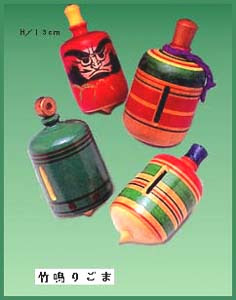


take narigoma 竹鳴りごま spinning bamboo top making a sound
This spinning top is made from wood and bamboo to produce a humming sound when spun. The string is wound around the grip on the top and then pulled.
The top begins to spin with the sound of booo ボーッ.

take ganguu 伊勢竹玩具 toys made from bamboo
They were favorite presents from a visit to the Ise Shrine.


takebue 竹笛 flute from bamboo 


takehebi 竹蛇 toy serpent from bamboo


. Take gangu 竹玩具 bamboo toys - Introduction .

.......................................................................

Ise no nerimono 伊勢の練り物 twisted clay dolls
made with the chips of the woodcarvers and woodworkers of the Ise Shrine buildings.


Favorite souvenirs from Ise Shrine since olden times. Many of them are painted red as amulets to ward off disease and evil influence.
Most of them have a part that can move, like the mouth of the lion mask or the legs of the octopus. The turtle or wild boar can move around by pulling a string.

. nerimono 練り物 "twisted" clay dolls - Introduction .

.......................................................................

saigi 賽木、伊勢の賽木(いせのさいぎ) wooden dice from Ise
also called ishinago 石子 / イシナゴ / 石投 / 擲石 or mameki 豆木.
いしなどり / 石な取り ishinadori / いしなごとり ishinagotori / 石投げ ishinage


Made until the beginning of the Showa period.
Dice for games played usually by girls. It can also be played with stones and pebbles.
This game was already popular in the Heian period.
One wooden block is about 4.1 cm wide, the top is decorated with colored patterns of 千鳥 Chidori birds, flowers and others in red and green. It can be broken down to 9 small pieces to play with.
The pieces can be used for various games. Throwing one stone in the air and use the same hand to pick up another dices or two or more, in various orders and arrangements, according to special songs.
It is a bit similar to the お手玉 Tedama hand-ball game.


. Kobayashi Issa 小林一茶 in Edo .

春風や十づつ十の石なごに
harukaze ya juu-zutsu juu no ishinago ni

spring breeze --
over the game stones
ten at a time


Issa is referring to ishinadori, a game that is played with little stones. The player would toss a stone in the air, pick up another stone, and then catch the tossed one. Edwin A. Cranston, A Waka Anthology (Stanford Univeristy Press, 2006) 2.411; see also Kogo dai jiten (Shogakukan 1983) 114.
In Issa's haiku an expert player is scooping up ten stones at a time.


石なごの玉の手元へ椿哉
ishinago no tama no temoto e tsubaki kana

reaching toward
the marble shooter's marble...
camellias


(ishinado) ... similar to the old English game of jackstones. In my translation, I use the more familiar game of marbles.
Tr. and comment : David Lanoue


- quote -
ishinago no ochikuru tama no hi fu mi yo itsutsu mutsu nanatsu yakamashi noyoya
pebble-game falling stones/jacks' one, two, three, four, five, six, seven, eight=noisy world!

In the time a jackstone takes to fall . . ?
"One!" "Two!" "Three! " I hear them bawl
"Four!" "Five!" "Six!" Why must they yell?
"Seven!" rhymes heaven but noise is hell!

There are degrees of anger. The ancient scholar was irked by the gall of a wet-nurse coming to work with a paltry supply of her goods while Issa was furious about what happened to his documents. The above is an example of Issa mildly angry. It is more a complaint than a maledicta. Issa also had complaints about certain repetitive bird calls getting on his nerves, or geese gaggling when a stroke took away his voice, etc. But all are haiku.
This is a kyoka. Like his silverfish, a single line, as there is no real break in the flow of the original, the pun is not explanatory like mine but natural, turning the eight, yatsu into yakamashi, or "noisy" half-way through the word. English would need a different content, say, counting farts up to something one eight/ate to match it. But, there is more than a pun in the poem. I feel Issa may have been playing upon Saigyo's hyperbolic metaphor of the transience of life:

いしなごの 玉の落ちくるほどなさに 過くる月日は かはりやはする
ishinago no tama no ochikuru hodonasa ni suguru tsukibi wa kawari ya wa suru

Mad in Translation - - -By Robin D. Gill
- source : books.google.co.jp -

.......................................................................


. kibikiguruma 木曳き車 car for hauling wood .
for the new shrine for the regular Ise Shrine renewal, 御木曳 okibiki, o-kibiki


. eto 干支 amulets with the zodiac animals .
from Ise Shrine 伊勢神宮


. Somin Shoorai Fu 蘇民将来符 Somin Shorai amulet from Ise


..................................................................................................................................................................
Kuwana town 桑名

ishitori matsuri no dashi 石取祭の山車 floats of the Stone Festival

..................................................................................................................................................................
Suzuka town 鈴鹿市

sumi ningyoo 墨人形 dolls from Sumi writing ink


Suzuka is most famous for the production of Sumi writing ink, right after Nara.
The origin of Suzuka-zumi ink is said to date back to the year 780, where the ink was made with soot taken from the burned pine trees that grew in the mountains of Suzuka.
Suzuka ink is loved by many calligraphers.
- reference and more photos : bunka.pref.mie.lg.jp/haku -

鈴鹿墨 Suzuka ink


In the beginning of 9th century, this kind of ink stick was originally made of soot collected after firing pine trees.
Today also, they make ink sticks (smoke black ink stick, blue ink stick and pine tree smoke ink stick) by collecting soot produced by burning plants and putting such materials in wooden molds, as people did in old days.
- source : pref.mie.lg.jp -


.......................................................................

Ise katagami 伊勢型紙 Ise pattern paper from Suzuka
pattern paper for dyeing, craft pattern paper


Ise pattern paper is a beautiful paper used for dyeing kimonos, carefully engraved with carving knives.
Ise katagami is used as dye pattern for hand printing on fabrics which is said to be initiated in about 8th century.
It is made of Japanese style paper bonded in many layers using vegetable glue.
On that paper, craftsmen carved sensitive pattern using a fine, sharp edged carving knife.
After carving, the cut papers are hardened with lacquer. The carving technique includes file carving, push carving and so on.
- source : pref.mie.lg.jp -

- quote -
paper stencils for dyeing
..... Multiple layers of thin washi paper are bonded with a glue extracted from persimmon, which makes a strong flexible brown coloured paper. The designs can be extremely intricate, and consequently fragile. Nowadays the stencils are sometimes sold as artwork, attached to hand fans, or used to decorate screens and doors in Japanese rooms. For kimono printing the stencils are stabilized by attaching them to a fine silk net. In past times, human hair was used instead of silk, but silk is less likely to warp and can be finer. .....
- - - More in the WIKIPEDIA !


. Edo Sarasa 江戸更紗 Printed Silk Calico .
with katagami - stencil paper from tesuke washi 手漉和紙 handmade Japanese paper treated with persimmon juice.


Paper Stencils and Japonisme
Katagami Stencil in Japan for Kimono Dress
Katagami - Ishii Collection
- reference : katagami paper -


..................................................................................................................................................................
Tado village 多度町

. hajiki saru はじき猿 "repelled monkey" .
- - - - - and
Matsuzaka saru hajiki 松阪猿はじき repelled monkey from Matsuzaka town

..................................................................................................................................................................


. ushi oni, ushioni, gyuuki 牛鬼 "bull-demon" .

The Legend of Kigobei in Miyamura Village
宮川村 の喜五兵衛
.......... and
The legend of Gokasho-Ura 五ヶ所浦
at Kirima no tani 切間の谷 Kirima valley

..................................................................................................................................................................
Yokkaichi town 四日市


oonyuudoo 四日市の大入道
huge monster with a tonsured head

O-nyudo
This monster, a priest of large features and a bald head, is known in various regions of Japan.

The O-Nyudo of Yokkaichi
It is paraded through the town on the shrine festival of Suwa Jinja 諏訪神社 on a special float.
This figure was made in a suburb called OKE 桶, as a pun to oobake 大化, big monster.
In the soy sauce storehouse of a merchant in Oke village lived an old badger (tanuki), who changed into this Big Nyudo monster and played tricks on people.
People drove the badger out of the storehouse and made a big figure on the Nyudo instead. When pulling a string the figure would extend its neck to great length. The badger could not imitate such a feat and finally run away in shame.

The festival float is about 2.2 meters high, the figure of the Big Nyudo is about 3.9 meters when the neck is fully stretched. It can show its tongue and roll its eyes to frighten people.
There are also small paper dolls now in Yokkaichi as souvenirs.
On the People's Festival in August a special mascot of this figure parades through the city.
more: : wikipedia 大入道

. . . CLICK here for more Photos !

shita dashi tanuki 舌出し狸 tanuki showing his tongue
. Tanuki 狸 Badger amulets .


. O-Nyudo Monsters of Japan - 大入道 .


shrine Miyamado Jinja 海山道神社
. Goshiki suzu, goshiki rei 五色鈴 five-colored clay bells .

.......................................................................

Bankoyaki 萬古焼 だるま Banko Pottery


Banko pottery began its own style ever since master potters stamped on their works a wish to have their pieces passed down to future generations, forever. These teapots are very famous.

. Bankoyaki 萬古焼 Banko Pottery .

:::::::::::::::::::::::::::::::::::::::::::::::::::::::::::::::::::::::::::::::::::::::::::::::::::::::::::::::::::::::::::::::::::::::::::::::::::::::::::::::::::::::::::::::::::::


Mikimoto pearls ミキモト

みきもと幸吉 Mikimoto Kokichi (1858 - 1954)
御木本幸吉】
三重県鳥羽(とば)市 Mie, Toba town


A pagoda made from pearls

- source : www.mikimotoamerica.com


:::::::::::::::::::::::::::::::::::::::::::::::::::::::::::::::::::::::::::::::::::::::::::::::::::::::::::::::::::::::::::::::::::::::::::::::::::::::::::::::::::::::::::::::::::::  

. Reference and Photos . Gangu Guide .

. Reference and Photos . Isamu Folk Toys .

. Reference and Photos . Yama no Ie . Folk Toys .

.................................................................................

Legends from Mie prefecture - Furusato no minwa 民話
source : www.bunka.pref.mie.

:::::::::::::::::::::::::::::::::::::::::::::::::::::::::::::::::::::::::::::::::::::::::::::::::::::::::::::::::::::::::::::::::::::::::::::::::::::::::::::::::::::::::::::::::::::  

. WASHOKU . Regional Dishes from Mie

MORE
. Mie Folk Toys - this BLOG .


. Japan after the BIG earthquake March 11, 2011


[ . BACK to WORLDKIGO . TOP . ]
[ . BACK to DARUMA MUSEUM TOP . ]
- - - - - #mie #ninja #isejingu #igaueno - - - - -
:::::::::::::::::::::::::::::::::::::::::::::::::::::::::::::::::::::::::::::::::::::::::::::::::::::::::::::::::::::::::::::::::::::::::::::::::::::::::::::::::::::::::::::::::::::

8 Feb 2016

YAKUSHI - placebo effect

http://gokurakuparadies.blogspot.jp/2016/02/placebo-and-yakushi.html

placebo and Yakushi

[ . BACK to DARUMA MUSEUM TOP . ]
. Yakushipedia - ABC-Index 薬師如来 .
::::::::::::::::::::::::::::::::::::::::::::::::::::::::::::::::::::::::::::::::::::::::::::::::::::::::::::::::::::::::::::::::::::::::::::::::::::::::::::::::::::::::::::::

placebo effect プラシーボ効果 and Yakushi Nyorai
プラセボ効果


- quote -
A placebo ( Latin placēbō, "I shall please" from placeō, "I please")
is a simulated or otherwise medically ineffectual treatment for a disease or other medical condition intended to deceive the recipient. Sometimes patients given a placebo treatment will have a perceived or actual improvement in a medical condition, a phenomenon commonly called the placebo effect or placebo response. The placebo effect consists of several different effects woven together, and the methods of placebo administration may be as important as the administration itself.
..... The placebo effect points to the importance of perception and the brain's role in physical health. Placebos can produce some objective physiological changes, such as changes in heart rate, blood pressure, and chemical activity in the brain, in cases involving pain, depression, anxiety, fatigue, and some symptoms of Parkinson's. In other cases, like asthma, the effect is purely subjective, when the patient reports improvement despite no objective change in the underlying condition.
- - - More in the WIKIPEDIA !

::::::::::::::::::::::::::::::::::::::::::::::::::::::::::::::::::::::::::::::::::::::::::::::::::::::::::::::::::::::::::::::::::::::::::::::::::::::::::::::::::::::::::::::


. jujutsushi 呪術師 magic healer .
The healer chanted special prayers and spells and poured water over the affected body part.


..... a more simple way of healing (possibly with a stronger placebo effect).
The healer would write the character の over the affected body part, chant some incantation and that was it.
As an aside, even now mothers use the spell for all kinds of pain
itai no itai no tonde ike (tondeke) 痛いの痛いのとんでいけ pain, pain go away

.............................................................................................................................................

. Abe no Seimei 阿倍晴明 (921 - 1005) .
He performed a lot of rituals to heal people of high rank and his power in this respect is now attributed to the placebo effect プラセボ効果 known to modern medicine.

..............................................................................................................................................

Curing with Kaji (加持 ritual incantations)
..... mentions complementary (hokan 補完) and alternative (daitai 代替) medicine, yet disparagingly analyzes all such modalities in light of the placebo effect.
- source : Nanzan Institute for Religion and Culture - - PDF file

..............................................................................................................................................


- quote -
薬師瑠璃光如来・大医王佛
・安心正巳 など至れり尽せりで他の如来のような精神的・哲学的なご利益などでは無く非常に実利的かつ菩薩的なご利益である、また神仏融合の先駆け的如来でもある、除病安楽を謳う薬師如来のプラシーボ効果(placebo)は大きな信仰を得た様である。
- source : mk123456.web.fc2.com/yakun.htm -

..............................................................................................................................................

- reference : プラセボ効果 薬師如来 -

::::::::::::::::::::::::::::::::::::::::::::::::::::::::::::::::::::::::::::::::::::::::::::::::::::::::::::::::::::::::::::::::::::::::::::::::::::::::::::::::::::::::::::::


東大寺ミュージアム Todai-Ji Museum

- quote -
Todai-Ji Temple Nara 東大寺
..... Yakushi Nyorai Buddha of healing, situated outside.
If you touch him, then touch the place where you're in pain, it will feel better.
Placebo effect? Maybe, but it worked for me!
- source : tripadvisor.jp -


::::::::::::::::::::::::::::::::::::::::::::::::::::::::::::::::::::::::::::::::::::::::::::::::::::::::::::::::::::::::::::::::::::::::::::::::::::::::::::::::::::::::::::::


The Cult of the Healing Buddha in East Asia
Donghwasa Temple, South Korea, May 29–30, 2013.

The cult of the Healing Buddha (Skt. Bhaiṣajyaguru, Ch. Yaoshi, K. Yaksa, J. Yakushi) constituted one of the major cults in East Asia. And yet, with the exception of Raoul Birnbaum's seminal work (The Healing Buddha, first published in 1979), it has been until now largely neglected in Western scholarship. The present conference is intended as a first step toward redressing this neglect.
The functional relation between Bhaiṣajyaguru and healing opens up a large area of research on the relationships between Buddhism, medicine, and healing cults. ..... More specifically, the extent to which Bhaiṣajyaguru's cult contributed to promoting Buddhist priests as healers remains unexplored territory.
- snip -
The esoteric Bhaiṣajyaguru as a cosmic deity, at the center of the spatio-temporal framework formed by the bodhisattvas Suryaprabha and Candraprabha and the twelve spirit-commanders (who are linked to the twelve zodiacal signs). In his capacity as an astral deity, Bhaiṣajyaguru is also associated with the cult of the seven Bhaiṣajyaguru and the pairing of this septet with the seven stars of Ursa Major (i.e., the Big, or Northern, Dipper). In Japan, for example, this cult provided a bridge between esoteric Buddhism and the so-called Way of Yin and Yang (Onmyōdō).
- snip -
in Japan the pestilence god Gozu Tennō 牛頭天王 is often considered a manifestation of Bhaiṣajyaguru.
- source : blogs.cuit.columbia.edu/c-bear -

::::::::::::::::::::::::::::::::::::::::::::::::::::::::::::::::::::::::::::::::::::::::::::::::::::::::::::::::::::::::::::::::::::::::::::::::::::::::::::::::::::::::::::::


- reference - yakushi nyorai placebo -

::::::::::::::::::::::::::::::::::::::::::::::::::::::::::::::::::::::::::::::::::::::::::::::::::::::::::::::::::::::::::::::::::::::::::::::::::::::::::::::::::::::::::::::


Join the friends on facebook !


. Yakushipedia - ABC-Index 薬師如来 .

. Yakushi Nyorai - Legends from the provinces .

. Yakushi Nyorai Pilgrimages 薬師霊場巡り - Introduction .


. O-Mamori お守り Amulets and Talismans .

. Japan - Shrines and Temples - ABC List .


[ . BACK to DARUMA MUSEUM . TOP . ]
[ . BACK to WORLDKIGO . TOP . ] - - - #placebo #placeboeffect #プラシーボ効果 - - -
::::::::::::::::::::::::::::::::::::::::::::::::::::::::::::::::::::::::::::::::::::::::::::::::::::::::::::::::::::::::::::::::::::::::::::::::::::::::::::::::::::::::::::::


7 Feb 2016

SHRINES - Hikosan Fukuoka

http://japanshrinestemples.blogspot.jp/2016/02/hikosan-shrines-fukuoka.html

Hikosan Shrines Fukuoka

[ . BACK to DARUMA MUSEUM TOP . ]
. Shinto Shrine (jinja 神社) - Introduction .
:::::::::::::::::::::::::::::::::::::::::::::::::::::::::::::::::::::::::::::::::::::::::::::::::::::::::::::::::::::::::::::::::::::::::::::::::::::::::::::::::::::::::::::::::::::

Hikosan  英彦山 / 彦山 Hikosan Shrines, Fukuoka and Oita
大分県中津市 / 福岡県田川郡添田町 Soeda-Machi, Tagawa-gun, Fukuoka

There are three peaks, Minami-dake (Southern Peak) 南岳 (1,200m), Naka-dake (Middle Peak) 中岳 (1,188m) Kita-Dake 北岳 (Northern Peak) (1,192m) and various Shrines on the way.
There are three torii gates as the stone steps go up the uppermost shrine on the mountain.

Hikosan Jingu 英彦山神宮 - 奉幣殿 Hohei-Den at about 720 meters high.
The main deity of the mountain is Hikosan Gongen 彦山権現 - (see below) - .

And the shrine at the top - 英彦山神宮上津宮


source : wikipedia

On the way up the long stone stairway there are various torii 鳥居 Shrine gates to pass, each leading to a different, deeper realm of the sacred mountain.

kane no torii 銅鳥居 The Great Bronze Gate at the entrance is about 7 meters high. It has been an offering by the lord of Shiga Domain, 鍋島勝茂 Nabeshima Katsushige (1580 - 1676).

ni no torii 二の鳥居 second gate
san no torii 石製の三の鳥居 third gate made from stone

- reference and photos : tetsuyosie/fukuoka -

.......................................................................

- quote
Hiko-san is one of Kyushu's finest hikes. During autumn, the colours of the turning leaves are simply stunning; vivid hues of red, gold and purple adding brilliance to the hike's many panoramic view points.
Hiko-san is notable also for its shrines which line the trail. The largest of these,
Hohei-den 奉幣殿 (built in 1616), is the most majestic and can be enjoyed for its history and magnificent sloping roof.


From Kane-no-torii there are two options for ascending to the start of the trail. The recommended option is to walk the great stone staircase to Hohei-den, which can be found just to the left of the car park. This ancient staircase, lined by maple and camphor trees, passes under several torii gates and has been well-trodden and worn by centuries of pilgrims travelling to Hohei-den. In 2005, a small mono-rail was built that runs parallel to the staircase and will transport you to Hohei-den in just under 15 minutes.
Just in front of the main shrine, a steep staircase runs upwards. This staircase continues to the Naka-dake (1,188m) summit . . .

Tamaya-jinja 玉屋神社,
which is built into a sheer cliff that rises impressively over the shrine. A sacred spring lies next to the shrine, where water coalesces in small droplets that drip from the roof of a moss covered grotto.

Onisugi 鬼杉, "Demon's cedar", a 1,200 year old cedar tree that presides over the rest of the forest.

Daiminami-jinja 大南神社
which, like Tamaya-jinja is built into the rock face behind it. A set of chains leads up the mountain to the right of the shrine, aiding the ascent.

On top of Naka-dake lies Jōgū 上宮, the uppermost shrine of Hōhei-Den.


Takasumi-jinja 高住神社,
the final shrine of the hike. Secluded in a forest, this shrine rivals both the majesty of Hohei-den and the beauty of Tamya-jinja. A bronze bull has been made golden by the touch of passersby and is supposed to possess healing powers, which may come in use after the tricky descent.

- - - - - Look at more photos and the full text :
- source : fukuoka-now.com - Oscar Boyd -

- - - - - Deities in residence - - - - -
Amenooshihomimi no Mikoto 天之忍穂耳命
Izanagi and Izanami no Mikoto


..............................................................................................................................................


shuin 朱印 stamp and stamp book


omamori お守り amulet


The shrine was originally built in 740 as a center of training for the Shugendō sect of Buddhism. However, the Shugendō temple was abolished by the separation of Shinto from Buddhism, introduced after the Meiji Restoration. Reisen-ji (霊泉寺), the head temple of the Tendai Buddhism, was converted into Hikosan Jinja (英彦山神社).
In 1975, it was renamed to its present name, Hikosan Jingū.


CLICK for more photos of the shrine !

- - - - - HP of the Shrine
- source : hikosanjingu.or.jp -

- List of all the sub-shrines in the precincts:
- source : hikosanjingu.or.jp/info -

:::::::::::::::::::::::::::::::::::::::::::::::::::::::::::::::::::::::::::::::::::::::::::::::::::::::::::::::::::::::::::::::::::::::::::::::::::::::::::::::::::::::::::::::::::::

wakudo iwa わくど岩 the Frog Rock
Wakudo わくど is the local dialect for frog or toad.


In the middle of Mount Hikosan three is a plain called Takasuhara たかす原 with a special rock formation,
just like a huge frog 蟇.
Once upon a time
a great frog came up to Mount Hikosan. He was heading for a smaller hill and begun his climb slowly. But as he climbed up slowly, the nearby fields and paddies sunk into a muddy sea. Many farmers were in deep trouble now. When Hikosan Gongen saw what happened, he threw the huge frog down from the hill and in no time the fields and paddies were back in their former splendor.
But a few years later, the huge frog started his climb again, each year the length of one grain of rice and if he would ever reach the top, the whole region would become submerged by the sea. This time Hikosan Gongen wanted to prevent the huge frog from doing any further damage to the farmers and removed the small hill from the region.
Again the huge frog tumbled down to the plain and there became a huge rock.


.......................................................................

亀石坊 Kameishi-Bo "Turtle Stone Dwelling"

The Old Kameishibo Garden 旧亀石坊庭園 is a garden which was built by the Muromachi Era artist-monk Sesshu.


:::::::::::::::::::::::::::::::::::::::::::::::::::::::::::::::::::::::::::::::::::::::::::::::::::::::::::::::::::::::::::::::::::::::::::::::::::::::::::::::::::::::::::::::::::::

Hikosan odori 彦山踊 / 英彦山踊り Hikosan dance

- quote -
Three traditional performing arts of Soeda Machi
In the Kamitsuno and Shimotsuno settlements in Soeda Machi, the "Tsuno Kagura" is dedicated for the Jinko-sai (Jinko festival) held by Takagi Shrine at the beginning of May every year. The kagura (Shinto music and dance performance) is performed by the Tsuno Kagura Preservation Association, and performance items consist of the following 12 performance items:
"Kome-maki," "Orii," "Mifuku," "Shime kiri," "Ji-wari," "bon," "San-no kiri," "San-bon Tsurugi," "Tsuna Misaki,"
"Yumi Kagura," "Hana Kagura," and "Iwato."
In Noda settlement,
the "Noda Shishi-gaku" is dedicated for the Jinko-sai (Jinko festival) held by Kamo Shrine at the beginning of May every year. Performing groups are divided mainly into the "gaku-uchi" group (who play musical instruments) and the "shishimai" group, where gaku-uchi is performed by elementary school boys and shishimai is performed by young adult men. There are five performance items:
"Godan," "Maeniwa," "Baba-iri," "Shin Baba-iri," and "Shinden Utsushi."


"Hiko-san Odori" (Hiko-san dance) is a highly elegant dance which is said to have been introduced by the priest of Hikosan Shrine in the Nanbokucho period (the Northern and Southern Courts period) around 1333. This dance is performed every year as a dedication for the "opening of Hiko-san mountain" and as a "requiem prayer."
- source : bunkashisan.ne.jp -


幣たてゝ彦山踊月の出に
nusa tatete Hikosan odori tsuki no de ni

placing the Nusa wand
for the Hikosan dance
as the moon comes out


. Sugita Hisajo 杉田久女 .
Hisajo liked the area and even climbed to the peak of the mountain.


. Kagura Dance 神楽 - Introduction .

:::::::::::::::::::::::::::::::::::::::::::::::::::::::::::::::::::::::::::::::::::::::::::::::::::::::::::::::::::::::::::::::::::::::::::::::::::::::::::::::::::::::::::::::::::::

- quote -
Hikosan shinkō 英彦山信仰
Beliefs and practices associated with Mt Hiko, in the southern part of Fukuoka Prefecture, Kyushu. Hiko is made up of three peaks: Minamidake, Nakadake, and Kitadake, the highest of which is Minamidake at 1200 m.

Formerly "Hiko" was written with the characters 日子, meaning "child of the sun"; in the first half of the ninth century, during the reign of the Emperor Saga, it was changed to the single character 彦, and then again to 英彦, its present designation, in 1729, at the order of the Retired Emperor Reigen.
According to the Kamakura-period Hikosan ruki, the Gongen of the Three Places of Mt Hiko (Hikosan sansho gongen) was composed of Mt Zokutai in the south (Shaka), Mt Hottai in the north (Amida) and Mt Nyotai in the center (Thousand-armed Kannon).
The present shrine Hikosan Jingū Honsha (the jōgū, or "upper shrine") is located on the central peak and amalgamates the enshrined deities (saijin) of the other two peaks. Formerly there were nine other sacred sites:
Mt. Hakusan, Daigyōji, Kitayamadono, Hannya Cave (Tamaya), Ōminami Cave, Buzen Cave, Chimuro Cave, Takanosu Cave, and the middle shrine (chūgū).

Added to the Gongen of the Three Places, they were worshipped as the Gongen of the Twelve Places (Hikosan jūnisho gongen). Altogether there were 49 caves, sites of veneration and religious training, which were considered to correspond to the 49 halls of the Tushita heaven, the dwelling-place of Maitreya. Each was said to have contained statues of the Gongen of the Three Places or protector deities, but today the only ones which remain sites of veneration are the Hannya, Ōminami, Buzen and Chimuro caves.
The caves can be thought to preserve an aspect of religious practice which was prominent in the medieval period, that of retreat (komori) inside caves, before the introduction of mountain asceticism in the form of moving from one sacred place to another (tosō).

Seasonal mountain entry rituals (junbu in spring, hanaku no mine in summer and gyakubu in autumn) took form during the Muromachi period. Here, Mt Hiko was considered to be the realm of the Womb Mandala, while the role of Diamond Mandala was fulfilled by Mt Hōman in spring and Mt Fukuchi in autumn.

Forty-eight places of ascetic training (gyōba) were established over a sixty kilometer route through the mountains, and the goal of training was represented as the unity of the two mandalas. Most of the sites fell into disuse after the discontinuation of mountain-entry rituals in 1870.

According to founding legends, Ame no Oshihomimi, son of Amaterasu, descended to this mountain and was enshrined here, En no Ozunu, with his mother on his back, climbed Mt Hiko and then went to China by way of Mt Hōman, and Jugen, having trained at Ōmine, brought the divided spirit of Kumano Gongen here.

Another legend says that Zenshō, a priest from the state of Northern Wei in China, brought a Buddhist statue to Hiko and taught a hunter called Fujiwara Kōyū about the precept of not taking life by means of a miraculous occurrence whereby he restored to life, as a white hawk, a white deer the hunter had pursued and shot.

In 538 Zenshō built a hermitage called Reisen on the mountain, and Kōyū, having taken the Buddhist name Ninniku, became his successor. The third priest in the lineage, Hōren, went to Kyoto at the order of the Emperor Saga; at this time the characters to write Hiko were changed (see above) and the hermitage was given the temple name of Reisenji.
It also received a land commendation ("seven ri in the four directions"), which it kept throughout the medieval period.

Hiko later thrived as a center for yamabushi; at its height it had 3800 priests, and, with Ōmine and Haguro, it was counted as one of the three great Shugendō sites of Japan.
In 1333, the imperial prince Yasuhito (said to have been a son of the Emperor Go-Fushimi) was invited to the temple as its head prelate (zasu 座主), and the shrine-temple complex on the mountain was organized under a hereditary married head, made up of priests (shūtō), kami priests (jinin) and shugen priests.
Shugendō rituals and organization became fixed during the Muromachi period.

Of particular importance were doctrinal developments, in which Hiko played a leading role. A comprehensive compilation of records was made by Akyūbō Sokuden (dates unknown), who had come to Hiko from Nikkō.

In the Edo period, Hiko was not under the authority of either Honzanha or Tōzanha, but maintained its independence from them. However in 1696, as a result of a dispute with Shōgoin (head temple of Honzanha), Hiko was designated a "special headquarters Shugen temple of Tendai" (Tendai Shugen bekkaku honzan). Its economic base was an income of 1200 koku donated by the Hosokawa and Ogasawara clans, plus the distribution of talismans and medicines among supporters (danna) throughout Kyushu, as well as the promotion of pilgrimage (sankei) to Hiko.
By the end of the Edo period,
it had 250 shugen priests and around 420,000 households in its parishes. The organization of the yamabushi was threefold – gyōjakata, shūtōkata, and sōkata, with lower-ranking shugen priests below them. All were under the authority of the zasu.
As a result of the separation of buddha and kami worship (shinbutsu bunri) and anti-Buddhist actions (haibutsu kishaku), virtually all buildings associated with Shugendō were lost, with the exception of the former Great Hall, which was converted into the shrine's Buheiden. Shugendō ritual was also abolished.
The shrine-temple complex known as Hikosan Gongen became Hikosan Shrine, the Buzenbō became Takanushi Shrine, and Hannyakutsu became Tamaya Shrine.
The zasu became the hereditary gūji. The shrine supported devotees of the confraternities (kō), drawn mainly from farming families.
The clay bell, a famous souvenir of Mt Hiko, is still used as a magical implement for agricultural rituals among farmers.
- source : Suzuki Masataka Kokugakuin 2006 -

..............................................................................................................................................


Hikosan no garagara 英彦山のガラガラ  clay bell clapper against insects

They are a kind of clay bell (Hikosan dorei 英彦山土鈴), said to be the oldest ones used by the Shugendo ascetics.

Some even had a tengu goblin mask on the bell
Hikosan no iwaidai dorei 英彦山の祝鯛土鈴 clay bell with festive sea bream
筒型鳥居鈴 clay bell with the metal torii gate
Hikosan no itajishi 英彦山の板獅子 lion head on a wooden plate
- - - - - Haiku about 豊前坊 Buzen-Bo.
- - - - - annual festivals 祭典行事

. Amulets from Hikosan 英彦山 お守り .

..............................................................................................................................................

Hikosan Gongen Chikai no Sukedachi  彦山権現誓助剣
Kabuki play


- quote -
The play "Hikosan Gongen Chikai no Sukedachi" was originally written for the puppet theater (Bunraku) and staged for the first time in the 10th lunar month of 1786 in Ôsaka at the Higashi no Shibai.
- - - - - Summary
Disguising himself as a traveling gambler named Dôhachi, Takumi preys on passers-by by his rigged gambling. When one of the victims accuses him of fraud, Takumi beats him up. He then exchanges pleasantries with street girls and goes away.

Sagohei, an old servant to Osono, appears and, giving money to the street girls, asks them to go away immediately. After they have gone, Osono arrives in a palanquin and, pretending to be a street girl, solicits passers-by. She inserts her hand into their sleeves and feels their arms as a means of identifying Takumi, who has a scar in the upper arm.

She makes her try first on a samurai and then on a sumô wrestler. The third person approached by her happens to be Todoroki Dengoemon, a former fencing disciple of Ichimisai and now chief retainer of the Lord of Kokura. He recognizes Osono as Ichimisai's daughter and gives her a wooden traveling certificate, which would enable her to pass through barriers on her tour in search of Takumi.

After Todoroki Dengoemon has gone, Tomohei arrives and tells Osono that Okiku was killed by Takumi. As evidence he shows a small bag containing Takumi's navel string which he found beside Okiku's body. He then kills himself by way of apology for his failure to protect Okiku from Takumi's attack. Just before he breathes his last, Tomohei throws Takumi's navel string into a pond. In no time clouds of spray rise from the pond and the incense burner in Osono's bosom issues a strange sound.

Takumi reappears as if drawn by a supernatural power. He realizes by intuition that he is the son of the late Mitsuhide. Believing that his deceased father threw his precious Kawazumaru sword into this pond and that he now wants Takumi to recover it, he looks for and finds the sword under floating weeds. Soon after he has picked up the sword Osono approaches Takumi, pretending to be a street girl and tries to rob him of the sword. Takumi resists. As the two struggle for its possession, the sword jumps onto a gourd trellis. They too climb onto the trellis and continue fighting.
At last Takumi makes good his escape, taking the precious sword with him.
- reference source : kabuki21.com/hyotandana -

..............................................................................................................................................


- quote -
Amenooshihomimi - Ame no oshihomimi no mikoto
Other names:
Masakaakatsu kachihayahi ame no oshihomimi no mikoto (Kojiki,Nihongi),
Masakaakatsu kachihayahi ame no oshihone no mikoto(Nihongi)
正勝吾勝勝速日天之忍穂耳命(アメノオシホミミ)/ 正勝吾勝勝速日天忍穂耳命


One of the male kami produced as a result of the trial by pledge (ukei) performed by Amaterasu and Susanoo.
According to both Kojiki and Nihongi, Amaterasu and Susanoo furnished personal items as "seed" (monozane) for the pledge; Amaterasu furnished the "Five-hundred Yasaka jewels" which she wore, and from those were produced five male deities, one of which was Amenooshihomimi.
Oshihomimi was later ordered by Amaterasu and Takagi no kami to descend to the Central Land of Reed Plains, but it was first necessary to pacify the Central Land, and in the interval, Oshihomimi had a son, Ninigi. As a result, following pacification of the land, Ninigi was entrusted with the mission, and he descended in place of Oshihomimi.
- reference source : Nishioka Kazuhiko Kokugakuin 2005-


Masakaakatsukachihayahi Amenooshihomimi no mikoto
Karl Florenz übersetzt mit
„Die [mit dem Rufe:] ‚Wahrlich ich siege!' triumphierend sich heftig gebarende allüberwindende große erlauchte Person des Himmels") ist ein männlicher Kami in der Mythologie des Shintō.
..... Amaterasu erkor Amenooshihomimi zur Herrschaft (shirasu) über das „Land der frischen Ähren der tausend Herbste und langen fünfhundert Herbste des Üppigen Schilfgefildes"
- Read the explanation in German:
. Ninomiya Jinja 二宮神社 Shrine Ninomiya - Kobe .

:::::::::::::::::::::::::::::::::::::::::::::::::::::::::::::::::::::::::::::::::::::::::::::::::::::::::::::::::::::::::::::::::::::::::::::::::::::::::::::::::::::::::::::::::::::

- - - - - The three famous Hikosan Sanctuaries in Japan :

英彦山 Hikosan in Fukuoka/Oita
弥彦山(新潟県)Yahikosan in Niigata
雪彦山(兵庫県)Seppikosan in Hyogo

The three famous Shugendo Sanctuaries in Japan :

英彦山 Hikosan in Fukuoka/Oita
羽黒山(山形県) Hagurosan Yamagata
熊野大峰山(奈良県) Kumano Ominesan Nara


:::::::::::::::::::::::::::::::::::::::::::::::::::::::::::::::::::::::::::::::::::::::::::::::::::::::::::::::::::::::::::::::::::::::::::::::::::::::::::::::::::::::::::::::::::::

- Reference : 英彦山
- Reference : English


. Shrine, Shinto Shrine (jinja 神社) - Introduction .

. kami 神 Shinto deities - ABC-LIST - .

- #hikosanfukuoka #AmenoOshihomimi -
:::::::::::::::::::::::::::::::::::::::::::::::::::::::::::::::::::::::::::::::::::::::::::::::::::::::::::::::::::::::::::::::::::::::::::::::::::::::::::::::::::::::::::::::::::::

- - - - -  H A I K U  - - - - -

英彦山の頂に置く夏帽子
Hikosan no itadaki ni oku natsubooshi

at the top
of Mount Hikosan I place
my summer hat


松尾隆信 Matsuo Takanobu

- reference : Matsuo Takanobu -

..............................................................................................................................................

英彦山の露降りてきし机かな
黒田杏子

英彦山の日暮うながす閑古鳥
荒巻信子

彦山や雲はひのぼる葛根ほり
水田正秀

:::::::::::::::::::::::::::::::::::::::::::::::::::::::::::::::::::::::::::::::::::::::::::::::::::::::::::::::::::::::::::::::::::::::::::::::::::::::::::::::::::::::::::::::::::::


. Fudō Myō-ō 不動明王 Fudo Myo-O .

英彦山大権現 湯の谷別院 Hikosan Yunotani Betsu-In


source : robounohana.seesaa.net


:::::::::::::::::::::::::::::::::::::::::::::::::::::::::::::::::::::::::::::::::::::::::::::::::::::::::::::::::::::::::::::::::::::::::::::::::::::::::::::::::::::::::::::::::::::

. 河童 / かっぱ / カッパ - Kappa, the Water Goblin of Japan! .

There are many legends about the Kappa in Soeda and around Mount Hikosan.


Kappa no wabi shoomon seki カッパの詫び証文石
stone memorial of the Kappa and his apology note


- quote -
昔、中元寺は虫生の庄といって、芦がしげる湿地が多くあった。
ある日の夕方のこと、一人の子供のような者が、民家を訪ね「今夜大雨が降って山が抜けるから逃げておくれ」といって回った。
人びとは、おかしなことだなあと思いながらも、避難をした。やがて夜になると、予告どおり大雨で川ははんらんし、猿渡あたりは山崩れが起こった。
これをみた村人は「あの子供は、瀬成の神に仕えているカッパに違いない、よくぞ知らせてくれた」と、カッパをかわいがってやることになった。
そうするとカッパはつけあがり、田畑を荒したり、子供を川に引き込んだりして村人を困らせるようになった。それで瀬成の神様は大変立腹されて、カッパに対し「悪さをするなら出て行け、心を入れかえるなら中元寺におらせるが」としかりつけた。
これにはカッパもこたえて反省し、石に詫び証文を書いて神様に差し出した。それ以後、中元寺の人びとは水難にあうことはなくなった。
カッパの詫び証文石は、瀬成神社参道入口右側のハゼの木の根元に抱きこまれたようになって残っている。
- reference : hikosan.sblo.jp/article -

:::::::::::::::::::::::::::::::::::::::::::::::::::::::::::::::::::::::::::::::::::::::::::::::::::::::::::::::::::::::::::::::::::::::::::::::::::::::::::::::::::::::::::::::::::::

[ . BACK to DARUMA MUSEUM TOP . ]
[ . BACK to WORLDKIGO . TOP . ]

:::::::::::::::::::::::::::::::::::::::::::::::::::::::::::::::::::::::::::::::::::::::::::::::::::::::::::::::::::::::::::::::::::::::::::::::::::::::::::::::::::::::::::::::::::::

YAKUSHI - Yakushi Paradise and Mandala


[ . BACK to DARUMA MUSEUM TOP . ]
. Yakushipedia - ABC-Index 薬師如来 .
::::::::::::::::::::::::::::::::::::::::::::::::::::::::::::::::::::::::::::::::::::::::::::::::::::::::::::::::::::::::::::::::::::::::::::::::::::::::::::::::::::::::::::::

The Paradise of Yakushi Nyorai
Yakushi Rurikoo Joodo 薬師瑠璃光浄土 Yakushi Ruriko Jodo
Toohoo Rurikoo Joodo / 東方瑠璃光浄土 Toho Ruriko Jodo


He resides in the
Eastern Paradise of Pure Lapis Lazuli 東方浄瑠璃世界 Toho Joruri Sekai.

joodo 浄土 Jodo is a general term for the region where a Buddha lives, where humans go after death,
often also called gokukraku 極楽 paradise.


source : tadekuu-mushi.jugem.jp

薬師浄土曼荼羅 Yakushi Jodo Mandala
Temple Yakushi-Ji 薬師寺

Painting from the Edo period. about 2.4 meters wide and 4 meters long.
According to the Sutra 薬師如来本願功徳経 Yakushi Nyorai Hongan Kudoku Kyo,
Bhaisajyaguru-vaidurya-prabha-raja Sūtra


::::::::::::::::::::::::::::::::::::::::::::::::::::::::::::::::::::::::::::::::::::::::::::::::::::::::::::::::::::::::::::::::::::::::::::::::::::::::::::::::::::::::::::::


With Nikko and Gakko Bosatsu at his side 日光菩薩 / 月光菩薩.
Surounded by the 12 Heavenly Generals 十二神将.

- quote
東方瑠璃光浄土
これは、薬師如来様が住む「東方瑠璃光浄土」を表現しています。「東方」とは、まさに私たちの住む世界から東を指し、美しい瑠璃(るり)の光に満ちた美しい世界だとされています。そのため、ここの主である「薬師如来様」は、「薬師瑠璃光如来様」とも呼ばれています。
- source : 神仏絵師の昌克


. Nikko Bosatsu (Sunlight) / Gakko Bosatsu (Moonlight)
Nikkoo to Gakkoo 日光菩薩と月光菩薩 .

Suryaprabha and Candraprabha
For a 24 hour watch over our health and well-being.


. Yakushi sanzon 薬師三尊 Yakushi Triad, Trias, Trinity .

::::::::::::::::::::::::::::::::::::::::::::::::::::::::::::::::::::::::::::::::::::::::::::::::::::::::::::::::::::::::::::::::::::::::::::::::::::::::::::::::::::::::::::::


Join the friends on facebook !


. Yakushipedia - ABC-Index 薬師如来 .

. Yakushi Nyorai - Legends from the provinces .

. Yakushi Nyorai Pilgrimages 薬師霊場巡り - Introduction .


. O-Mamori お守り Amulets and Talismans .

. Japan - Shrines and Temples - ABC List .


[ . BACK to DARUMA MUSEUM . TOP . ]
[ . BACK to WORLDKIGO . TOP . ] - - - #yakushiruriko #yakushiparadise #paradiseyakushi - - -
::::::::::::::::::::::::::::::::::::::::::::::::::::::::::::::::::::::::::::::::::::::::::::::::::::::::::::::::::::::::::::::::::::::::::::::::::::::::::::::::::::::::::::::

--
Posted By Gabi Greve to Gokuraku - Jigoku on 2/02/2016 04:10:00 pm

YAKUSHI - sanzon triad

http://gokurakuparadies.blogspot.jp/2016/02/yakushi-sanzon-triad.html

Yakushi Sanzon Triad

[ . BACK to DARUMA MUSEUM TOP . ]
. Yakushipedia - ABC-Index 薬師如来 .
::::::::::::::::::::::::::::::::::::::::::::::::::::::::::::::::::::::::::::::::::::::::::::::::::::::::::::::::::::::::::::::::::::::::::::::::::::::::::::::::::::::::::::::

Yakushi sanzon 薬師三尊 Yakushi Triad, Trias, Trinity
薬師瑠璃光如来三尊佛 Yakushi Ruriko Nyorai Sanzon

Three Buddhist deities, the principal image chuuson 中尊 Chuson in the center,
and an attendant kyouji, wakiji 脇侍 Wakiji on each side.
. sanzon 三尊 triad / sanzonbutsu 三尊仏 .
- Introduction -

The two attendants of Yakushi are Nikkō on the left and Gakkō on the right.
If you think of Yakushi as a doctor of a hospital, Nikko is the nurse for the day shift and Gakko has the night shift.
So you are in good hands for 24 hours.

. Nikkoo Bosatsu (Sunlight) 日光菩薩 - Gakkoo Bosatsu (Moonlight) 月光菩薩
Suryaprabha and Candraprabha - Nikko and Gakko .


. 円空 Enku : Yakushi Sanzon 薬師三尊 .

::::::::::::::::::::::::::::::::::::::::::::::::::::::::::::::::::::::::::::::::::::::::::::::::::::::::::::::::::::::::::::::::::::::::::::::::::::::::::::::::::::::::::::::


薬師三尊 (魅惑の仏像 5)
西村公朝 Nishimura Kocho, 小川光三 Ogawa Kozo,


::::::::::::::::::::::::::::::::::::::::::::::::::::::::::::::::::::::::::::::::::::::::::::::::::::::::::::::::::::::::::::::::::::::::::::::::::::::::::::::::::::::::::::::


. 刀田山鶴林寺 Kakurin-Ji Todasan .
Toda no Taishi 刀田の太子
Hyogo, Kakogawa 兵庫県加古川市加古川町北在家424


::::::::::::::::::::::::::::::::::::::::::::::::::::::::::::::::::::::::::::::::::::::::::::::::::::::::::::::::::::::::::::::::::::::::::::::::::::::::::::::::::::::::::::::


The statues date back to the Heian period and are made in the style of Joochoo 定朝様 Jocho. They are made from hinoki 檜 Japanese cypress. Even after 900 years there are rays of golden color coming from the face, neck and breast.

. 大島山瑠璃寺 Ruri-Ji Ojimasan .
Nagano - 薬師瑠璃光如来三尊佛 Yakushi Ruriko Sanzon

::::::::::::::::::::::::::::::::::::::::::::::::::::::::::::::::::::::::::::::::::::::::::::::::::::::::::::::::::::::::::::::::::::::::::::::::::::::::::::::::::::::::::::::


Yakushi-Ji Nara 薬師寺旧金堂


source : wikipedia


::::::::::::::::::::::::::::::::::::::::::::::::::::::::::::::::::::::::::::::::::::::::::::::::::::::::::::::::::::::::::::::::::::::::::::::::::::::::::::::::::::::::::::::


By Yo Ikon 葉偉混
- source : fogcircus.exblog.jp -

::::::::::::::::::::::::::::::::::::::::::::::::::::::::::::::::::::::::::::::::::::::::::::::::::::::::::::::::::::::::::::::::::::::::::::::::::::::::::::::::::::::::::::::


CLICK for more photos !


. 薬師浄土曼荼羅 Yakushi Jodo Mandala .

::::::::::::::::::::::::::::::::::::::::::::::::::::::::::::::::::::::::::::::::::::::::::::::::::::::::::::::::::::::::::::::::::::::::::::::::::::::::::::::::::::::::::::::


Join the friends on facebook !


. Yakushipedia - ABC-Index 薬師如来 .

. Yakushi Nyorai - Legends from the provinces .

. Yakushi Nyorai Pilgrimages 薬師霊場巡り - Introduction .


. O-Mamori お守り Amulets and Talismans .

. Japan - Shrines and Temples - ABC List .


[ . BACK to DARUMA MUSEUM . TOP . ]
[ . BACK to WORLDKIGO . TOP . ] - - - #yakushisanzon #sanzonyakushi #nikkogakko #gakkonikko - - -
::::::::::::::::::::::::::::::::::::::::::::::::::::::::::::::::::::::::::::::::::::::::::::::::::::::::::::::::::::::::::::::::::::::::::::::::::::::::::::::::::::::::::::::
.

EDO - shuppansha publisher

http://edoflourishing.blogspot.jp/2016/01/shuppansha-publishing.html

shuppansha publishing

[ . BACK to DARUMA MUSEUM TOP . ]
. Doing Business in Edo - 商売 - Introduction .
:::::::::::::::::::::::::::::::::::::::::::::::::::::::::::::::::::::::::::::::::::::::::::::::::::::::::::::::::::::::::::::::::::::::::::::::::::::::::::::::::::::::::::::::::::::  
shuppansha 出版社 publishing company, book publisher

There are various articles about books, publishing and famous publishers in the Edopedia.
This page will be updated regularly.


Edo no honyasan 江戸の本屋さん Book stores in Edo
今田洋三

:::::::::::::::::::::::::::::::::::::::::::::::::::::::::::::::::::::::::::::::::::::::::::::::::::::::::::::::::::::::::::::::::::::::::::::::::::::::::::::::::::::::::::::::::::::

. akahon 赤本 red book .


. Edo Meisho Zue 江戸名所図会, "Guide to famous Edo sites" .
Edo Meisho Hanagoyomi 江戸名所花暦 Flower Calendar of Famous Places in Edo


. ezooshi 絵草子 illustrated book or magazine .
「絵草子屋」 ezooshiya store
Ezoushi - Also written 絵双紙.
otogizooshi 御伽草子 popular tales
ukiyo zooshi 浮世草子 Ukiyo-zoshi - books about the floating world


. kashihonya, kashihon'ya 貸本屋 booklender, booklender
furuhonya, furu-honya 古本屋 selling old books .


. kawaraban 瓦版 Edo newspaper, handbill, broadside .
news broadsheet, lit. "tile-block printing" / yomiuri 読売、lit. "to read and sell"
Japanese newspapers (新聞 "shinbun")


. kibyooshi 黄表紙 Kibyoshi, "yellow book covers" .


. saiken 細見 "guide book" / Yoshiwara saiken 吉原細見 .
shibai saiken 芝居細見 guide book for theaters and actors
horizontal format (yokobon 横本), vertical format (tatebon 竪本)


. seihonshi 製本師 bookbinder - Buchbinder
seihonya 製本屋 - seihon gyoosha 製本業者 .

seihon ginooshi 製本技能士
seihon 製本 bookbinding - seihonjo 製本所 bookbinding factory, bookbindery, Buchbinderei
wasoobon, wasoohon 和装本 Japanese book making / wahon 和本 Japanese Book


. shunga 春画 "spring pictures" erotic pictures .


. Teikin Oorai, Teikin ōrai 庭訓往来 textbooks .
Kakimori Bunko 柿衛文庫 .


. Tsuruya Kiemon 鶴屋喜右衛門 Publisher 仙鶴堂 Senkakudo, Edo .

.......................................................................

Tsutaya Juuzaguroo, Tsutaya Jūzaburō 蔦屋重三郎 Tsutaya Jusaburo (1750 - 1797)
see below


. ukiyo-e shi 浮世絵師 Ukiyo-e producer .
ukiyo-e, lit. pictures of the floating world. Paintings and woodblock prints.
planned by the publisher hanmoto 版元 and produced in collaboration with the painter/designer eshi 絵師, carver horishi 彫師 and printer surishi 摺師.


:::::::::::::::::::::::::::::::::::::::::::::::::::::::::::::::::::::::::::::::::::::::::::::::::::::::::::::::::::::::::::::::::::::::::::::::::::::::::::::::::::::::::::::::::::::


CLICK for more Japanese books !

出版文化と江戸の教養


:::::::::::::::::::::::::::::::::::::::::::::::::::::::::::::::::::::::::::::::::::::::::::::::::::::::::::::::::::::::::::::::::::::::::::::::::::::::::::::::::::::::::::::::::::::

Tsutaya Juuzaburoo, Tsutaya Jūzaburō 蔦屋重三郎 Tsutaya Jusaburo (1750 - 1797)

- quote -
. . . the founder and head of the Tsutaya publishing house in Edo, Japan, and produced illustrated books and ukiyo-e woodblock prints of many of the period's most famous artists. Tsutaya's is the best-remembered name of all ukiyo-e publishers. He is also known as Tsuta-Jū and Jūzaburō I.


Tsutaya set up his shop in 1774 and began by publishing guides to the Yoshiwara pleasure quarters.

- MORE in the wikipedia -


:::::::::::::::::::::::::::::::::::::::::::::::::::::::::::::::::::::::::::::::::::::::::::::::::::::::::::::::::::::::::::::::::::::::::::::::::::::::::::::::::::::::::::::::::::::


the Book in Japan:
A Cultural History from the Beginnings to the Nineteenth Century
by Peter F. Kornicki (Author)

:::::::::::::::::::::::::::::::::::::::::::::::::::::::::::::::::::::::::::::::::::::::::::::::::::::::::::::::::::::::::::::::::::::::::::::::::::::::::::::::::::::::::::::::::::::

- quote -
Printing and Publishing
Pre-Modern Printing
- - - - - Tokugawa Period
..... Roughly 300 titles were produced in the 1590s-1630s using moveable type, .....
- snip -
The earliest publishing houses emerged in Kyoto around 1600; simply called hon'ya (bookstores) they engaged in both printing/publishing and retail, and numbered over a hundred by the 1630s.
- snip -
Over the course of the entire Edo period, an estimated 3,757 publishing/bookstore operations were established in Japan, 1,530 of which went out of business before the end of the period.
- - - - - Process
Publishers would often initiate projects, deciding on themes and hiring illustrators or print designers. The illustrators would then submit their designs to the publisher, who would then take over much of the remainder of the process.
- hangiya (板木屋, block-carver)
- copyist or hanshitagaki (版下書)
- nishiki-e and surimono
- the verb 上梓 (jôshi), meaning "to print" or "to publish."
- woodblocks, known as zôhan (蔵版)
- - - - - Paper
- hemp (mashi 麻紙) - kôzo (楮) - Bamboo paper (tôshi 唐紙 or gasenshi 画箋紙)
- - - - - Pigments
- hide-glue called nikawa
Sumi - the same black ink used for painting and calligraphy was used for printing blacks and greys.
White pigments made from seashell (gofun) or lead oxide (enpaku)
Dayflower blue (tsuyukusa) - a light blue hue which reacts easily to moisture, turning yellow.
Prussian blue - the first chemical/artificial pigment developed in the world (i.e. deriving directly from neither vegetable or mineral sources); first used in Japan in 1829; a deep, rich blue that does not fade or discolor.
Beni (safflower red), used to produce various shades of red, pink, orange, and yellow.
Purples obtained by mixing dayflower blue with safflower red, or by other means.

- reference source : wiki.samurai-archives.com/index -
(very extensive reference !)

.......................................................................

Japanese books
Books in Japan (和本, wahon or 和装本, wasouhon) have a long history, which begins in the late 8th century AD. The majority of books were hand-copied until the Edo period (1603–1867), when woodblock printing became comparatively affordable and widespread. Movable-type printing had been used from the late 16th century, but for various aesthetic and practical reasons woodblock printing and hand-copied remained dominant until much later. Japanese equivalents for "book" include 本 (hon) and 書籍 (shoseki). The former term indicates only bound books, and does not include scrolls. The latter is used for printed matter only. The most general term is 書物 (shomotsu), which means all written or printed matter that has been collected into a single unit, regardless of construction.
1 Book composition
1.1 Binding methods
1.1.1 Pre-binding books
1.1.2 Bound books
2 Printing history
2.1 Nara Period
2.2 Heian and Kamakura Periods
2.3 Muromachi Period
2.4 The early-modern printing revolution
2.5 Meiji Period and beyond
- reference : wikipedia -


江戸時代の出版
- reference : wikipedia -

:::::::::::::::::::::::::::::::::::::::::::::::::::::::::::::::::::::::::::::::::::::::::::::::::::::::::::::::::::::::::::::::::::::::::::::::::::::::::::::::::::::::::::::::::::::


- - - To join me on facebook, click the image !

:::::::::::::::::::::::::::::::::::::::::::::::::::::::::::::::::::::::::::::::::::::::::::::::::::::::::::::::::::::::::::::::::::::::::::::::::::::::::::::::::::::::::::::::::::::

. Doing Business in Edo - 商売 - Introduction .

. shokunin 職人 craftsman, craftsmen, artisan, Handwerker .

. senryu, senryū 川柳 Senryu poems in Edo .

. Edo bakufu 江戸幕府 The Edo Government .

. Famous Places and Powerspots of Edo 江戸の名所 .


[ . BACK to DARUMA MUSEUM TOP . ]
[ . BACK to WORLDKIGO . TOP . ]- - - - - #shuppansha #publishinginedo #tsutaya - - - -
::::::::::::::::::::::::::::::::::::::::::::::::::::::::::::::::::::::::::::::::::::::::::::::::::::::::::::::::::::::::::::::::::::::::::::::::::::::::::::::::::::::::::::::::::::