4 Apr 2016

HEIAN - Yakushi Ishi Stones

http://gokurakuparadies.blogspot.jp/2016/03/ishi-yakushi-stone.html

Ishi Yakushi Stone

[ . BACK to DARUMA MUSEUM TOP . ]
. Yakushipedia - ABC-Index 薬師如来 .
::::::::::::::::::::::::::::::::::::::::::::::::::::::::::::::::::::::::::::::::::::::::::::::::::::::::::::::::::::::::::::::::::::::::::::::::::::::::::::::::::::::::::::::

Ishi Yakushi 石薬師 "Stone Yakushi" and Yakushi Ishi 薬師石 "Yakushi Stone

::::::::::::::::::::::::::::::::::::::::::::::::::::::::::::::::::::::::::::::::::::::::::::::::::::::::::::::::::::::::::::::::::::::::::::::::::::::::::::::::::::::::::::::

Ishiyakushiji 石薬師寺 Temple Ishiyakushi-Ji
1 Ishiyakushicho, Suzuka, Mie


Founded by priest Taichoo 泰澄 Taicho (681 - 767) in the Nara period. When Taicho walked here in 726, there was a groaning in the ground and a huge stone appeared. He realized that this was The Buddha of Healing trying to have a temple here to help the people.
In 796 Kobo Daishi Kukai came here and carved a statue of Yakushi.
In 1575 the buildings burned down, but was built anew in 1601 by priest 円賢法印 Enken with the support of the Lord of Kobe, 一柳監物直盛 Hitotsuyanagi Kenmotsu Naomori (1564 - 1636).

People come here to pray for good health, and also for the well-being of the family and protection from disasters.

- - - - - Pilgrim Temple at :
西国薬師第三十三番霊場 - 33 Yakushi Temples in Saikoku
三重四国番外霊場 - Mie-Shikoku Bangai Pilgrims Temples
鈴鹿七福神恵比寿霊場 - Seven Deities of Good Luck in Suzuka


- - - - - HP of the temple
- source : geocities.jp/ishiyakushiji -

- quote -
Officially, this temple is called Takatomiyama Ruriko-in Ishiyakushi-ji.
Legend has it that the temple got its name from the presence there of an image of Yakushi, the Healing Buddha, carved into a rock by Kukai (774-835), a celebrated Buddhist priest also known as Kobo Daishi.
A farming village nestles in the bosom of mountains depicted in gradations of three different tints ? indigo blue, black and green. In this landscape, the temple stands quietly among the trees. Two men carrying bundles hurry along the road leading to the temple gateway while farmers work in a dry rice field dotted with stacks of straw. These human figures, meticulously depicted, eloquently portray the idyllic aspect of rural life.
- source : tokaido53tsugi.omd-net.com -


- - - Hiroshige 広重

. The 53 stations of the Tokaido Road 東海道五十三次 .
44. Ishiyakushi-juku 石薬師宿 (Suzuka)

It is located in former Ise Province in what is now part of the city of Suzuka, Mie Prefecture, Japan.
It received its name from the nearby Buddhist temple, Ishiyakushi-ji.
Ishiyakushi-juku was established in 1616, as part of the Edo period's Tōkaidō. Originally, there had been no post stations between Yokkaichi-juku and Kameyama-juku, so Ishiyakushi-juku was formed with about 180 buildings at its inception. The Ozawa family managed the honjin in the town and kept many records, which are still available today in a local archives museum.
The classic ukiyoe print by Ando Hiroshige (Hoeido edition) from 1831-1834 depicts the temple in a grove of trees on the left and a village on the right, with a range of hills in the background.
- source : wikipedia -

::::::::::::::::::::::::::::::::::::::::::::::::::::::::::::::::::::::::::::::::::::::::::::::::::::::::::::::::::::::::::::::::::::::::::::::::::::::::::::::::::::::::::::::

Yakushi-Ishi, Yakushiishi 薬師石 Yakushi Stone

..............................................................................................................................................

Kasagidera 笠置寺 Kasagi-Dera and Pagoda
京都府相楽郡笠置町大字笠置小字笠置山29 Kyoto, Kasagiyama


A stone relief of 弥勒磨崖仏 Miroku Magaibutsu


source : 8mada.at.webry.info/201504
薬師石 Yakushi Ishi

There are two big rocks involved in the naming of Kasagiyama and the temple.
When the son of Emperor Tenji Tenno 天智天皇 (626 - 671) passed here while hunting for shika 鹿 deer, he got stuck on top of the rock 薬師石 Yakushi-Ishi.
He prayed to Yama no Kami 山の神, the Deity of the Mountain :
"If you save my life, I will have the figure of 弥勒菩薩 Mikoku Bosatsu carved in this stone."
With the help of the deity he made his way back to safety.
And not ever to forget this place again, he oki 置 placed his kasa 笠 hat on a stone in the middle.

笠置 reads kasaoki "to place a hat", now shortened to Kasagi-dera.

- quote -
Short history of Kasagi Dera ( Kasagi Temple )
Kasagi Dera has a long history. About 2000 years ago, the big rocks of Kasagi Yama (Mt. Kasagi, 288 m)) were regarded as religious symbols by the people. Years ago, a part of a Yuhi-style stone sword was found in front of one of the big rocks. This particular kind of stone sword presumed to have been used in the Yayoi Period.

About 1300 years ago, people gradually settled in the Kasagi Yama area. In the years that followed, Jiichu Wajou ( Priest Jiichu ) of Toudaiji Temple and his master Ryouben Soujou ( Great Priest Ryouben ) carved the images of Buddha on the face of the big rocks. Kasagi Yama became very famous as the heart of learning Buddhism.

During the Heian Period, after Eisho 7 ( the 7th year of Eisho, in 1052), Mappo Shisou (the concept of Mappo 末法思想) spread all over Japan. Mappo Shisou is one of the Buddhist theories:2000 years after the death of Buddha, everything in the world will become worse and worse. The people of that time thought that the Mappo Period would begin in 1052. And the images of Buddha on the big rock in Kasagi Yama ( these images of Buddha are called Magaibutsu ) became the symbol of Buddhism among the people. At that time, these images were thoght to have been carved by God. Kasagi Yama became the place for spiritual training.
- snip -
On August 27th in Genkou 1 ( the 1st year of Genkou, in 1331 ), Emperor Go Daigo 後醍醐天皇, who attempted to usurp power from the Kamakura shougunate but failed, escaped into Kasagi Dera. For about a month, these was a battle between Emperor Go Daigo and the Kamakura shougunate (Kasagiyama no Tatakai 笠置山の戦い Siege of Mount Kasagiyama). At the end, Emperor Go Daigo lost and retreated to Yoshino Yama. Only the burnt ruins of Kasagi Dera remained.
- snip -
In Meiji 9 ( the 9th year of Meiji, in 1876 ), Jouei Wajou (Prist Wajou ) began to live in Kasagi Dera. He tried to rebuild the temple. After 20 years, his efforts fulfilled, Kasagi Dera was restored at last.
- continued here :

- - - - - HP of the temple 鹿鷺山 笠置寺 Shikasagizan Kasagidera
- source : kir.jp/kasagidera.html -


source : nichibun.ac.jp/meisyozue

- further reference -


. Godaigo, Go-Daigo-tennō 後醍醐天皇 - Emperor Go-Daigo .

.......................................................................

笠置路に俤描く桃青忌
Kasagi ji ni omokage egaku Toosei ki

along the Kasagi road
there are traces of the past -
Green Peach Day


. 高浜虚子 Takahama Kyoshi (1874 - 1959).


. Toosei ki 桃青忌 "Green Peach Memorial Day" for Matsuo Basho .
- kigo for early winter -


葛の崖笠置の山は上に在りと
高浜年尾 Takahama Toshio


..............................................................................................................................................

薬師石 Yakushi Ishi

Standing before this stone memorial, silently just praying intensely to get better - will heal a person.


- source : dora-moon/entry

at 達磨寺 Daruma-Ji, Ooji, Nara
奈良県北葛城郡王寺町

. Darumaji 達磨寺 Daruma-Ji temples of Japan .

................................................................................................................................................

Hyogo, 神戸市 Kobe 東灘区 Higashinada ward

. Yakushi Ishi 薬師石 A Yakushi Stone Legend .
and 石薬師 an Ishi Yakushi Legend from Shiga, Shigaraki 信楽町

..............................................................................................................................................


From Murakami Onsen Hot Spring, Niigata
Radium-Stones
新潟県五頭温泉郷「村杉温泉」産ラジウム鉱石 / 薬師石
日本薬石研究所 Yakuseki Kenkyujo
- reference : yakuseki-shop.jp/SHOP -


::::::::::::::::::::::::::::::::::::::::::::::::::::::::::::::::::::::::::::::::::::::::::::::::::::::::::::::::::::::::::::::::::::::::::::::::::::::::::::::::::::::::::::::


Join the friends on facebook !


. Yakushipedia - ABC-Index 薬師如来 .

. Yakushi Nyorai - Legends from the provinces .

. Yakushi Nyorai Pilgrimages 薬師霊場巡り - Introduction .


. O-Mamori お守り Amulets and Talismans .

. Japan - Shrines and Temples - ABC List .


[ . BACK to DARUMA MUSEUM . TOP . ]
[ . BACK to WORLDKIGO . TOP . ] - - - #yakushiishi #ishiyakushi #kasagidera #kasagiyama - - -
::::::::::::::::::::::::::::::::::::::::::::::::::::::::::::::::::::::::::::::::::::::::::::::::::::::::::::::::::::::::::::::::::::::::::::::::::::::::::::::::::::::::::::::

30 Mar 2016

MINGEI - Tokushima Folk Art

http://omamorifromjapan.blogspot.jp/2011/08/tokushima-folk-toys.html


. Tokushima Folk Toys

[ . BACK to DARUMA MUSEUM TOP . ]
:::::::::::::::::::::::::::::::::::::::::::::::::::::::::::::::::::::::::::::::::::::::::::::::::::::::::::::::::::::::::::::::::::::::::::::::::::::::::::::::::::::::::::  

Tokushima Folk Art - 徳島県 


:::::::::::::::::::::::::::::::::::::::::::::::::::::::::::::::::::::::::::::::::::::::::::::::::::::::::::::::::::::::::::::::::::::::::::::::::::::::::::::::::::::::::::

Awajishima 淡路島 Awaji Island
Hyogo prefecture
Awaji originally means "the road to Awa",
the historic province bordering the Shikoku side of the Naruto Strait, now part of Tokushima Prefecture.

. WKD : Awaodori Dance 阿波踊り .
Dance during the O-Bon season in August.

...........................


Awaodori no take ningyoo 阿波踊竹人形
bamboo dolls of the Awa dance


They are made in various parts of Tokushima, since after WW2.
They use hoteichiku 布袋竹 bamboo for it.
Phyllostachys aurea
A joint of the bamboo is used for the hip of the doll. Arms and legs are glued to this.
The first craftsman to make them was probably Fujita Yoshiharu 藤田義治.

quote
Locally grown bamboo is used in producing these bamboo figures of about five or six centimetres in length, modeled after Awa Odori dancers. Patient craftsmanship breathes life into the simple and natural materials, each doll slightly different from the next.
The traditional craft of making bamboo dolls that depict the culture of Tokushima is based on the motif of Awa Odori dancers pioneered by Yoshiharu Fujita from Naruto City, who began making such bamboo figures after World War II.
After the bamboo is bleached and dried,
the dolls are created by a detailed process of bending the twigs into shape. This is made possible by heating the nodes of the bamboo with an incense stick, but skilled craftsmanship is essential.
source : www.pref.tokushima.jp


時雨るるや竹人形のなびく髪
shigururu ya take ningyoo no nabiku kami

winter drizzle -
the bent hair
of bamboo dolls


Takayama Kaori 高山薫


. take gangu 竹玩具 bamboo toys and dolls .

.......................................................................

- - - - - More Tokushima products from this source

: aizome 藍染  Indigo Dye

: Shijira Weaving
Awa Shijira-ori is created by applying a different weaving tension to the warp and the weft. This technique brings out an uneven appearance (known as shibo) in the surface of the cloth.

: Handmade Paper
This high-quality paper is made with natural dyes, and has a subtle tint and soft texture that can only come from paper that is made by hand.

: Otani pottery
Otani pottery was originally made in the form of large urns in which Tokushima's well-known indigo dye was stored.

: Woodcrafts
furniture, wood fittings, and Buddhist altars

:::::::::::::::::::::::::::::::::::::::::::::::::::::::::::::::::::::::::::::::::::::::::::::::::::::::::::::::::::::::::::::::::::::::::::::::::::::::::::::::::::::::::::  
Naruto town 鳴門市


Awa kubi ningyoo 阿波首人形 head dolls from Awa
from the Awaji Joruri Puppet Theater
ichimon deko 一文でこ, Awa no deko ningyo 阿波のでこ人形
They have been made since 1853, with very vivid facial expressions.
But now they are not made any more for the theater, but only as local souvenirs.


source : yahoo.co.jp/besshohidetoshi

. Kubi ningyoo 首人形 head dolls INFO .

. Bunraku and Joruri 文楽 . 浄瑠璃 .

..................................................................................................................................................................


wanwandako, wanwan tako わんわん凧 "Wanwan" Wan Wan round kite (like a bowl)


WAN 「丸」や「円」 is a word of Naruto and the Awa region, meaning round.
These kites are famous in the Muya region 撫養.

The tradition of these huge kites dates back to 1695 and has been most cherished during the Taisho period around 1935.
Every village makes its own large round kite with a special pattern.


a ranking of the best from 1917 凧番付表 大正6年
- source : www.joruri.jp


- quote
A man-carrying kite would have to be big, but there have been some far larger than is necessary for the task. At least one was large enough to carry a man, together with his wife and child, and perhaps even a small grandmother. Though it in fact did not take on passengers, the largest kite in the world until its demise it was known as the wanwan, which was made and flown in the city of Naruto in Shikoku.

This kite was the apotheosis of Japan's ability to enlarge things normally associated with a modest scale to a size almost beyond comprehension. Reports of the actual size of giant, out-of-the-ordinary objects in Japan tend to be quite contradictory. This is not surprising, for one is hard pressed for accuracy or a point of reference when confronted with such unbelievable size.

The following figures, with attendant qualifications, are, I believe, reliable :
The wanwan kite, made of bamboo and paper, came in a variety of sizes from small to giant. The largest version was sixty-three feet in diameter; its shape was round but slightly flattened on the horizontal. This kite, together with its bridle and tail, weighed 8,800 pounds. Depending on the wind, 150 to 200 men were required to fly it.

The great kite was flown annually in a summer festival from the middle of the nineteenth century until 1914. Eyewitnesses to the wanwan festivals over the years variously reported that the kite was sixty to sixty-five feet in diameter and weighed from as little as 1,700 pounds to as much as 5,500 pounds.

In fact, the size of the giant wanwan varied from year to year. Also, large numbers of kites of different sizes were flown from day to day in the same festival period. The apparent discrepancies in weight can be accounted for by the varying sizes as well as by the inclusion or exclusion in the total of the weight of the bridle and flying line. Thirty-five to one hundred separate bridle lines, depending on the kite's size, would have been required. These lines add considerably to a kite's weight, and as a kite is actually lifting this weight, it is not unreasonable to count the bridles and flying line in the total weight of a kite.

The wanwan required a huge tail to help stabilize its flight; the largest wanwan required one five hundred feet long that was made from lengths of heavy ship rope.
Strong sea winds carried the huge kite aloft. Retrieving it was even more difficult than sending it skyward. The winch that let out the heavy flying line was held securely by virtue of being buried deep in the ground. Winch-reeling it in, however, was often impossible. An alternative was to walk it in ; that is, using a technique whereby the flyers walk down the line toward the kite, in this way shortening the flying line and causing the kite to come down. Not infrequently, the wind was too strong for the kite to be safely retrieved even with the combined strength of two hundred men. In such cases it had to be left flying until the wind died, allowing it to fall back to earth of its own accord.

ORIENTAL KITES: A BRIEF HISTORY

- source : Tal Streeter


a traditional Wan Wan from northern part of Shikoku Island. The image is Three Geishas from a print by Torij Kiyonaga (1752-1815). The Wan Wan is unique in Japan for its round shape -- reputedly based on a typical lacquer plate.
The washi and bamboo kite is six inches in diameter with an extended spar another three inches long.
- source : Gomberg Kites

..................................................................................................................................................................

. Oasahiko Daruma 大麻比古
Deutsches Haus Naruto

:::::::::::::::::::::::::::::::::::::::::::::::::::::::::::::::::::::::::::::::::::::::::::::::::::::::::::::::::::::::::::::::::::::::::::::::::::::::::::::::::::::::::::  
Tokushima town 徳島市


aitsuki o-kura 藍搗きお蔵 shed for pounding Indigo
When you pull the string, the three hammers start moving and it makes a sound :
gatagata ガタガタ.
In the beginning it was a toy for pounding rice with a water wheel, since the Meiji period. Since Tokushima is a great producer of Indigo, it changed to pound the indigo plant.


Awa Indigo is a well-known indigo dye produced in the Tokushima region.
The indigo is derived from the Polygonaceae plant that is cultivated in the Yoshino river basin. This plant was first cultivated during the Kamakura Era in the Mima-gun region of Tokushima, later shifting to the Oe-gun region. By the Edo Era, the lower river basin of the Yoshino River had become an important centre for indigo production, and with the patronage and protection of the local government, Tokushima became the nation's largest centre for indigo production.
. . . In 1968, the Awa Indigo dyeing methods were designated as one of Tokushima's intangible cultural assets. This method of dyeing is used in the production of clothes and interior furnishings.
source : aizome 藍染  Indigo Dye

. kometsukiguruma, kometsuki kuruma 米つき車 / 米搗車 wheels for pounding rice .

. WKD : Indigo plant (ai 藍)

.......................................................................


yoiyasho ヨイヤショ「布団山車」 festival float
From the autumn festival of the shrine Shisho Jinja 四所神社 in Tokushima town.

.......................................................................

jooruri ningyoo 浄瑠璃人形 puppet performance dolls

. Bunraku 文楽 puppet play and Joruji

..............................................................................................................................................

Tokushima no kakudako, kaku tako 徳島の角凧 square kite
. . . CLICK here for Photos !


Awa yakkodako 阿波奴凧 Yakko kite from Awa


Yakkodako 奴凧 is one of the most well-loved kites in Japan. It is very difficult to fly without a tail, so children often attach about 3 meters of tails made by newspaper slips or other tape.
Now there is only one store in Tokushima which makes this kite.

. wadako 和凧 Japanese Kite - Introduction .

. yakko 奴 servant of a lord .


:::::::::::::::::::::::::::::::::::::::::::::::::::::::::::::::::::::::::::::::::::::::::::::::::::::::::::::::::::::::::::::::::::::::::::::::::::::::::::::::::::::::::::  

. Reference and Photos . Gangu Guide .
. Reference and Photos . Isamu Folk Toys .
. Reference and Photos . Yama no Ie . Folk Toys .

:::::::::::::::::::::::::::::::::::::::::::::::::::::::::::::::::::::::::::::::::::::::::::::::::::::::::::::::::::::::::::::::::::::::::::::::::::::::::::::::::::::::::::  

. WASHOKU .
Regional Dishes from Tokushima


MORE
. Tokushima Folk Toys - this BLOG .


. Japan after the BIG earthquake March 11, 2011


[ . BACK to WORLDKIGO . TOP . ]
[ . BACK to DARUMA MUSEUM TOP . ]
- #tokushima -
:::::::::::::::::::::::::::::::::::::::::::::::::::::::::::::::::::::::::::::::::::::::::::::::::::::::::::::::::::::::::::::::::::::::::::::::::::::::::::::::::::::::::::  

29 Mar 2016

HEIAN legends - otoragitsune fox

http://heianperiodjapan.blogspot.jp/2016/03/otoragitsune-fox-legends.html

Otoragitsune fox legends

- BACK to the Daruma Museum -
. Japanese legends and tales 伝説 民話 昔話 - Introduction .
Yamazumisama - see below
::::::::::::::::::::::::::::::::::::::::::::::::::::::::::::::::::::::::::::::::::::::::::::::::::::::::::::::::::::::::::::::::::::::::::::::::::::::::::::::::::::::::::::::

Otoragitsune, O-Tora-Gitsune お寅狐 / オトラギツネ Legends about the Fox named Tora (Tiger)
おとら狐 / オトラギツネ

. kitsune densetsu 狐 伝説 fox legends .
- Introduction -


source : anaguma.moo.jp/blog


Otoragitsune no hanashi お寅狐の話
Tōkyō : Genbunsha, Taishō 9 [1920]), by 早川孝太郎 Hayagawa Kōtarō

.............................................................................................................................................

This is a fox Yokai from 愛知県 Aichi prefecture.

The fox was the messenger of the Inari Fox Shrine at the Nagashino Castle, 長篠城の稲荷社. The fox had lost his "home" at the shrine and was now wandering around, causing trouble.
Otoragitsune bewitches people and causes a lot of trouble and harm. The first to have been bewitched was a young woman called "O-Tora", hence the name.
People often loose their eyesight on one eye or begin to limp on the left food. This is because the fox was hurt by bullets during the Battle of Nagashino. When he lay down to rest after his eye was hurt, another soldier came close and shot him in the left leg.
Many bewitched people can also suddenly tell stories about this battle.
Another shrine has later been built in the compound of temple 大通寺 Daitsu-Ji in 新城市 Shinshiro, Aichi.


source : blogs.yahoo.co.jp/hemulen_civa

Nagashino Inari Shrine 長篠稲荷 at Daitsu-Ji

.............................................................................................................................................

- quote -
The Battle of Nagashino (長篠の戦い Nagashino no Tatakai) took place in 1575 near Nagashino Castle on the plain of Shitaragahara in the Mikawa province of Japan (now Aichi).
Forces under Takeda Katsuyori had besieged the castle since the 17 June; Okudaira Sadamasa, a Tokugawa vassal, commanded the defending force. The Takeda forces attacked the castle because it threatened Takeda's supply lines.
Both Tokugawa Ieyasu and Oda Nobunaga sent troops to assist Okudaira Sadamasa and break the siege, and their combined forces defeated Takeda Katsuyori. Nobunaga's skillful use of firearms to defeat Takeda's cavalry tactics is often cited as a turning point in Japanese warfare; many cite it as the first 'modern' Japanese battle. In fact, the cavalry charge had been introduced only a generation earlier by Katsuyori's father, Takeda Shingen. Furthermore, firearms had already been used in other battles. Oda Nobunaga's innovation was the wooden stockades and rotating volleys of fire which led to a decisive victory at Nagashino.
- - - More in the WIKIPEDIA !


- LINK to many ema 絵馬 votive tablets with O-Toragitsune:
- source : youkaiodaie.blog.fc2.com -


::::::::::::::::::::::::::::::::::::::::::::::::::::::::::::::::::::::::::::::::::::::::::::::::::::::::::::::::::::::::::::::::::::::::::::::::::::::::::::::::::::::::::::::
- - - - - ABC List of the prefectures :

........................................................... Aichi 愛知県 .............................................................

There are many reports of people being bewitched by this fox.

A young person got bewitched by this fox. After about two years he came back to his normal safe. Then he went to Ise and became a boatsman.
- - -
An old man got bewitched. He had no teeth but he begun to eat raw fish, putting the fish head into his mouth and biting as fast as he could.
- - -
A granddaughter went to the mountain to get firewood. When she came back, O-Toragitsune followed her. He had bewitched her grandmother.
- - -
Another grandmother was bewitched. Every night a dog 牡犬 came to her home, but she was afraid of it. One day before she died, although she had been bedridden for about one year, she suddenly got up and dances like wild the whole night - and then died in peace.
- - -
One day in the morning the rooster was attacked by a fox. It was in fact the grandmother of the family, who had been bewitched by this fox.
- - -
A woman was recovering from an operation, but then got bewitched by this fox and tried to eat her faeces. A mountain priest was called to perform an exorcism for her, but it did have no effect. She died a short while later.

.......................................................................
東加茂郡 Higashikamo district 下山村

This fox オトラ狐 had lost one eye by a stray bullet in the battle.
A person with bad eyesight is said to have been cursed by オトラサン "Otora San", "the honorable Tora fox".
The curse stays in some families for a long time.


........................................................... Shizuoka 静岡県 .............................................................

In this area, there are many stories about people being bewitched by special fox, the
Toragitsune.
When he heard the sound of guns during the Battle of Sekigahara, he run away and became lame on one leg. People who are bewitched by this fox become lame, but also begin to talk about war strategy.

. The Battle of Sekigahara 関ヶ原の戦い .

This seems a mix-up with the name of the battle of Nagashino,
Nagashino Shitaragahara 長篠設楽原 (ながしの したらがはら).
::::::::::::::::::::::::::::::::::::::::::::::::::::::::::::::::::::::::::::::::::::::::::::::::::::::::::::::::::::::::::::::::::::::::::::::::::::::::::::::::::::::::::::::

- reference : nichibun yokai database 妖怪データベース -
オトラギツネ / 山住様

::::::::::::::::::::::::::::::::::::::::::::::::::::::::::::::::::::::::::::::::::::::::::::::::::::::::::::::::::::::::::::::::::::::::::::::::::::::::::::::::::::::::::::::

Yamazumisama 山住様 /ヤマズミサマ "Deity living in the mountains"

If someone is bewitched by Otoragitsune, people call for an 陰陽師 Onmyo-Shi Yin-Yang Master or a 修験者 Shugendo priest to perform exorcism rituals.
If this does not help, they have to go deep into the mountains of 秋葉山 Akibasan and call Yamazumisama for help. He has a helper, the sacred 山犬 Mountain Wolf and is also called
Oinusama 御犬様 O-Inusama, "Honorable Wolf Deity".


Yamazumi Jinja 山住神社 in Hamamatsu

- - - - - Deities in residence
大山積命 Oyamatsumi no Mikoto - オオヤマツミ(大山積神、大山津見神、大山祇神)
- Deity of the Mountains
事解男命 Kotosakao no Mikoto
伊邪冊命 Izanami no Mikoto
速玉男命 Hayatamao no Mikoto

- quote -
Yamazumi Shrine is a shrine with a long history of Wolf Worship.
It is said that the shrine was founded in 709, when Oyamazu no Kami, or generally called Yamazumi Daigongen, was invited here from Iyo province (present-day Matsuyama Pref.). Enshrined together are Kotosakao no Mikoto, Izanami no Mikoto and Hayatamao no Mikoto.
Yamazumi Shrine is famous for its wolf cult. When Tokugawa Ieyasu took refuge in a mountain to escape from the attack of the Takeda clan, the mountain suddenly began to quake and he heard great roaring of a wolf, which drove away the enemy. Because of this, it is said, Ieyasu paid great respect for this shrine.
Around 1700, Yamazumi Daizennosuke, the chief priest of this shrine, planted 360,000 cedar and zelkova trees in as long as 40 years to improve the rough mountain. Now Mt. Yamazumi is full of fine trees. In the precinct are two sacred cedar trees, which are over 1,200 years old.
- source : nippon-kichi.jp -

静岡県浜松市天竜区水窪町山住230番地
Yamazumi, Mizukubo-cho, Hamamatsu City, Shizuoka
- reference : wikipedia -


. ookami 狼, yamainu 山犬 Okami, wolf legends .
yamainu 豺 "mountain dog" Wolf


........................................................... Nagano 長野県 .............................................................
飯田市 Handa town

クダショ Kudasho Fox
A person bewitched by Kudasho begins to sigh and moan in a loud voice day and night. He might also not be able to get up any more and tremble all over.
In a lighter case a simple exorcism might be helpful. In a difficult case, they have to call Yamazumisama to do the rituals. He brings a special shinsatsu 神札 "talisman of God" and calls on Oinusama to help. When the Wolf appears, the fox has to run away fast and the person is healed.


........................................................... Shizuoka 静岡県 .............................................................
磐田郡 Iwata district

クダショー Kudashoo Fox and Oinusama お犬様
When people get a high fever, stomach ache and begin to mumble in fever, they are bewitched by this fox. They need some exorcism to get healed. Yamazumisama changes his form into the wolf お犬様 Oinusama for the exorcism. But people who take part in this ritual are not allowed to look back at him.
Some say Kudasho is like a weasel (イタチ itachi) wit white hair.
If a family gets a bride from a family with Kudasho experience, this new family home will prosper soon.

.......................................................................

押出(おしで))押出の山住神社分社
a small sub-shrine in the village of Oshide
- reference : mis.janis.or.jp/~takao424

::::::::::::::::::::::::::::::::::::::::::::::::::::::::::::::::::::::::::::::::::::::::::::::::::::::::::::::::::::::::::::::::::::::::::::::::::::::::::::::::::::::::::::::

kudashoo クダショー, kudasho クダショ "Pipe Fox"

- quote -
Mythology and Folklore - Kudakitsune:
In the area is also known as kudasho and it seems that some people saw a cat capture it.
It had black fur and they say it looked like a marmot.
- source : mugetsu.silverblood.net


. kudagitsune, kudakitsune クダ狐 / 管狐 "Pipe-Fox" .
- Introduction -

::::::::::::::::::::::::::::::::::::::::::::::::::::::::::::::::::::::::::::::::::::::::::::::::::::::::::::::::::::::::::::::::::::::::::::::::::::::::::::::::::::::::::::::

. kitsune densetsu 狐 伝説 fox legends .

. Japanese legends and tales 伝説 民話 昔話 - Introduction .

- Yookai 妖怪 Yokai Monsters of Japan -
- Introduction -

::::::::::::::::::::::::::::::::::::::::::::::::::::::::::::::::::::::::::::::::::::::::::::::::::::::::::::::::::::::::::::::::::::::::::::::::::::::::::::::::::::::::::::::


. Join the friends on Facebook ! .

- #otoragitsune #foxlegends #yamazumisama -
::::::::::::::::::::::::::::::::::::::::::::::::::::::::::::::::::::::::::::::::::::::::::::::::::::::::::::::::::::::::::::::::::::::::::::::::::::::::::::::::::::::::::::::

[ . BACK to DARUMA MUSEUM TOP . ]
[ . BACK to WORLDKIGO . TOP . ]

::::::::::::::::::::::::::::::::::::::::::::::::::::::::::::::::::::::::::::::::::::::::::::::::::::::::::::::::::::::::::::::::::::::::::::::::::::::::::::::::::::::::::::::

EDO - Sekigahara and the Battle

http://edoflourishing.blogspot.jp/2016/03/sekigahara.html

Sekigahara

[ . BACK to DARUMA MUSEUM TOP . ]
. Edo bakufu 江戸幕府 The Edo Government .
::::::::::::::::::::::::::::::::::::::::::::::::::::::::::::::::::::::::::::::::::::::::::::::::::::::::::::::::::::::::::::::::::::::::::::::::::::::::::::::::::::::::::::::::::::

Sakigahara 関が原 / 関ケ原 / 関ヶ原

The village of Sekigahara 関ケ原町 Sekigahara-cho is located in the Fuwa District of Gifu.
In 1600, the Battle of Sekigahara took place here.

::::::::::::::::::::::::::::::::::::::::::::::::::::::::::::::::::::::::::::::::::::::::::::::::::::::::::::::::::::::::::::::::::::::::::::::::::::::::::::::::::::::::::::::::::::


- quote
The Battle of Sekigahara
(関ヶ原の戦い/ 關ヶ原の戰い Sekigahara no Tatakai)

was a decisive battle on October 21, 1600 (Keichō 5, 15th day of the 9th month) that preceded the establishment of the Tokugawa shogunate.
Tokugawa Ieyasu
took three more years to consolidate his position of power over the Toyotomi clan and the daimyo, but Sekigahara is widely considered to be the unofficial beginning of the Tokugawa bakufu, the last shogunate to control Japan. Japan had a long period of peace after the battle.
- snip -
- - - - - Seeds of dissent from Sekigahara
While most clans were content with their new status, there were many clans, especially those on the western side, who became bitter about their displacement or what they saw as a dishonorable defeat or punishment. Three clans in particular did not take the aftermath of Sekigahara lightly:
The Mōri clan,
headed by Mōri Terumoto (Mori Terumoto), remained angry toward the Tokugawa shogunate for being displaced from their fief, Aki, and being relocated to the Chōshū Domain, even though the clan did not take part in the battle at all.
The Shimazu clan,
headed by Shimazu Yoshihiro, blamed the defeat on its poor intelligence-gathering, and while they were not displaced from their home province of Satsuma, they did not become completely loyal to the Tokugawa shogunate either. Taking advantage of its large distance between Edo and the island of Kyūshū as well as its improved espionage, the Shimazu clan demonstrated that it was virtually an autonomous kingdom independent from the Tokugawa shogunate during its last days.
The Chōsokabe clan,
headed by Chōsokabe Morichika, was stripped of its title and domain of Tosa and sent into exile. Former Chōsokabe retainers never quite came to terms with the new ruling family, the Yamauchi clan, which made a distinction between its own retainers and former Chōsokabe retainers, giving them lesser status as well as discriminatory treatment. This class distinction continued even generations after the fall of the Chōsokabe clan.
The descendants of these three clans would in two centuries collaborate to bring down the Tokugawa shogunate, leading to the Meiji Restoration.
- - - More details in the WIKIPEDIA !


Sekigahara Kassen Byōbu (『関ヶ原合戦屏風』),
Japanese screen depicting the Battle of Sekigahara (関ヶ原の戦い).
This 1854 replica recreates the original Hikone-jō Bon Sekigahara Kassen Byōbu (彦根城本『関ヶ原合戦屏風』 by Sadanobu Kanō (狩野貞信) from the 1620s and was a treasure of the Lord Ii of Hikone (彦根藩井伊家) thereinafter.
However, it is not a faithful rendition of the original, with some noticeable omissions and design alterations throughout the layout. Collection of The Town of Sekigahara Archive of History and Cultural Anthropology (関ヶ原町歴史民俗資料館所蔵), found in a private collection of a long-term resident of Ōgaki, near Sekigahara.
- source : commons.wikimedia.org -


. Mori Terumoto about winning a battle .
"The Mori Clan should never be involved in a battle!".

::::::::::::::::::::::::::::::::::::::::::::::::::::::::::::::::::::::::::::::::::::::::::::::::::::::::::::::::::::::::::::::::::::::::::::::::::::::::::::::::::::::::::::::::::::

. Nakasendoo 中山道 Nakasendo Road .

58. Sekigahara-juku 関ヶ原宿


Hiroshige print

- quote -
Sekigahara-juku is convenient because it is located at the intersection of many roads. In addition to being part of the Nakasendō, it also is connected to the Hokkoku Kaidō and the Ise Kaidō. However, its location has also been the site of many battles, including the Jinshin War and the Battle of Sekigahara.
In 1843,
the post station had 1,389 residents and 269 buildings. Among the buildings, there was one honjin, one sub-honjin, and 33 hatago.
As the area around the former Sekigahara-juku remains a convenient and popular transportation hub, there are no ruins of the former post town to be found. However, because of all the battles in their area, there are many other ruins that can be seen.
- source : wikipedia -

::::::::::::::::::::::::::::::::::::::::::::::::::::::::::::::::::::::::::::::::::::::::::::::::::::::::::::::::::::::::::::::::::::::::::::::::::::::::::::::::::::::::::::::::::::

- quote - Japan Times -
Battle of Sekigahara: a war set in stone
by Stephen Mansfield

They were selling steamed buns and mugwort ice cream to a handful of history buffs when I arrived at the entrance to War Land, or to use its full name, The Immersion Museum — Sekigahara War Land.
- snip -
The open valley basins of Gifu Prefecture at the very center of Honshu, where the town of Sekigahara lies, were easily co-opted as theaters of war. It's no coincidence, given the martial history of the region, that the prefectural town of Seki, sitting on the Nakasendo trunk road connecting Tokyo (then Edo) and Kyoto, was once known as the premier sword-making spot in the country.


CLICK for more photos !

Sekigahara was second only to the Battle of Okinawa in being the largest armed conflict between two opposing armies to take place on Japanese soil. It was unquestionably the foremost confrontation between two Japanese forces. In terms of Japanese history, the battle altering the future course of the nation might be compared to Gettysburg.
- snip -
- source : japantimes.co.jp/life/2016/03/19-

..............................................................................................................................................

- quote -
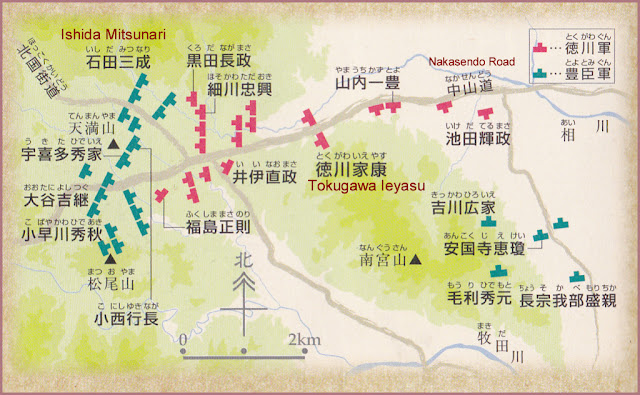
In 1600, Sekigahara, the dividing point between eastern and western Japan, was the scene of a decisive battle fought between the Eastern Army led by Tokugawa Ieyasu who aimed to unite Japan under his rule, and the Western Army formed to fight the Tokugawa forces under the command of Ishida Mitsunari.
Although the Western Army had a slight upper hand at first, the situation reversed when Kobayakawa Hideaki defected to the Eastern Army resulting in its victory.


The Battle of Sekigahara, regarded as one of the largest pivotal conflicts in Japanese history, lasted only six hours. Three years later, Ieyasu established the Tokugawa Shogunate at Edo (present-day Tokyo) and took over the rule of Japan. The town of Sekigahara which served as the battlefield of this massive battle abounds today with historic battle-related landmarks. We invite you to come and explore the army base camps and historic landmarks of the Battle of Sekigahara which will take you back to the time of this historic battle. You can also enjoy the beautiful natural surroundings as you stroll around the town of Sekigahara.
- source : kanko-sekigahara.jp -


- further reference -

::::::::::::::::::::::::::::::::::::::::::::::::::::::::::::::::::::::::::::::::::::::::::::::::::::::::::::::::::::::::::::::::::::::::::::::::::::::::::::::::::::::::::::::::::::


やぎ乳アイス Ice cream from Goat's milk
笹尾山麓で関ヶ原名物 - speciality from Sekigahara


. aisukuriimu アイスクリーム ice cream .

.......................................................................

shigure hamaguri 時雨蛤 clamshells in sweet syrup
This refers back to the famous battle of Sekigahara (1600), near Ogaki castle, where the fishermen of Kuwana gave some clams to Tokugawa Ieyasu.
The clams are harvested out of the sand and then left for a while in a bucket of plain water to spit out the sand they still have in their body. They are then boiled in this water with shredded ginger roots and then cooled. Next they are simmered in special soy sauce from Ise (tamari shoyu たまり醤油) and flavored with sweet mizuame syrup.

. WASHOKU - clamshell, hamaguri 蛤 (はまぐり) .

::::::::::::::::::::::::::::::::::::::::::::::::::::::::::::::::::::::::::::::::::::::::::::::::::::::::::::::::::::::::::::::::::::::::::::::::::::::::::::::::::::::::::::::::::::

. Legends and Tales from Japan 伝説 - Introduction .

Yamabushi 山伏 mountain priest
During the Battle of Sekigahara, a Samurai cut off the legs of a mountain priest and took away all his food. The Yamabushi cursed him until the seventh generation and then died.
Since then, if a Head of this Samurai family inherits the name, he will suffer from heavy pain in his legs. If he passes on the Headship, he will be healed.

.......................................................................
Ehime 愛媛県 砥部町 Tobe

mekura hebi メクラヘビ the blind snake
Once upon a time
in the 芳賀家 Haga famili, which served as village head, there was a very special woman. She had been to the Battle of Sekigahara and came back. But the family thought of her as a shame and killed her.
Since then there roamed a blind snake in 猿谷 Saruya and got killed, but was later venerated in a Shinto shrine.
She became the deity 芳賀大明神 Haga Daimyojin.

and not related another legend from Matsuyama
八股榎お袖大明神(やつまたえのきおそでだいみょうじん)
Yatsumata Enoki O-Sode Daimyojin
- source : wikipedia -

.......................................................................
Gifu 岐阜県

Nagaragawa no kajika 長良川の河鹿 the Kajika frogs of Nagaragawa
The he lost the battle, female attendants of Oda Hidenobu 織田秀信 (1580 - 1605) threw themselves in the river Nagaragawa and died. Their souls became the Kajika frogs.

. kajikagaeru 河鹿蛙 Polypedates buergeri, river frog .


.......................................................................
Mie 三重県 松坂市 Matsuzaka

Kawakami Hachimangu 川上八幡宮 Shrine
At the battle of Sekigaraha, the head of 大谷刑部 Otani Gyobu (Otani Yoshitsugu, 1559 - 1600) was burried at the roots of some 菖蒲 Japanese Iris by a vassal. A wandering priest observed this, and told Tokugawa Ieyasu that he had cut off the head. Later he became the first Lord of the Todo Clan of Ise 伊勢の藤堂家.
The head of Gyobu was burried at the Shrine Kawakami Hachimangu, but it brought a curse with it.
So the Head of the Todo clan cound never visit this shrine.

川上八幡宮 - 三重県津市美杉町川上3498
3498 Misugicho Kawakami, Tsu, Mie - - - HP of the shrine S
- reference : wakamiya.info-


.......................................................................
Shiga 滋賀県

At the battle of Sekigahara, the leader of the loosing Western Army pleaded for its soldiers not to be beheaded,
but the Eastern Army, in its frenzy of victory, beheaded them all. A serpent living in the weeds there was all washed in blood and became blind and all white.
The souls of the dead slipped into its body and to our day a white serpent lingers on the mountain roads of the region.

When Ishida Mitsunari 石田三成 lost the battle of Sekigahara, his wife and her attendants threw themselves into the ponds 千貫池 Senkan-Ike and 万貫池 Mankan-Ike. Their curse stayed with the ponds and during a great rainfall at night people hear their crying and sniffing voices to our day.

. Ishida Mitsunari 石田三成 (1560 - 1600) .


.......................................................................
Shizuoka 静岡県

Otoragitsune, O-Tora-Gitsune お寅狐 the Fox named Tora (Tiger)
In this area, there are many stories about people being bewitched by a special fox, the
Toragitsune.
When he heard the sound of guns during the Battle of Sekigahara, he run away and became lame on one leg. People who are bewitched by this fox become lame, but also begin to talk about war strategy.

関が原の戦いで鉄砲の音がしてから逃げたらビッコになったという。
. Otoragitsune, O-Tora-Gitsune お寅狐 The Fox named Tora (Tiger) .
and the Battle of Nagashino (長篠の戦い).


- LINK to many ema 絵馬 votive tablets with O-Toragitsune:
- source : youkaiodaie.blog.fc2.com -

This seems a mix-up with the name of the battle of Nagashino,
Nagashino Shitaragahara 長篠設楽原 (ながしの したらがはら).


::::::::::::::::::::::::::::::::::::::::::::::::::::::::::::::::::::::::::::::::::::::::::::::::::::::::::::::::::::::::::::::::::::::::::::::::::::::::::::::::::::::::::::::::::::

- - - - - H A I K U and S E N R Y U - - - - -

関ヶ原畦一筋の野火走る
Sekigahara aze hitosuji no nobi hashiru

Sekigahara -
burning the small paths
between the withered fields

Tr. Gabi Greve

山本悦子 Yamamoto Etsuko

. WKD : nobi 野火(のび)fire of the withered fields .
noyaki 野焼 (のやき) burning the withered fields
- - kigo for spring - -


source : momotaro.naganoblog.jp


.......................................................................

蚊柱のさまよい歩く関が原
岩下四十雀

あらたまの虹かかりゐる関ケ原
鈴木恵美子

胴赤き蟻のさまよふ関ケ原
荒島禾生

古藁塚は伏兵霧の関ヶ原
柴田奈美

- source : haikureiku database -
::::::::::::::::::::::::::::::::::::::::::::::::::::::::::::::::::::::::::::::::::::::::::::::::::::::::::::::::::::::::::::::::::::::::::::::::::::::::::::::::::::::::::::::::::::


- - - To join me on facebook, click the image !

:::::::::::::::::::::::::::::::::::::::::::::::::::::::::::::::::::::::::::::::::::::::::::::::::::::::::::::::::::::::::::::::::::::::::::::::::::::::::::::::::::::::::::::::::::::

. Edo bakufu 江戸幕府 The Edo Government .

. Famous Places and Powerspots of Edo 江戸の名所 .

. senryu, senryū 川柳 Senryu poems in Edo .

. Legends and Tales from Japan 伝説 - Introduction .


[ . BACK to DARUMA MUSEUM TOP . ]
[ . BACK to WORLDKIGO . TOP . ]- - - - - #sekigahara - - - -
::::::::::::::::::::::::::::::::::::::::::::::::::::::::::::::::::::::::::::::::::::::::::::::::::::::::::::::::::::::::::::::::::::::::::::::::::::::::::::::::::::::::::::::::::::

27 Mar 2016

MINGEI - Yamaguchi Folk Art

http://omamorifromjapan.blogspot.jp/2011/07/yamaguchi-folk-toys.html

. Yamaguchi Folk Toys

[ . BACK to DARUMA MUSEUM TOP . ]
::::::::::::::::::::::::::::::::::::::::::::::::::::::::::::::::::::::::::::::::::::::::::::::::::::::::::::::::::::::::::::::::::::::::::::::::::::::::::::::::::::::::::::::::::::::::::::  

Yamaguchi Folk Art - 山口県 


The capital is Yamaguchi town.

Hagi town 萩市
Iwakuni 岩国


. Kotozaki Hachimangu 琴崎八幡宮 amulets .
山口県宇部市上宇部大小路 - Ube town


Shirasaki Hachimangu 白崎八幡宮 - Iwakuni
. Omamori - amulets from this shrine .

. byooma taisan 病魔退散 amulet warding off disease .

. momo no hana omamori 桃の花 お守り amulet with a peach blossom .

........................................................................................................................................................
Hagi town 萩市

. Choomon hariko 長門張り子 Chomon hariko -
papermachee dolls from the Chomon gorge .


. Hagi no takezaiku 竹細工 bamboo craft from Hagi .

.......................................................................

Kohagi ningyoo 小萩人形 small dolls from Hagi


made by 柳橋貞子 Yanagibashi Teiko in 1935. She learned how to make dolls from Matsumura Nobu 松村ノブ.

Since the beginning of the Showa period, the ladies from Hagi began to make these small dolls, representing topics from the traditional dance, buyoo 舞踊.
Most are between 11 and 19 cm.


ishoo ningyo 衣裳人形 dolls dressed in real robes with expensive material.
Most are topics of famous dances - Maiko Dance Girl Dolls
「藤娘」Fuji Musume, 「舞妓 / 舞妓」「Maiko, 「八重垣姫」Yaegaki Hime, 「汐汲」Shiokumi,
「七枚笠」Nanamaigasa (doll with seven large straw hats)

. . . CLICK here for more Photos - 衣裳人形 !


. . . CLICK here for Photos !
Nanamaigasa (Shichimaigasa) 七枚笠 doll with seven red straw hats
from a scene of the Dojo-Ji dance.
- reference -


maiko ningyoo 舞妓人形 Maiko Dance Girl Dolls
. . . CLICK here for Photos !

........................................................................................................................................................


Mishima no oni yoozu 見島の鬼揚子
Oniyozu demon kite from Mishima island


yoozu is the local name for a kite.
This kite has been used since the Heian period. It is flown on the New Year in a family where a boy was born, with a prayer for the health of the child when growing up.

........................................................................................................................................................
Iwakuni town 岩国市


ishi ningyoo 岩国の石人形 dolls from stone
... ningyoo ishi 人形石
They are hand-made stone dolls, made from the nest of an insect called "ningyoo tobikera 石蚕" which is found in the very clear and clean rivers in Iwakuni. The dolls are said to be the incarnations of the souls of people who died during the construction of the Kintai bridge 錦帯橋 or were human offerings made during that time (hitobashira 人柱).
The most common are the seven gods of good luck, Jizo Bosatsu and other religious figures.
source : www.iwa.gr.jp

. hitobashira 人柱 human sacrifice, "human pillar" .
- ikenie 生贄 / 生け贄 human sacrifice - Introduction


. shooryuu magatama omamori 昇龍勾玉お守り
Rising Dragon and Magatama amulet .

Shrine Shirasaki Hachimangu 白崎八幡宮

........................................................................................................................................................
Ooshima town 大島町 Oshima

. Yanai no kingyo choochin 柳井の金魚堤灯 goldfish lanterns from Yanai village .
and the 柳井金魚ちょうちん祭り Yanai Goldfish Festival

........................................................................................................................................................
Shimonoseki town 下関

. kanju manju no rei 干珠満珠の鈴 clay bells of ebb and tide .
Iminomiya jinja 忌宮神社
- Introducing the Tide Jewels -

.......................................................................

. fugu choochin ふぐ提灯 puffer fish lantern .
fugu fue 下関のふぐ笛 puffer fish whistle

.......................................................................

. tairyoo ningyoo 大漁人形 doll for a good catch of fish .
at Dan no Ura 壇ノ浦

. . . CLICK here for Photos - DannoUra Dolls !

. Battle of Dan-no-Ura 壇ノ浦の合戦 .
the Genpei war. 源平

........................................................................................................................................................
Toyoura 豊浦付近 Toyoura inlay

tohetohe uma とへとへ馬 Tohetohe straw horse


tohe no uma とへの馬 Tohe straw horse

とへとへ馬:山口県豊浦郡豊浦付近 Tohetohe Uma in Toyoura
とへの馬:山口県岩国市周辺 Tohe no Uma in Iwakuni
A kind of wara uma わら馬 straw horse from the region 中国地方.


........................................................................................................................................................
Yamaguchi town 山口市


. Oouchi Daruma 大内だるま Ouchi Daruma
and more Ouchi Laquer ware 大内人形 Ouchi ningyoo


. Kumiki gangu 組木玩具 wooden puzzle toys .
木村菊人 Kimura Kikuto


. Kosen rei 古銭鈴 clay bell like an old coin .
The first coin money made in Japan at the Heian period was made in Yamaguchi. It had the inscription 和同開珎, with the wish to bring peace to the land.
Now this clay bell is a mascot for peace and richess.
More clay bells from :
source : 内田延子 Uchida Nobuko
花神鈴 - with Omura Masujiro 大村益次郎
代神楽獅子頭鈴 Kagura Lion Dance
やたがらす鈴 three-legged crow
大内人形鈴 Ouchi Laquer dolls in clay
十二支鈴 zodiac animals
sagi mai さぎ舞鈴 dancing cranes from Tsuwano

from shrine 弥栄神社 Yasaka Jinja in Shimane, Tsuwano town
amulet for the happiness of the whole family

. Tsuwano Heron Dance 津和野の鷺舞 Tsuwano no sagimai .
clay doll of the Heron Dance
famous washi paper dolls from Tsuwano
津和野の和紙人形


. sumi ningyoo お炭人形 dolls made from charcoal

........................................................................................................................................................
Yamaguchi hariko 山口張り子 papermachee dolls
Yamaguchi ningyoo 山口人形 Yamaguchi Dolls

They are not made any more, the Dan no Ura fishing doll was the last one.
They used to have a small bell inside the doll to make a sound.


Daruma


::::::::::::::::::::::::::::::::::::::::::::::::::::::::::::::::::::::::::::::::::::::::::::::::::::::::::::::::::::::::::::::::::::::::::::::::::::::::::::::::::::::::::::::::::::::::::::  
. Reference and Photos . Gangu Guide .
. Reference and Photos . Isamu Folk Toys .
. Reference and Photos . Yama no Ie . Folk Toys .

::::::::::::::::::::::::::::::::::::::::::::::::::::::::::::::::::::::::::::::::::::::::::::::::::::::::::::::::::::::::::::::::::::::::::::::::::::::::::::::::::::::::::::::::::::::::::::   

. WASHOKU . - Regional Dishes from Yamaguchi

MORE
. Yamaguchi Folk Toys - this BLOG .


. Japan after the BIG earthquake March 11, 2011


[ . BACK to WORLDKIGO . TOP . ]
[ . BACK to DARUMA MUSEUM TOP . ]
- #yamaguchi #hagi -
::::::::::::::::::::::::::::::::::::::::::::::::::::::::::::::::::::::::::::::::::::::::::::::::::::::::::::::::::::::::::::::::::::::::::::::::::::::::::::::::::::::::::::::::::::::::::::