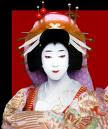
14 Jun 2015

EDO - Furuyama Moromasa


[http://darumasan.blogspot.jp/]
[ . BACK to DARUMA MUSEUM TOP . ]

. - - - PERSONS - ABC - LIST of this BLOG - - - .
::::::::::::::::::::::::::::::::::::::::::::::::::::::::::::::::::::::::::::::::::::::::::::::::::::::::::::::::::::::::::::::::::::::::::::::::::::::::::::::::::::::::::::::::::

Furuyama Moromasa 古山師政

Ukiyoe-Master of the Edo period, dates unknown.


- quote
古山師重の子。姓は古山、名は新七郎(一説には新九郎とも)。
月々堂、文志、文翅と号す。はじめは菱川昌則と称した。江戸両国の江市長屋に住んでいたと伝わる。『浮世絵類考』の一本には師政について「画法を師宣に学ぶ」と記されているが、「此の人に至りて菱川の画風を失ふ」ともあり、残されている作品を見てもその画風は菱川派ではなく、同じ時代に活躍した奥村政信や石川豊信、上方の西川祐信といった絵師たちの影響を受けているといわれる。従来作画期は宝永から延享の頃にかけてとされていたが、「浮世絵屏風」(今治市河野美術館蔵)の発見により、師政は元禄10年(1697年)前後には菱川派の画風で絵を制作し父師重の代筆をしており、更に元禄14年(1701年)頃には菱川一門を離れたことが判明した。

現在までに大判漆絵、浮絵、墨摺絵、紅絵(柱絵2点、浮絵3点を含む)の他に、多くの肉筆画が確認されている。木版画では特に大判墨摺絵の「吉田街道」、紅絵の「新吉原座舗けんすもふ」はよく知られている。肉筆画の代表作としては「梅下美人図」、「踊りの稽古図」、「巳屋店先図」などがある。
© More in the WIKIPEDIA !

::::::::::::::::::::::::::::::::::::::::::::::::::::::::::::::::::::::::::::::::::::::::::::::::::::::::::::::::::::::::::::::::::::::::::::::::::::::::::::::::::::::::::::::::::


Rare Japanese painting by Furuyama Moromasa
discovered in Edinburgh's Central Library collections


Undated photo of a section of a rare Japanese painting by Furuyama Moromasa, made available by City of Edinburgh Council, Scotland Friday Jan. 4, 2013, depicting early 18th century street life which has been discovered in a library's special collections. The 44ft scroll was donated in the 1940s but its significance has only just been realised by experts in Edinburgh. It is believed to be the largest of his works anywhere in the world. Two other examples of his work are held by the British Museum.
The scroll depicts a street scene from Edo, which became Tokyo, showing shops, theatres and domestic life. A funding application has been made to the Japan-based Sumitomo Foundation for conservation funding, with a result expected in March.


The scroll, by Japanese painter Furuyama Moromasa, is over 44ft in length and depicts an extended street scene in C18th Edo, or Tokyo, showing the shops and theatres and domestic detail of life at that time.

Two of Furuyama Moromasa's paintings are currently held by the British Museum, but this is thought to be the largest of his works discovered anywhere in the world.

AP Photo/ City of Edinburgh Council.

- source : artdaily.com/news - June 2015


::::::::::::::::::::::::::::::::::::::::::::::::::::::::::::::::::::::::::::::::::::::::::::::::::::::::::::::::::::::::::::::::::::::::::::::::::::::::::::::::::::::::::::::::::

- Reference - Japanese -

- Reference - English -


. Welcome to Edo 江戸 ! .

- - - #furuyamamoromasa #moromasa- - -
::::::::::::::::::::::::::::::::::::::::::::::::::::::::::::::::::::::::::::::::::::::::::::::::::::::::::::::::::::::::::::::::::::::::::::::::::::::::::::::::::::::::::::::::::


Join the friends on facebook !


. - - - PERSONS - ABC - LIST of this BLOG - - - .

[ . BACK to DARUMA MUSEUM TOP . ]
[ . BACK to WORLDKIGO . TOP . ]

::::::::::::::::::::::::::::::::::::::::::::::::::::::::::::::::::::::::::::::::::::::::::::::::::::::::::::::::::::::::::::::::::::::::::::::::::::::::::::::::::::::::::::::::::

--
Posted By Gabi Greve to PERSONS - index - PERSONEN on 6/11/2015 04:09:00 p.m.

EDO - kashihonya lending books


[http://darumasan.blogspot.jp/]
[ . BACK to DARUMA MUSEUM TOP . ]

. - Doing Business in Edo - 商売 - Introduction .
::::::::::::::::::::::::::::::::::::::::::::::::::::::::::::::::::::::::::::::::::::::::::::::::::::::::::::::::::::::::::::::::::::::::::::::::::::::::::::::::::::::::::::::::::::: 
kashihonya, kashihon'ya 貸本屋 booklender, booklender
furuhonya, furu-honya 古本屋 selling old books


貸本屋も盛んで、文化五年(1808年)の記録によると、貸本屋は地域ごとに組をつくっており、江戸では日本橋南組、本町組、神田組その他あわせて12組、合計人数約650人、大坂でも約300人という人数が貸本屋を営んでいました。また、天保年間(1830年代)の「江戸繁昌記」という文献では、江戸の貸本屋は八百軒とあり、その盛んな様子が伺えます。普通の貸本屋では、170-180軒ほどのお得意先があり、江戸だけで10万軒に及ぶ貸本読者がいたと考えられます。
- source : ameblo.jp/yonezu011 -

..............................................................................................................................................

- quote
Kashihon'ya, or booklenders, played a prominent role in the publishing and distribution industry of Edo period Japan. While many consumers purchased books outright from publishers/bookshops or from traveling salesmen, borrowing of books from booklenders, and from one another, was extremely popular.

They are believed to have emerged around the late 17th century, if not earlier, with one source indicating the emergence of the term in 1713. By 1808, booklenders in Edo numbered at least 656, outnumbering public bathhouses in the city; this number jumped to at least 800 by the 1840s. Similar numbers were seen in Osaka. Most booklenders/booksellers maintained storefronts, but conducted much of their business through visits directly to the homes of regular customers, or by peddling books on the street. One scholar has estimated the customer base of each kashihon'ya at, on average, 150-200 households.


The book peddler, with a rectangular pile of books on his back, is actually a very common sight in ukiyo-e genre paintings. Traveling booklenders - or perhaps staff in the employ of a booklender from one of the major urban centers - are also known to have made visits to more rural communities and individuals.

The seal of the kashihon'ya would often be placed in the front of the book - either on the inside cover, or on the first page. Along with the seals of later owners of the books (e.g. 20th century Western collectors), these booklenders' seals provide interesting and useful information about the provenance or history of a particular copy of a book.

Prices varied dramatically from city to city and from one booklender to another, but are cited by historian Eiko Ikegami as being roughly 1/6th the cost of buying the book outright. She estimates the cost of purchasing a thin kibyôshi volume at less than 16 mon, the cost of a bowl of soba, but more than the cost of a visit to the public bathhouse.
- source : wiki.samurai-archives.com


. ezooshi 絵草子 illustrated book or magazine .
「絵草子屋」 ezooshiya store
Ezoushi - Also written 絵双紙.
otogizooshi 御伽草子 popular tales
ukiyo zooshi 浮世草子 Ukiyo-zoshi - books about the floating world

:::::::::::::::::::::::::::::::::::::::::::::::::::::::::::::::::::::::::::::::::::::::::::::::::::::::::::::::::::::::::::::::::::::::::::::::::::::::::::::::::::::::::::::::::::::

- reference in Japanese - 貸本屋 江戸時代 -

- reference in English -


source : runomi.at.webry.info

:::::::::::::::::::::::::::::::::::::::::::::::::::::::::::::::::::::::::::::::::::::::::::::::::::::::::::::::::::::::::::::::::::::::::::::::::::::::::::::::::::::::::::::::::::::

- - - - - H A I K U and S E N R Y U - - - - -

暦売る門前町の古本屋
koyomi uru monzenmachi no furuhonya

the used bookstore
of the temple town
sells calendars


Tsuchiya Kyooko 土屋孝子 Tsuchiya Kyoko

. kigo for the End of the Year .

..............................................................................................................................................


Edo no honyasan 江戸の本屋さん Book stores in Edo
今田洋三


Edo no kinsho 江戸の禁書 Prohibited books in Edo
今田洋三


..............................................................................................................................................


hatsuharu ni maneki neko itte furuhonya

The first day of spring
there is a welcoming cat
at the old bookshop.

. by Mr. Oyadomari

. manekineko 招き猫 beckoning cat .


..............................................................................................................................................


貸本屋唐と日本を背負ってくる
kashihonya sho too to nihon o seotte kuru

the booklender
carries China and Japan
on his back


..............................................................................................................................................


source : blog.goo.ne.jp/aboo-kai

貸本の底に春画や夏の午後
kashihon no soko ni shunga ya natsu no gogo

below the rental books
there are the Shunga -
afternoon in summer


Many peddlers had two kinds of clients . . . the dilligent housewifes and then . . . their husbands, with erotic booklets hidden at the bottom of their bags.


. shunga 春画 "spring paintings" erotic pictures .


:::::::::::::::::::::::::::::::::::::::::::::::::::::::::::::::::::::::::::::::::::::::::::::::::::::::::::::::::::::::::::::::::::::::::::::::::::::::::::::::::::::::::::::::::::::


- - - To join me on facebook, click the image !

:::::::::::::::::::::::::::::::::::::::::::::::::::::::::::::::::::::::::::::::::::::::::::::::::::::::::::::::::::::::::::::::::::::::::::::::::::::::::::::::::::::::::::::::::::::


. - Doing Business in Edo - 商売 - Introduction .

. senryu, senryū 川柳 Senryu poems in Edo .


[ . BACK to DARUMA MUSEUM TOP . ]
[ . BACK to WORLDKIGO . TOP . ]- - - - - #edokashihonya #furuhonya #kashihonya - - - -
::::::::::::::::::::::::::::::::::::::::::::::::::::::::::::::::::::::::::::::::::::::::::::::::::::::::::::::::::::::::::::::::::::::::::::::::::::::::::::::::::::::::::::::::::::

--
Posted By Gabi Greve to Edo - the EDOPEDIA - on 6/14/2015 12:58:00 p.m.

12 Jun 2015

HEIAN - Books about the Heian Period


- BACK to the Daruma Museum -
. ABC List of Contents .
::::::::::::::::::::::::::::::::::::::::::::::::::::::::::::::::::::::::::::::::::::::::::::::::::::::::::::::::::::::::::::::::::::::::::::::::::::::::::::::::::::::::::::::

Books about the Heian Period (794 to 1185)

- - - - - Featured in the facebook group
. Japanese Literature .


. Reference online .

::::::::::::::::::::::::::::::::::::::::::::::::::::::::::::::::::::::::::::::::::::::::::::::::::::::::::::::::::::::::::::::::::::::::::::::::::::::::::::::::::::::::::::::

Three very long entries in wikibooks:

Japanese History/The Early Heian Period
- source : wikibooks.org -

Japanese History/The Middle Heian Period
- source : wikibooks.org -

Japanese History/The Late Heian Period
- source : wikibooks.org -

::::::::::::::::::::::::::::::::::::::::::::::::::::::::::::::::::::::::::::::::::::::::::::::::::::::::::::::::::::::::::::::::::::::::::::::::::::::::::::::::::::::::::::::


Ambros Barbara Ambros
Pilgrimages of Noblewomen in Mid-Heian Japan


Broma-Smenda Karolina Broma-Smenda
How to Create a Legend?
An Analysis of Constructed Representations of Ono no Komachi in Japanese Medieval Literature


Fukayama Toshio Fukuyama (Author), Ronald K Jones (Translator)
Heian Temples: Byodo-In and Chuson-Ji


Herail Francine Herail (Author), Wendy Cobcroft (Translator)
Emperor and Aristocracy in Heian Japan: 10th and 11th centuries


Izumi Shikibu / Ono no Komachi
The Ink Dark Moon (tr. Hirschfeld and Aratani)


Keller Kimbrough
Preachers, Poets, Women, and the Way
Izumi Shikibu and the Buddhist Literature of Medieval Japan


Laffin Christina
Rewriting Medieval Japanese Women:
Politics, Personality, and Literary Production in the Life of Nun Abutsu


Sango Asuka
The Halo of Golden Light: Imperial Authority and Buddhist Ritual in Heian Japan


Sen Sōshitsu Sen
Tea in the Heian Era
The Japanese Way of Tea: From Its Origins in China to Sen Rikyu
- source : books.google.co.jp -


Stockdale Jonathan
Imagining Exile in Heian Japan: Banishment in Law, Literature, and Cult


Suzuki Yui
Medicine Master Buddha: The Iconic Worship of Yakushi in Heian Japan


::::::::::::::::::::::::::::::::::::::::::::::::::::::::::::::::::::::::::::::::::::::::::::::::::::::::::::::::::::::::::::::::::::::::::::::::::::::::::::::::::::::::::::::

Colors and Heian Court Literature
色彩から見た王朝文学 と『源氏物語』の色
発行:笠間書院


Music in Heian literature - Ongaku
源氏物語の音楽 - ─平安・鎌倉時代の雅楽はこんな曲
- source : jupiter.kcua.ac.jp -


Waka no Rule 和歌のルール / 渡部泰明編 (Rules about Waka poetry)
「枕詞まくらことば」「掛詞かけことば」「本歌取り」. . .


::::::::::::::::::::::::::::::::::::::::::::::::::::::::::::::::::::::::::::::::::::::::::::::::::::::::::::::::::::::::::::::::::::::::::::::::::::::::::::::::::::::::::::::


. Join the friends on Facebook ! .

- #heianbooks -
::::::::::::::::::::::::::::::::::::::::::::::::::::::::::::::::::::::::::::::::::::::::::::::::::::::::::::::::::::::::::::::::::::::::::::::::::::::::::::::::::::::::::::::

[ . BACK to DARUMA MUSEUM TOP . ]
[ . BACK to WORLDKIGO . TOP . ]

::::::::::::::::::::::::::::::::::::::::::::::::::::::::::::::::::::::::::::::::::::::::::::::::::::::::::::::::::::::::::::::::::::::::::::::::::::::::::::::::::::::::::::::

--
Posted By Gabi Greve to Heian Period Japan on 6/06/2015 12:29:00 p.m.

HEIAN - Persons of the Heian Period


- BACK to the Daruma Museum -
. ABC List of Contents .
::::::::::::::::::::::::::::::::::::::::::::::::::::::::::::::::::::::::::::::::::::::::::::::::::::::::::::::::::::::::::::::::::::::::::::::::::::::::::::::::::::::::::::::

Persons of the Heian Period (794 to 1185)

Most of the persons are introduced here :
. Persons, Personen, People of Japan .
- Introduction -

::::::::::::::::::::::::::::::::::::::::::::::::::::::::::::::::::::::::::::::::::::::::::::::::::::::::::::::::::::::::::::::::::::::::::::::::::::::::::::::::::::::::::::::


. Antoku Tenno 安徳天皇 (1178 – 1185) .


. Dengyo Daishi 伝教大師最澄 Saicho (766 - 822) .


. Kobo Daishi, Kukai 弘法大師 空海 (774 - 835) .


. Murasaki Shikibu 紫式部 (973 - 1014) .


Sei Shonagon 清少納言 (966 - 1017)
- source : wikipedia -


. Sugawara Michizane 菅原道真 Tenjin Sama (845 - 903) .


. Taira no Kiyomori 平清盛 (1118 - 1181) .


::::::::::::::::::::::::::::::::::::::::::::::::::::::::::::::::::::::::::::::::::::::::::::::::::::::::::::::::::::::::::::::::::::::::::::::::::::::::::::::::::::::::::::::

- Emperors - Tenno 天皇 -

784: Emperor Kammu moves the capital to Nagaoka-kyō (Kyōto)
794: Emperor Kammu moves the capital to Heian-kyō (Kyōto)
858: Emperor Seiwa begins the rule of the Fujiwara clan[18]

1050: Rise of the military class (samurai)
1053: The Byōdō-in temple (near Kyōto) is inaugurated by emperor Fujiwara Yorimichi
1068: Emperor Go-Sanjo overthrows the Fujiwara clan
1087: Emperor Shirakawa abdicates and becomes a Buddhist monk, the first of the "cloistered emperors" (insei)

1180 (June): Emperor Antoku moves the capital to Fukuhara-kyō (Kobe)
1180 (November): Emperor Antoku moves the capital to Heian-kyō (Kyōto)

1185: Taira is defeated (Gempei War) and Minamoto Yoritomo with the support (backing) of the Hōjō clan seizes power, becoming the first shogun of Japan, while the emperor (or "mikado") becomes a figurehead

- source : wikipedia -


桓武天皇……第50代天皇。Kanmu
平城天皇……第51代天皇。Heizei
嵯峨天皇……第52代天皇。Saga
淳和天皇……第53代天皇。Junna
仁明天皇……第54代天皇。Ninmyo
文徳天皇……第55代天皇。Montoku
清和天皇……第56代天皇。Seiwa
陽成天皇……第57代天皇。Yozei
光孝天皇……第58代天皇。Koko
宇多天皇……第59代天皇。Uda
醍醐天皇……第60代天皇。Daigo
朱雀天皇……第61代天皇。Suzaku
村上天皇……第62代天皇。Murakami
冷泉天皇……第63代天皇。Reizei
円融天皇……第64代天皇。Enyu
花山天皇……第65代天皇。Kazan
一条天皇……第66代天皇。Ichijo
三条天皇……第67代天皇。Sanjo
後一条天皇……第68代天皇。Go-Ichijo
後朱雀天皇……第69代天皇。Go-Suzaku
後冷泉天皇……第70代天皇。Go-Reizei
後三条天皇……第71代天皇。Go-Sanjo
白河天皇……第72代天皇。Shirakawa
堀河天皇……第73代天皇。Horikawa
鳥羽天皇……第74代天皇。Toba
崇徳天皇……第75代天皇。Sutoku
近衛天皇……第76代天皇。Konoe
後白河天皇……第77代天皇。Go-Shirakawa
二条天皇……第78代天皇。Jijo
六条天皇……第79代天皇。Rokujo
高倉天皇……第80代天皇。Takakura
安徳天皇……第81代天皇。Antoku
後鳥羽天皇……第82代天皇。Go-Toba


平安時代の人物一覧
- source : wikipedia

::::::::::::::::::::::::::::::::::::::::::::::::::::::::::::::::::::::::::::::::::::::::::::::::::::::::::::::::::::::::::::::::::::::::::::::::::::::::::::::::::::::::::::::


. Join the friends on Facebook ! .

- #heian -
::::::::::::::::::::::::::::::::::::::::::::::::::::::::::::::::::::::::::::::::::::::::::::::::::::::::::::::::::::::::::::::::::::::::::::::::::::::::::::::::::::::::::::::

[ . BACK to DARUMA MUSEUM TOP . ]
[ . BACK to WORLDKIGO . TOP . ]

::::::::::::::::::::::::::::::::::::::::::::::::::::::::::::::::::::::::::::::::::::::::::::::::::::::::::::::::::::::::::::::::::::::::::::::::::::::::::::::::::::::::::::::

--
Posted By Gabi Greve to Heian Period Japan on 6/06/2015 11:10:00 a.m.

HEIAN - ABC List Contents


- BACK to the Daruma Museum -
::::::::::::::::::::::::::::::::::::::::::::::::::::::::::::::::::::::::::::::::::::::::::::::::::::::::::::::::::::::::::::::::::::::::::::::::::::::::::::::::::::::::::::::

ABC List of Contents - Heian Period

Artwork

Books

Legends

Literature and Poetry

Persons

Reference online

Schrines

Temples


::::::::::::::::::::::::::::::::::::::::::::::::::::::::::::::::::::::::::::::::::::::::::::::::::::::::::::::::::::::::::::::::::::::::::::::::::::::::::::::::::::::::::::::

- More Keywords -

A

B

C


::::::::::::::::::::::::::::::::::::::::::::::::::::::::::::::::::::::::::::::::::::::::::::::::::::::::::::::::::::::::::::::::::::::::::::::::::::::::::::::::::::::::::::::


. Join the friends on Facebook ! .

- #heianabclist #abclist -
::::::::::::::::::::::::::::::::::::::::::::::::::::::::::::::::::::::::::::::::::::::::::::::::::::::::::::::::::::::::::::::::::::::::::::::::::::::::::::::::::::::::::::::

[ . BACK to DARUMA MUSEUM TOP . ]
[ . BACK to WORLDKIGO . TOP . ]

::::::::::::::::::::::::::::::::::::::::::::::::::::::::::::::::::::::::::::::::::::::::::::::::::::::::::::::::::::::::::::::::::::::::::::::::::::::::::::::::::::::::::::::

--
Posted By Gabi Greve to Heian Period Japan on 6/12/2015 10:07:00 a.m.

11 Jun 2015

MINGEI - O-Kin jo doll, Benta doll Kumamoto

LINK
http://omamorifromjapan.blogspot.jp/2011/08/kumamoto-folk-toys.html

.......................................................................


Hinagu Hot Spring 日奈久温泉 in the bay of Hachidai

okin jo ningyoo, O-Kin おきん女人形 / おきん女人形 The Girl O-Kin

O-Kin was a beautiful girl working at the Hot Spring, about 200 years ago.
The doll is made from the wood of the paulownia 桐. Its arms and legs are fixed to the main body with stark-red cotton strings and cloth and can be moved.
On the bib painted on the brest are flower patterns.
They come in many sizes.
This simple doll was used by girls to play "mother and child".


The doll is also called penta ningyoo, benta ningyoo ぺんた人形 / 弁太人形 / べんたにんぎょう - Benta Doll

The name Benta derives from the name of the original creator of this doll "Benta" during the Bunsei period (1818-1830). He was said to be a Korean immigrant using remnant Kiri wood material from Geta clog production as most of the folk toys from Hinagu were made. Hinagu is known for its Geta production because many good quality Kiri trees grow in this area.
The doll is also called the "Okin-jyo" doll modeled after a girl from a nearby fishing village who helped to find a hot spring with Rokurouzaemon. He was a son of Hamada Ukon, a very important warrior for the Kumamoto lord. When Ukon was injured during a battle, his son Rokurouzaemon came to pray at Ichikishima Shinto Shrine to find a healing hot spring for his father and with the help from Okin, he finally found the present day Hinagu hot spring. It used to be a custom to buy this Benta doll at the Hinagu festival.

The original Benta dolls are simple wooden doll without limbs just like the Kokeshi dolls but the arms and legs were added in the mid-Meiji period (1868-1912). The condition of this piece is very good and her age is from the 1960's.
- source : www.worthpoint.com -

.......................................................................


ita sumoo 板相撲 sumo wrestling on a bord
. Sumo 相撲  Sumo wrestling dolls .


kiji uma きじ馬 pheasant horse, pheasant on wheels


..................................................................................................................................................................

MINGEI - Unsun karuta Hitoyoshi

LINK
http://omamorifromjapan.blogspot.jp/2011/08/kumamoto-folk-toys.html

.......................................................................


unsun karuta ウンスンかるた Unsun card game


- quote -
Unsun Karuta is a card game, based on the western deck of playing cards, that was first brought to Japan by a Portuguese sailor.
During the Tenshou Era (1573 ~1591), the very first copy of western-style playing cards was made in Japan. These cards, made in Mitsuike, Oomuta City, Fukuoka, came to be known as Tenshou Karuta. In the Edo period, they were developed further and Unsui Karuta was born.
While Tenshou Karuta had 48 cards, Unsun Karuta has 75 cards and more complicated rules. The name, Unsun, is said to have derived from the Portuguese words for the number one – "un" and the best – "sun".
As Unsun Karuta gained popularity, the gambling potential of the game became so popular that, in the middle of the Edo period, it was banned. Unsun Karuta was believed to have entirely disappeared until it was discovered that the people of the Hitoyoshi region in Kumamoto had been enjoying the game all along.
- source : nippon-kichi.jp -


. Karuta, Uta Karuta 歌留多 Japanese playing cards .

..................................................................................................................................................................

.

MINGEI - hanatebako boxes

Kumamoto

..................................................................................................................................................................

Hitoyoshi town 人吉市

hanatebako, hana tebako 花手箱 box with flowers
mostly camellia

The boxes are made from cedar wood, painted with stark red camellia blossoms and green leaves. The edges are black. Other boxes have chrysanthemums for decoration.
They were sold at local markets and Shrine fairs.

Kijiuma are wheeled-bird toys, hanatebako are camellia-motif boxes, and hagoita are wooden paddles for Japanese badminton.


These traditional toys were born out of tragedy about 800 years ago. After the Heike clan was run out of power and all but wiped out in the 12th century, a group of survivors escaped to the Kuma region, where they continued to hide in exile. With their simple but vivid colors, these playthings were originally made out of a longing for the clan's glory days.
Today, they are treated more as traditional decorations rather than recreational articles.
- source : kumanago.jp/en -


CLICK for more photos !

.......................................................................


kiji uma きじ馬 / kiji kuruma 雉子車 pheasant horse
uzuraguruma うずら車 quail on wheels

.......................................................................

shunnamejo しゅんなめじょ Shunnamejo

しゅん=春 shun is for spring
なめ=男女 name is for male and female
じょ=愛称の接尾語 jo is a pleasent word ending

decoration for the New Year, to pray for a good harvest and good luck.

Made from a stick of the paper mulberry tree (koozo 楮) in the simple form with a human face.


This simple doll is then decorated with paper robes for male and female forms.
A stand is made from a straw barrel with four legs.


The dolls and some flower imitations of mochi rice are stuck into the straw.
The more human figures a family decorated, the more hands there would be during the harvest time to help with the farm work.
This decoration was made by all farming families and put up in the tokonoma alcove for decoration during the New Year holidays.

- source : www.pe-toru.or.jp -


CLICK for more photos !

.......................................................................

EDO - onnagata female Kabuki actors

LINK
http://wkdkigodatabase03.blogspot.jp/2007/12/woman-and-haiku.html

::::::::::::::::::::::::::::::::::::::::::::::::::::::::::::::::::::::::::::::::::::::::::::::::::::

Man and Woman, otoko to onna 男と女


CLICK for more female male actors

In Kabuki, men play the female roles and learn how to express female feelings through very precise and ritualistic gestures.

onnagata 女形 female actors

Yoshizawa Ayame I (初代 吉沢 菖蒲)
(1673-15 July 1729)


an early Kabuki actor, and the most celebrated onnagata (specialist in female roles) of his time. His thoughts on acting, and on onnagata acting in particular, are recorded in Ayamegusa (菖蒲草, "The Words of Ayame"), one section of the famous treatise on Kabuki acting, Yakusha Rongo (役者論語, "The Actors' Analects").

A.C. Scott wrote that "Yoshizawa Ayame I was regarded as the greatest onnagata or female impersonator of his time and was an artist of ability, who developed the unique technique which was to be a model for the actors of the future. His ideas and secrets were written down in a book called 'Ayamegusa', which was afterwards regarded as the Bible of the female impersonator."
Ayame
is famous for advocating that onnagata behave as women in all their interactions, both onstage and off. In Ayamegusa, he is quoted as saying that
"if [an actor] does not live his normal life as if he was a woman, it will not be possible for him to be called a skillful onnagata."
Following his own advice, Ayame cultivated his femininity throughout his offstage life, and was often treated as a woman by his fellow actors. His mentor, Arashi San'emon, and others are said to have praised him on many occasions for his devotion to his art.
- - - More in the WIKIPEDIA !


. Kabuki Theater in Japan 歌舞伎 .

. Bando Tamasaburo 坂東玉三郎 . - (1950 - )


. nanshoku、danshoku 男色 homosexuality .
Yamashita Kinsaku II 山下金作 - Nakamura Handayû


*****************************

10 Jun 2015

GOKURAKU Waka poetry and Buddhism


[http://darumasan.blogspot.jp/]
[ . BACK to DARUMA MUSEUM TOP . ]
::::::::::::::::::::::::::::::::::::::::::::::::::::::::::::::::::::::::::::::::::::::::::::::::::::::::::::::::::::::::::::::::::::::::::::::::::::::::::::::::::::::::::::::

Waka poetry and Buddhism  和歌と仏教

. Utamakura, place names used in Poetry .
- Introduction -

- quote
Waka (和歌, literally, "Japanese poem")
is a type of poetry in classical Japanese literature. Waka are composed in Japanese, and are contrasted with poetry composed by Japanese poets in Classical Chinese, which are known as kanshi. Although waka in modern Japanese is written as 和歌, in the past it was also written as 倭歌 (see Wa (Japan)), and a variant name is yamato-uta (大和歌).

The word waka has two different but related meanings: the original meaning was "poetry in Japanese" and encompassed several genres such as chōka and sedōka (discussed below); the later, more common definition refers to poetry in a 5-7-5-7-7 metre. Up to and during the compilation of the Man'yōshū in the eighth century, the word waka was a general term for poetry composed in Japanese, and included several genres such as tanka (短歌, "short poem"), chōka (長歌, "long poem"), bussokusekika (仏足石歌, "Buddha footprint poem") and sedōka (旋頭歌, "repeating-the-first-part poem").
However, by the time of the Kokinshū's compilation at the beginning of the tenth century, all of these forms except for the tanka and chōka had effectively gone extinct, and chōka had significantly diminished in prominence. As a result, the word waka became effectively synonymous with tanka, and the word tanka fell out of use until it was revived at the end of the nineteenth century (see Tanka).
- source : wikipedia -


Buddha's Footprints ー Bussokuseki 仏足石


Temple Daisan-Ji, Nr. 56, My Shikoku Pilgrimage in 2005


. Bussokusekika, bussokuseki ka (仏足石歌) .

..............................................................................................................................................


- quote -
Buddhist poetry in Asia - Japanese Buddhist Poetry

1.
The earliest extant collection of the Japanese poetry, the Man'yōshū, contains a preface (Jp. jo 序 or daishi 題詞) to two poems on the love of parents towards their children: "Sakyamuni expounds truthfully from his golden mouth, 'I love all things equally, the way I love my child, Rahula.' He also teaches that 'no love is greater than the love for ones child.' Even the greatest of saints cherishes his child. Who, then, among the living creatures of this world could fail to love children claimed as one's own?" There are several prefaces and poems in the Man'yōshū that mention the name of Buddha Śākyamuni (Jp. Shaka Nyorai 釋迦如来 /an honorific title of Siddhārtha Gautama), Buddhist temples (Jp. tera 寺), monks and nuns.

2.
Among the treasures of Yakushi-ji Temple in Nara there are stone blocks dating from the Nara period modeled as "the footsteps" of the Buddha (Jp. Bussokuseki 佛足石). These blocks contain poems in man'yōgana that may be considered the oldest Buddhist waka (Japanese language poems) known to date. These poems are usually referred to as bussokusekika (lit. "poems on stone imprints of Buddha's feet": 仏足石歌).
Consider the following example:

misoji amarifutatsu no katachiyasogusa to sodareru hito no
fumishi atodokoro mare ni mo aru ka mo

Rare indeed
are the footprints
where trod the man
who lacked none
of the thirty two marks
and the eighty signs [of Buddhahood].

Both examples above have one trait in common. Namely, the focus on the physical characteristics of the Buddha is prominent: "the golden mouth" of the Buddha in the Man'yoshu and the "feet of the Buddha" in the stone inscriptions relate to the marks of perfection of the Buddha's body / speech (Skt. mahāpuruṣa, lit. [signs of] "a great person").

In the Heian period, Buddhist poetry began to be anthologized in the Imperial Anthologies (Jp. chokusenshū 勅選集. Among the 21 Imperial Anthologies, 19 contain Buddhist tanka (lit. short waka) starting with the Shūi Wakashū, compiled between 1005 and 1007 C.E.

The first Imperial Anthology to treat Buddhist tanka as a separate genre, i.e. shakkyōka (lit. "Poems of Śākyamuni's Teaching": 釈教歌), is the Senzai Wakashū, which has an exclusive section dedicated to the Buddhist Poems in Volume 19 (第十九巻). Among the most famous poets who wrote shakkyōka are: Saigyō; Jakuren; Kamo no Chōmei; Fujiwara no Shunzei; Jien; Nōin; Dōgen, Ton'a, etc.
Many of the so-called "Thirty-six Poetry Immortals" wrote Buddhist poetry.

Shakkyōka can be subdivided according to the ten following motifs:

01 Buddhas and bodhisattvas;
02 Eminent monks / nuns;
03 A passage from a sutra;
04 A passage from commentatorial corpus of the Buddhist canon;
05 Buddhist Experience (meditative / devotional states);
06 Mental states, such as delusion, passion, anger, etc. that are important in the Buddhist discourse;
07 Religious deeds;
08 Related to temples and shrines;
09 Buddhist views of Nature;
10 Natural phenomena alluding to Buddhist themes (e.g. transience of flowers blooming).

These motifs are not mutually exclusive and are very often combined within a given poem.
- source : wikipedia -


世の中の悩み嘆きのもろもろは 
朝顔に乗るただの露だよ

藤原清輔 Fujiwara Kiyosuke (1104 - 1177)

::::::::::::::::::::::::::::::::::::::::::::::::::::::::::::::::::::::::::::::::::::::::::::::::::::::::::::::::::::::::::::::::::::::::::::::::::::::::::::::::::::::::::::::


The Wind from Vulture Peak:
The Buddhification of Japanese Waka in the Heian Period
Stephen D. Miller (Author), Patrick Donnelly (Translator)

The Wind from Vulture Peak addresses the history of the gradual incorporation of Buddhist concepts into Heian waka poetry and the development among court poets of a belief in the production of that poetry as a Buddhist practice in itself.


The Wind from Vulture Peak Mountain

is an extraordinary book for anyone attracted to the life of art, poetry, mediation and contemplation. It explores the ways in which a traditional Japanese poetic form, the waka became an integral part of the Buddhist spiritual path. Thus it became for many in Heian Japan that "the path of poetry is none other than the path of Buddha".
Steven Miller's exposition is subtle, clear and deeply sensitive; the poems with which he collaborated with Patrick Donelly are like hearing directly into the heart. Here's Kogen's poem on the Buddha's death:

today's tears
are the tears
of "if we had met"
In that long-gone garden.
of good bye.

D. J Penick, 2013 - amazon com

::::::::::::::::::::::::::::::::::::::::::::::::::::::::::::::::::::::::::::::::::::::::::::::::::::::::::::::::::::::::::::::::::::::::::::::::::::::::::::::::::::::::::::::


. Japan - Shrines and Temples - ABC .


[ . BACK to DARUMA MUSEUM . TOP . ]
[ . BACK to WORLDKIGO . TOP . ]
- - #gokuraku -
::::::::::::::::::::::::::::::::::::::::::::::::::::::::::::::::::::::::::::::::::::::::::::::::::::::::::::::::::::::::::::::::::::::::::::::::::::::::::::::::::::::::::::::

--
Posted By Gabi Greve to Gokuraku - Jigoku on 6/10/2015 01:17:00 p.m.

DARUMA - Four Word Zen Teachings


[ . BACK to DARUMA MUSEUM TOP . ]
::::::::::::::::::::::::::::::::::::::::::::::::::::::::::::::::::::::::::::::::::::::::::::::::::::::::::::::::::::::::::::::::::::::::::::::::::::::::::::::::::::::::::::::

Four-word Zen Teachings 四字禅語 yoji zengo

. Koan and Haiku 公案と俳句 .
- Introduction -

- quote
四字禅語集 100 Zen Teachings in Four Words

shooken 正見(しょうけん)
shooyui 正思惟(しょうしゆい) 
shoogo 正語(しょうご)
shoogoo 正業(しょうごう)
shoomyoo 正命(しょうみょう)
shooshoojin 正精進(しょうしょうじん)
shoonen 正念(しょうねん)
shoojoo 正定(しょうじょう)

- - - - -  extensive resource in Japanese
- source : 四字禅語集


Japanese-English Glossary of Zen Terms
Compiled by Gábor Terebess
- source : Terebess Online -

::::::::::::::::::::::::::::::::::::::::::::::::::::::::::::::::::::::::::::::::::::::::::::::::::::::::::::::::::::::::::::::::::::::::::::::::::::::::::::::::::::::::::::::


A55
泥多佛大(どろおおければほとけだいなり)
doro ookereba hotoke dai nari

時々、不思議な意味を持つ言葉に出遭う。この「泥多ければ佛大なり」もその分野に入る言葉である。泥とは煩悩であり、煩悩が多ければそれだけ悟りも大きいと言っている。私達は佛になるのには、煩悩という迷いを持っていてはいけないと理解している。この理解を土台ごとひっくりかえしてしまう言葉である。佛教では、迷いが多いということは、それだけ努力しているのだと考える。自分の欠点に気づくということは、それを直したい自分があるということである。迷いや煩悩がないということは、自分に対しての反省もないのである。私達は物事に失敗したときは、何故失敗したのだろうかと、反省をする。そして「不運」とか「幸運」という言葉にいき当たる。私が失敗したのは不運だった。彼が成功したのは幸運だったという言葉である。しかし、待ってください。
「不運だ」「不幸だ」と嘆いても、人間の都合で勝手に善いものと悪いものに振り分けているのだ。自分を中心とした身勝手な嘆きといえる。結局、「不運」「不幸」も私達自身の心が作り出した「幻影」に過ぎないのである。自分で作り出した「幻影」に腹を立て、イライラしているようである。幻影に惑わされない方法如何なるものかと、考えを進めなければならない。一言で言うと「感謝」という言葉に代表される。血気盛んな青春時代は、自分を中心に世の中が回っていると思っている。社会へ出て、一つ一つ壁にぶち当たり、、挫折しなければ、本当の意味の感謝は理解出来ないであろう。皆のおかげで自分が存在していること、目に見えない「ご縁」に対しても感謝が出来る心を持ちたいものである。

doro ookereba hotoke dai nari
mizu maseba fune takashi

Much mud will make a lager Buddha
with much water your boat will ride high.

The One Taste of Truth: Zen and the Art of Drinking Tea
By William Scott Wilson
Mud and water here symbolize adversity. The more clay or mud, the bigger and more impressive the Buddhist statue will be; as water increases, your boat will ride high above the river bottom. Thus, the more your confusion, the more your despair (if you continue and work hard), the deeper your enlightenment, the more exquisite your skills will be.
- source : www.slideshare.net -


::::::::::::::::::::::::::::::::::::::::::::::::::::::::::::::::::::::::::::::::::::::::::::::::::::::::::::::::::::::::::::::::::::::::::::::::::::::::::::::::::::::::::::::


身心脱落とは坐禅なり
Dropping off body and mind is zazen.


Skeleton Performing Zazen on Waves, Maruyama Okyo
(Daijoji Temple, Hyogo, Japan)

Ōkyo's "Skeleton", Not Performing Zazen;
Reflections on the Iconography of the Daijōji's kyakuden
Beatrice Shoemaker
Ōkyo's "Skeleton" may have been the first anatomically accurate skeleton depicted in a lotus position, but skeletons had a long and bifurcated history in Japanese iconology. Ōkyo's innovative depiction rested on shasei, the realism he adopted from rangaku, Western studies [...]. Until the first officially authorised dissection of a human corpse, performed in Kyoto in 1754 by the physician Yamawaki Tōyō, published as the  Zōshi 蔵志 Anatomical Record in 1759, knowledge of human anatomy had rested exclusively on Chinese medical treatises. [...]
The visual dissonance between the naturalistic skeleton and the traditional, Song inspired waves would have shocked the non-metropolitan viewer, who might not have easy access to Sugita Denpaku's Kaitai Shinsho [another rangaku anatomical work]. Ōkyo effectively uses the latest scientific findings to represent what is left once all that is transient, from human passions to the various processes of aging, disease and decay, have been stripped away.
- source : www.academia.edu -

- reference -

::::::::::::::::::::::::::::::::::::::::::::::::::::::::::::::::::::::::::::::::::::::::::::::::::::::::::::::::::::::::::::::::::::::::::::::::::::::::::::::::::::::::::::::

. Japan - Shrines and Temples - ABC .


[ . BACK to DARUMA MUSEUM . TOP . ]
[ . BACK to WORLDKIGO . TOP . ]
- - #gokurakuzenteachings #fourwordzenteachings #zenteachings -
::::::::::::::::::::::::::::::::::::::::::::::::::::::::::::::::::::::::::::::::::::::::::::::::::::::::::::::::::::::::::::::::::::::::::::::::::::::::::::::::::::::::::::::

--
Posted By Gabi Greve to Gokuraku - Jigoku on 6/10/2015 11:00:00 a.m.

EDO - Tanuma Okitsugu


[http://darumasan.blogspot.jp/]
[ . BACK to DARUMA MUSEUM TOP . ]

. - - - PERSONS - ABC - LIST of this BLOG - - - .
::::::::::::::::::::::::::::::::::::::::::::::::::::::::::::::::::::::::::::::::::::::::::::::::::::::::::::::::::::::::::::::::::::::::::::::::::::::::::::::::::::::::::::::::::

Tanuma Okitsugu 田沼意次

(September 11, 1719 – August 25, 1788) - (1719 - 1788)

He is quite two-faced, either seen a corrupt official or as a saviour of a dismal economic situation . . .


- quote
a rōjū (senior counselor) of the Tokugawa shogunate who introduced monetary reform. He was also a daimyo, and ruled the Sagara han. He used the title Tonomo-no-kami.

His regime is often identified with rampant corruption and huge inflation of currency. In Tenmei 4 (1784), Okitsugu's son, the wakadoshiyori (junior counselor) Tanuma Okitomo, was assassinated inside Edo Castle. Okitomo was killed in front of his father as both were returning to their norimono after a meeting of the Counselors of State had broken up. Okitomo was killed by Sano Masakoto, a hatamoto. The involvement of senior figures in the bakufu was suspected, but only the assassin himself was punished. The result was that the Tanuma-initiated, liberalizing reforms within the bakufu and the relaxation of the strictures of sakoku were blocked.
© More in the WIKIPEDIA !

..............................................................................................................................................

- quote -
Tanuma Okitsugu
Tairô (1767/7-1786/8/27)
Tanuma Okitsugu served as Tairô from 1767 to 1786.
Though Tanuma is generally remembered as a terribly corrupt official, John Whitney Hall emphasizes his contributions to the expansion of trade through expansion of government control over it, going so far as to suggest that his programs might have led Japan towards industrializing earlier.
Hall places the blame for Japan's economic and military weakness in the 19th century on the conservative policies of Tanuma's successor, Matsudaira Sadanobu.

As Tairô
Tanuma's time as Tairô is generally associated with political corruption, especially in the form of bribes, and with rampant inflation, and widespread moral decay.
In the 1770s,
Tanuma provided Tsushima han with sizable monetary loans and grants on a number of occasions, eventually putting into place an annual grant of 12,000 ryô which helped the domain accommodate for the decline in the Korea trade caused by continued debasement of silver coinage and expansion of domestic production of ginseng and other goods which drove down the demand for imports; the domain would continue to be paid this grant every year until 1862.

In 1785, he established clearinghouses in Hakodate, Edo, Osaka, and Shimonoseki which oversaw the collection and transportation of marine products to Nagasaki for export; as with similar steps taken in other industries where the shogunate established or reorganized za trade associations, this did not push private merchants out of the business, but rather made them into something akin to government contractors, placing the operations of that business under more direct government oversight, in the hopes of stemming fluctuations, smuggling, and other problems.

The 1783 eruption of Mt. Asama, combined with the nearly ten-year-long Great Tenmei Famine, were widely seen as symbols that the country was in need of serious change and a return to virtuous leadership. Tanuma was ousted from power in 1786, and replaced as Tairô by Matsudaira Sadanobu the following year.

He is buried at the Zen temple Mannen-zan Shôrin-ji in the Komagome neighborhood of Tokyo.
- source : samurai archives -

..............................................................................................................................................


Tanuma Okitsugu, 1719-1788, forerunner of modern Japan
John Whitney Hall

This is a study of Tanuma Okitsugu, the most powerful political figure in Japan during the quarter century between 1760-1786. The book also provides a descriptive history of mid-eighteenth-century Japan.
- source : books.google.co.jp -


::::::::::::::::::::::::::::::::::::::::::::::::::::::::::::::::::::::::::::::::::::::::::::::::::::::::::::::::::::::::::::::::::::::::::::::::::::::::::::::::::::::::::::::::::

Once
Tanuma looked at the pond in his garden and mumbled:
"It would be nice to have some fish swim here!"
And when he came back in the afternoon, the pond was full of the most beautiful koi goldfish - gifts (bribes) from people who depended on his support.

Once
Tanuma got a large gift parcel with the inscription :
"A Doll from Kyoto". When he opened it, it was a living Maiko girl with splendid robed and . . .


. shimonya 四文屋 "Four Mon Shop" .
They begun sprouting up everywhere during the period of Tanuma.
Small shops in Edo where everything cost just one coin, the "Four Mon Coin".
That was the beginning of our 100 Yen Shop, the One Dollar Shop, the One Euro Shop.
Other cheap items in Edo were multiplied with four.

::::::::::::::::::::::::::::::::::::::::::::::::::::::::::::::::::::::::::::::::::::::::::::::::::::::::::::::::::::::::::::::::::::::::::::::::::::::::::::::::::::::::::::::::::


He supported the trade with foreign countries through the port of Nagasaki, especially
tawaramono 俵物 "goods packed in straw bags"
Nagasaki tawaramono yakusho 長崎俵物役所

- quote -
In the era of Edo, export goods from Nagasaki were such as dried sea cucumbers, dried abalones, dried fins of sharks that were all packed with straw rice bags, or tawara.
Foreign trade payment had been dealt with gold, silver and cotton at that time.
An outflow of these metals from Japan was so immense that a part of its trade payment was replaced with stuffs packed with straw rice bags called tawaramono.
The club was established to gather tawaramono for the convenience of those who were concerned in the first year of Enkyo (1744), but it often moved until being settled at this site in the 6th year of Anei (1777).
Later it was run exclusively by the shogunate but it didn't work well.
The club remained until the end of the shogunate.
Osaka, 2-15, 2-chome, Kitahama, Chuo-ku
- source : www.city.osaka.lg.jp -

- tawaramono sanpin 俵物三品: The three best were
iri namako 煎海鼠(いりなまこ/いりこ)- dried sea cucumbers
hoshi awabi 乾鮑(干鮑(ほしあわび))- dried abalones
fukahire 鱶鰭(ふかひれ)- dried sharks fins

- quote -
Sino-Japanese Interaction via Chinese Junks in the Edo Period
Matsuura Akira
In Japan as well, increased production of these three products — dried sea cucumber, dried abalone, and shark's fin, collectively called tawaramono or hyōmotsu (俵物 goods in straw bags) — was actively promoted. At the beginning of the Guangxu years (1875–1908), He Ruzhang, appointed as plenipotentiary to Japan, wrote in his Shidong zaji (Miscellany of an Envoy to Japan),
"Many Chinese merchants take raw cotton and white sugar, and return with various marine products such as sea cucumbers and dried abalone."
He Ruzhang's note clearly underscores the importance of these products in China even after the Edo era . . .
- Read the full article PDF file, 14 pages :
- source : Matsuura Akira -


Through the tawawamono and payment in 銅 bronze instead of gold he managed to deal with the huge trade deficit of his times.
He founded the "Bronze Bank" dooza 銅座 in Osaka to deal with trade payments.

Since silver was rare in Japan and not enough to print silver coins for trade, he started the import of silver from China and then Holland. This silver also helped to grease the trade within Japan.
Gold was used as payment in Edo (Eastern Japan, whith more gold mines) whereas silver was used as payment in Osaka (Western Japan, with more silver mines). And the poor people used the bronze coins to make their payments.

- - - - - Monetary reform of 1772
nanryoonishugin なんりょうにしゅぎん 南鐐二朱銀 Nanryo Nishu Gin
silver coins introduced by Tanuma
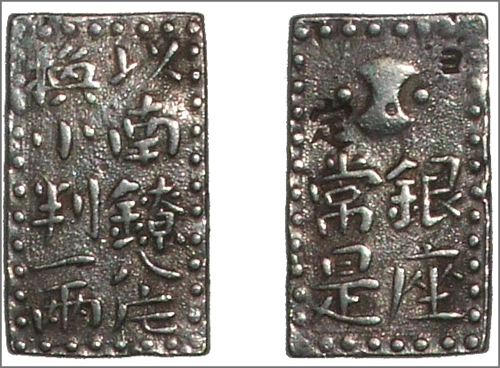


nishububan 貮朱之歩判
nishuban 貮朱判
meiwa nanryoonishugin 明和南鐐二朱銀

- quote -
In the latter half of the 18th century, the demand for small-denomination currency increased due to expanded production of commercial crops in local villages. The Tokugawa Shogunate government issued silver coins (Meiwa Nanryo Nishu-gin <2-shu-gin>) with denominations based on gold coin units. Thus, the silver coins eventually became supplementary currencies of gold coins.
Toward the end of the Edo period, recoinages (Bunsei and Tenpo recoinages) were often carried out to finance the budget deficits of the Shogunate government, which led to chronic inflation. After the re-opening of international trade at the end of the Edo period, Japan experienced a huge outflow of gold coins overseas, and the Man'en recoinage, which was carried out to stop this outflow, caused further inflation, resulting in confusion of the nation's monetary system toward the Meiji Restoration.
- source : BOJ Currency Museum -


. Coins (zeni, kozeni (銭、小銭) and Japanese money .


. kabunakama, kabu nakama 株仲間 merchant guild, merchant coalition
za 座 trade guilds, industrial guilds, artisan guilds .

Tanuma encouraged the kabunakama system in Edo.
Roju Tanuma 老中 田沼意次 - 株仲間の奨励

..............................................................................................................................................


. satoo 砂糖 History of Japanese sugar .
Tanuma
encouraged the trade of white European sugar via the merchants of Nagasaki.
He also introduced the plant satokibi , first grown at his request at a Nichiren temple, the Ikegami Honmon-Ji 池上本門寺 in the South of Edo. From there its growth spread to other suitable areas of Japan.


. koorai ninjin 高麗人参 Panax ginseng .
Tanuma
around 1760 encouraged their planting in Japan. He offered positions as "ministers" (bakushin 幕臣) to the scholars of kanpo 漢方 Chinese medicine plants.
Japanese ginseng 東洋参 (Panax japonicus)


:::::::::::::::::::::::::::::::::::::::::::::::::::::::::::::::::::::::::::::::::::::::::::::::::::::::::::::::::::::::::::::::::::::::::::::::::::::::::::::::::::::::::::::::::: 

A 狂歌 Kyoka parody poem about Tanuma

白河の 清き流れに住みかねて もとの田沼の にごり恋しき
Shirakawa no kiyoki nagare ni sumikanete moto no tanuma no nigori koishiki

River Shirakawa is shorthand for Matsudaira Sadanobu.
tanuma, lit. fields and swamps.
.
古河の清き流れに住みかねて もとの田沼ぞ今は恋しき

We can't get used to the clean flow of Shirakawa -
We rather long for the dirty puddles of fields and swamps.


- quote -
Matsudaira Sadanobu 松平定信 (1759 - 1829)
Japanese daimyo of the mid-Edo period, famous for his financial reforms which saved the Shirakawa Domain, and the similar reforms he undertook during his tenure as chief senior councilor (rōjū shuza; 老中首座) of the Tokugawa Shogunate, from 1787 to 1793.
- - - More in the WIKIPEDIA !


::::::::::::::::::::::::::::::::::::::::::::::::::::::::::::::::::::::::::::::::::::::::::::::::::::::::::::::::::::::::::::::::::::::::::::::::::::::::::::::::::::::::::::::::::


増補版 通史 田沼意次 - 2013


東日本大震災で破壊してしまった田沼家墓所
The grave of the Tanuma family has been destroyed by the Great Tohoku Earthquake in 2011.


- reference : TBS - Edo no Susume -

::::::::::::::::::::::::::::::::::::::::::::::::::::::::::::::::::::::::::::::::::::::::::::::::::::::::::::::::::::::::::::::::::::::::::::::::::::::::::::::::::::::::::::::::::


. senryuu, senryū 川柳 Senryu in Edo .

- - - - - The most famous senryu in the times of Tanuma :


役人の子はにぎにぎをよく覚え
yakunin no ko wa niginigi o yoku oboe

the son of an official
learns quite easily
to grab anything


Taking bribes became the rule of the day in the time of Tanuma.


役人の骨っぽいのは猪牙に乗せ
yakunin no honeppoi no wa choki ni nose

a serious official
is best invited
to take a choki boat trip


. choki 猪牙 / chokibune 猪牙舟 water taxi, river taxi .
to the Yoshiware pleasure quarters.
Once an official has learned to enjoy (and spent his money) at the pleasure quarters, he can be kept with more bribes to indulge more and so on . . .


::::::::::::::::::::::::::::::::::::::::::::::::::::::::::::::::::::::::::::::::::::::::::::::::::::::::::::::::::::::::::::::::::::::::::::::::::::::::::::::::::::::::::::::::::

- Reference - Japanese -

- Reference - English -

- #tanumaokitsugu -
::::::::::::::::::::::::::::::::::::::::::::::::::::::::::::::::::::::::::::::::::::::::::::::::::::::::::::::::::::::::::::::::::::::::::::::::::::::::::::::::::::::::::::::::::


Join the friends on facebook !


. - - - PERSONS - ABC - LIST of this BLOG - - - .

[ . BACK to DARUMA MUSEUM TOP . ]
[ . BACK to WORLDKIGO . TOP . ]

::::::::::::::::::::::::::::::::::::::::::::::::::::::::::::::::::::::::::::::::::::::::::::::::::::::::::::::::::::::::::::::::::::::::::::::::::::::::::::::::::::::::::::::::::

--
Posted By Gabi Greve to PERSONS - index - PERSONEN on 6/02/2015 03:11:00 p.m.

DARUMA - Jizo Pilgrims Introduction


[http://darumasan.blogspot.jp/]
[ . BACK to DARUMA MUSEUM TOP . ]
. Pilgrimages in Japan .
::::::::::::::::::::::::::::::::::::::::::::::::::::::::::::::::::::::::::::::::::::::::::::::::::::::::::::::::::::::::::::::::::::::::::::::::::::::::::::::::::::::::::::::

Pilgrimages to Jizo Bosatsu 地蔵菩薩 - 地蔵霊場 Jizo Reijo

. - Jizo Bosatsu 地蔵菩薩 Jizō - Introduction - .

Roku Jizō 六地蔵 Six Jizō
Jizō vowed to assist beings in each of the Six Realms of Desire and Karmic Rebirth, in particular those in the hell realm, and is thus often shown in groupings of six.
- source : Mark Schumacher -


The 24th day of each month is considered the Special Day for Jizo, 縁日 ennichi.

under construction
::::::::::::::::::::::::::::::::::::::::::::::::::::::::::::::::::::::::::::::::::::::::::::::::::::::::::::::::::::::::::::::::::::::::::::::::::::::::::::::::::::::::::::::


................................................... Aichi 愛知県 ..................................................

知多半島くるま六地蔵 Chita Hanto 6 Jizo

岡崎三十六地蔵 Okazaki 36 Jizo

尾張六地蔵 Owari Roku Jizo


................................................... Chiba 千葉県 ..................................................

安房白寿六地蔵 Boso Hakuju Roku Jizo

第1番 高倉山 真野寺
第2番 尾浦山 海福寺
第3番 藤林山 藤栄寺
第4番 慈眼山 耀沢寺
第5番 太子山 長福寺
第6番 長安山 東光院 石堂寺


................................................... Ehime 愛媛県 ..................................................

伊予六地蔵 Iyo Roku Jizo


................................................... Fukuoka 福岡県 ..................................................

筑前六地蔵 Chikuzen Roku Jizo

北九州六地蔵 Kita Kyushi Roku Jizo


................................................... Fukushima 福島県 ..................................................

会津二十一地蔵

................................................... Hyogo 兵庫県 ..................................................

神戸六地蔵 Kobe Roku Jizo


................................................... Kanagawa 神奈川県 ..................................................

鎌倉二十四地蔵 Kamakura 24 Jizo

Records show that the Kamakura Jizō Pilgrimage of 24 sites has existed since 1725. With the decline of Buddhism, however, the pilgrimage gradually became obsolete, especially after the Meiji Imperial Restoration of 1868. After Shintō was designated as the state religion, many of the Buddha statues were thrown away, destroyed or just disappeared.
In 1901, Jizō worshippers checked how many Jizō statues were extant and confirmed there were 24. To promote worship for Jizō, Buddhist groups reinstated this pilgrimage in the same year. Most of them are located in the city of Kamakura, but a few will be found at the outskirts of the city.
- source : Mark Schumacher -


................................................... Kyoto 京都府 ..................................................

京都六地蔵 Kyoto Roku Jizo
since 1157

第1番 法雲山 浄妙院 大善寺
第2番 恵光山 浄禅寺
第3番 久遠山 地蔵寺
第4番 常盤山 源光寺
第5番 千松山 遍照院 上善寺
第6番 柳谷山 徳林庵

.......................................................................

洛陽二十四地蔵 Rakuyo 24 Jizo


................................................... Kyushu 九州 ..................................................

in 福岡県 Fukuoa,, 佐賀県 Saga and 長崎県 Nagasaki
九州二十四地蔵 Kyushu 26 Jizo


in 長崎県・佐賀県
西海六地蔵 Saikai Roku Jizo


................................................... Mie 三重県 ..................................................

東海近畿三十五地蔵 Tokai Kinki 35 Jizo


................................................... Nara 奈良県 ..................................................

大和地蔵十福 Yamato 10 auspicious Jizo


................................................... Shimane 島根県 ..................................................

古江六地蔵 Furue Roku Jizo
since 1983, all located in 松江市 Matsue

第1番 華巌山 道栄寺
第2番 瑞應山 金剛寺
第3番 延林山 成相寺
第4番 来慶山 実西寺
第5番 起雲山 瑞龍院
第6番 金亀山 満願寺


................................................... Tokyo 東京都 ..................................................

江戸六地蔵 Edo Roku Jizo

江戸東方四十八地蔵 Edo 48 Jizo in Eastern Edo
mentioned in the Tokyo Saijiki, but now almost forgotten

江戸山の手二十八地蔵 Edo Yamanote 24 Jizo

東都六地蔵 Tokyo Roku Jizo

玉川六地蔵 Tamagawa Roku Jizo


................................................... Wakayama 和歌山県 ..................................................

東海近畿三十五地蔵 Tokai Kinik 35 Jizo


::::::::::::::::::::::::::::::::::::::::::::::::::::::::::::::::::::::::::::::::::::::::::::::::::::::::::::::::::::::::::::::::::::::::::::::::::::::::::::::::::::::::::::::

- - - - - reference - - - - -


ニッポンの霊場へようこそ - all pilgrimages of Japan
- source : nippon-reijo.jimdo.com -


::::::::::::::::::::::::::::::::::::::::::::::::::::::::::::::::::::::::::::::::::::::::::::::::::::::::::::::::::::::::::::::::::::::::::::::::::::::::::::::::::::::::::::::


. Join the Jizo Bosatsu Gallery - Facebook .


. Pilgrimages in Japan .

. O-Mamori お守り Amulets and Talismans .

. Japan - Shrines and Temples - ABC .


[ . BACK to DARUMA MUSEUM . TOP . ]
[ . BACK to WORLDKIGO . TOP . ]
- - #gokurakujizopilgrims #jizopilgrims -
::::::::::::::::::::::::::::::::::::::::::::::::::::::::::::::::::::::::::::::::::::::::::::::::::::::::::::::::::::::::::::::::::::::::::::::::::::::::::::::::::::::::::::::

--
Posted By Gabi Greve to Gokuraku - Jigoku on 6/09/2015 09:56:00 a.m.