14 Dec 2015

YAKUSHI - Yamanaka Yakushi Gifu


[ . BACK to DARUMA MUSEUM TOP . ]
. Yakushipedia - ABC-Index 薬師如来 .
::::::::::::::::::::::::::::::::::::::::::::::::::::::::::::::::::::::::::::::::::::::::::::::::::::::::::::::::::::::::::::::::::::::::::::::::::::::::::::::::::::::::::::::

Yamanaka Yakushi 山中薬師, Gifu
瑠璃山医王寺 Rurisan Io-Ji

岐阜県中津川市落合山中 1423-2 / Gifu, Nakatsu, Ochiai, Yamanaka


It is also known as
mushifuuji no Yakushi 虫封じの薬師 "Yakushi warding off the three worms".

The old buildings were lost in fire and it was reconstructed by the Jodo sect in 1544.

Visitors and pilgrims come from all parts of Japan.
The main statue of Yakushi was carved by 行基 Gyoki.

It is also known for its medicine to heal wounds, the 狐膏薬 Fox Medicine.

The main lodging of Ochiai village is run by the 本陣井口家 Iguchi family.
It is said a traveller was told the secret of the medicine by the deity 秋葉大明神 Akiba Daimyojin.


. mushifuuji 虫封じ amulets to ward off the "Three Worms" .

. Akiba Gongen 秋葉権現 the Akiba Deity .


This is one of the three great Yakushi temples of Japan 日本三薬師, besides
三河の鳳来寺 Horai-Ji in Mikawa and
. Kani Yakushi 御嵩の蟹薬師 at Ganko-Ji . - Gifu

.......................................................................


There is also a memorial stone with a haiku by Matsuo Basho in the back garden:

ume ga ka ni notto hi no deru yamaji kana
. 梅が香にのっと日の出る山路かな .

..............................................................................................................................................


- reference -

::::::::::::::::::::::::::::::::::::::::::::::::::::::::::::::::::::::::::::::::::::::::::::::::::::::::::::::::::::::::::::::::::::::::::::::::::::::::::::::::::::::::::::::

- Further Information -

中津川 Nakatsugawa was a postal station along the 中山道 Nakasendo Road. On the road toward Magome was the next station, the small hamlet of 落合 Ochiai.

山中薬師の狐膏薬伝説 Yamanaka Yakushi and the legend of the Fox Medicine

ズイトンさんの狐膏薬 The legend of Zuiton san and the Fox Medicine

Once upon a time
there lived an old monk at the temple, called ズイトンさん Zuiton san.
Once he was working in the garden when a fox appeared who looked rather painful. When he picked him up, he saw a large thorn in the leg of the fox. Zuiton san pulled it out and the fox suddenly seemed to smile at Zuiton san. Then he walked back into the mountain forest.


A few evenings later
he heard a sound at the entrance door and when he opened he saw the fox. The fox wanted to show his gratitude by teaching Zuiton san how to make good medicine cream.

まず、マムシグサの根っこのまあるい奴をすり潰す。そこへオオバコの種とキツネノマゴの葉をすり潰して混ぜる。次はモーチを入れて良く練り合わせる。それと油を布切れに塗り付けて、痛いところに張れば、たちどころに痛みが取れます.

(Other versions talk about the fox appearing in the dream of Zuiton san, teaching him.)
Zuiton san made the cream as told and put some on his back, which always hurt him. And in no time his pain was healed. Zuiton san was overjoyed.

He put up a sign 御夢想狐こうやく (Fox Medicine given in a Dream) and began to sell it. The villagers came and soon buyers from other parts of Japan showed up in a never-ending row.


In a similar legend, a fox in the disguise of a running messenger 飛脚 taught how to make the medicine, then called
Tokusan no kitsune kooyaku 徳さんの狐膏薬


source and more photos : saikoro0438/nakasendo

- reference : jimy1700 -
- reference : ja-higashimino.or.jp/book -

. kitsune densetsu 狐 伝説 fox legends .
- Introduction -

::::::::::::::::::::::::::::::::::::::::::::::::::::::::::::::::::::::::::::::::::::::::::::::::::::::::::::::::::::::::::::::::::::::::::::::::::::::::::::::::::::::::::::::

- quote -
Ochiai-juku (落合宿 Ochiai-juku) was the forty-fourth of the sixty-nine stations of the Nakasendō.


It is located in the present-day city of Nakatsugawa, Gifu Prefecture, Japan. The honjin and the sub-honjin, as well as some old street lights, remain from the Edo period. The Honjin were the main rest areas in old post towns and very few remain today.
There are ten hills that must be traversed to get to Ochiai-juku from the preceding post town of Magome-juku.
- source : wikipedia -


::::::::::::::::::::::::::::::::::::::::::::::::::::::::::::::::::::::::::::::::::::::::::::::::::::::::::::::::::::::::::::::::::::::::::::::::::::::::::::::::::::::::::::::


Join the friends on facebook !


. Yakushipedia - ABC-Index 薬師如来 .

. Yakushi Nyorai - Legends from the provinces .

. Yakushi Nyorai Pilgrimages 薬師霊場巡り - Introduction .


. O-Mamori お守り Amulets and Talismans .

. Japan - Shrines and Temples - ABC List .


[ . BACK to DARUMA MUSEUM . TOP . ]
[ . BACK to WORLDKIGO . TOP . ] - - - #yamanakayakushi #foxmedicine - - -
::::::::::::::::::::::::::::::::::::::::::::::::::::::::::::::::::::::::::::::::::::::::::::::::::::::::::::::::::::::::::::::::::::::::::::::::::::::::::::::::::::::::::::::

--
Posted By Gabi Greve to Gokuraku - Jigoku on 12/12/2015 10:15:00 am

YAKUSHI - Kani Yakushi Gifu

[ . BACK to DARUMA MUSEUM TOP . ]
. Yakushipedia - ABC-Index 薬師如来 .
::::::::::::::::::::::::::::::::::::::::::::::::::::::::::::::::::::::::::::::::::::::::::::::::::::::::::::::::::::::::::::::::::::::::::::::::::::::::::::::::::::::::::::::

Kani Yakushi 蟹薬師 "Crab Yakushi"
大寺山願興寺 Daiji San, Ganko-Ji
Mitake no Kani Yakushi 御嵩の蟹薬師

岐阜県南部,可児(かに)the district of Kani in Gifu
岐阜県可児郡御嵩町御嵩1377-1 / Mitake town

Situated on the Western Side of 御嶽宿 Mitake-Juku of the old 中山道 Nakasendo road.
The temple was first built in 713.
In 815, 伝教大師(最澄) Dengyo Daishi Saicho dedicated the statue of Yakushi.
It is also closely related to the emperor Ichijoo Tennoo 一条天皇 Ichijo Tanno, when the annual festival 蟹薬師祭礼 started
The temple was lost to fire many times in its history, but usually rebuilt in greater splendor.
A special hall for the Yakushi Statue, 薬師如来の厨子堂, was built in 1610.


- source : gankoji.sakura.ne.jp - [


The crest of the temple 願興寺の紋章
kani botan 蟹牡丹 crab and peony


- quote -
The foundation of Gankoji Temple
At the age of 36, Saicho visited China with Kukai (referred to as Kobo-taishi) as a member of Kentoshi (a mission represening Japan to China). On his return from China, he founded Enryakuji Temple (the headquarters of Tendai-shu, a faction of Buddhism) at Hieizan in north-eastern part of Kyoto. In order to carry out the Tendai-shu's tenet "relieve all the people", Saicho travelled all around Japan and finally reached Mitake via Tosando (an old passway connecting northern Japan and Kyoto). At that time the area surrounding Mitake was suffering from epidemic, so he built a fuseya, leaving a hand-made sculpture of Yakushi-Nyorai and said his prayer for the residents' recovery.

Building of Shichido-Garan
There was a very clever girl who was a daughter of Emperor Ichijyo. She boasted about her own ability but the Emperor was uncomfortable with her attitude and drove her out of Kyoto. She started travelling along the Tosando , but during her trip she became exhausted and much thinner than before. It was already winter when she arrived in Nakamura village (currently called Naka district in Mitake-cho) in her ragged clothes. She built an hermitage with the help of neighbors in the village and began to live there. She shaved her hair and became a nun named Gyouchini, praying for Yakushi-Nyorai every day.
At that time, a line of light began to appear every night from a pond at the foot from the mountain in the south of the village. Fierce wind blew, waves in the pond and a roar of mountain went accompanied the light. Gyouchi went close to the bank of the pond in the evening and found the pond had flooded and the entire village was under water with people almost drowned. Gyouchi counted her beads and kept praying, gazing the pond. Then an enormous 30-meter-long, big snake suddenly appeared and tried to swallow her.
Despite the snake's appearance, Gyouchi just kept praying for Yakushi Nyorai without any fear. After a while the wind and wave stopped, and a small 6-centimeters-long image of Buddha surrounded by small crabs appeared in front of her. Inspired by this development, Gyouchi said her prayer for the image and enshrined it in her hermitage. On hearing the whole story, the Emperor Ichijyo issued a permission to build a sanctum there. This led to the establishment of a magnificent Shichido-Garan style temple in 998 named "Oterasan-Gankoji".

Gankoji, burnt down twice by wars
Gankoji was burnt down in 1108 (the first year of Tenjin Era) during a rebellion led by Yoshitsugu Minamoto. At that time the image of Yakushi-Nyorai was moved to and enshrined at a shrine in Tsushima, Aichi Prefecture. After a while, the Yakushi-Do (a hall to enshrine Yakushi-Nyorai) was rebuilt in the premises of Gankoji. 100 years later, Koketsu Gengo Yasumori (in his capacity as Jito, an administrator of the Mitake area from the central government) re-constructed the rest of Gankoji. In 1572, in the midst of the battle between Takeda and Oda, a servant of Shingen Takeda set fire to Gankoji and burnt it down. As valuable images of Buddha and scriptures were kept ivied Gankoji, a number of monks of Gukeiji temple rushed into Gankoji and carried them out of the temple. Thanks to their work, all the images and 600 sets of scriptures remained intact. The images were kept in a temporary hall in the premises of Gukeiji for a while.

Building of the present hall
Shingen Takeda, an enthusiastic believer of Tendai-shu, expressed his strong anger with his staff for setting fire to the Gankoji. It is believed that he gave residents in Mitake area his promise to rebuild the temple. However, Shingen died before undertaking the restoration. 10 years later, led by Yojiro Tamaki, residents in the area began to rebuild Gankoji by themselves. Not only did they collect a fund from neighboring temples and shrines, but also brought wooden boards and pillars voluntarily. The restoration was completed in 1582 (the 9th year of Tensho Era).
One feature of the present hall is its wide corridors. This shows the residents' thoughtful consideration in order for travelers to avoid rain during the night. The other is that the humble style of the back of the hall compared to the front. It shows that the residents tried hard to rebuild the hall within their financial constraints.
In the concert on the 23rd November 2006 held during the event "Nakasendo Walk", Mr. Bincho Tanaka, a teacher of Gagaku both in Japan and all over the world played a whistle. In the concert which took place at Gankoji, some attendees would have felt eternal history as in the air the Emperor Ichijyo was known as an expert of whistle.
- source : gankoji.sakura.ne.jp -


. Dengyo Daishi Saicho 伝教大師最澄 .
(766 - 822)

..............................................................................................................................................


- Homepage of the temple
- source : gankoji.sakura.ne.jp

..............................................................................................................................................

- Yearly Festivals -


CLICK for more photos !

The origin of the Gankoji Festival 蟹薬師祭礼
The Gankoji Festival is originated in 999 (the 5th year of Chotoku Era), when the Shichido-Garan style temple was completed. Since then, ceremonies such as Daiji-Hyoshi, Shishi-mai and Hae-oi have been held part of the festival. Among them, Hae-oi was an important ceremony to drive off something unclean, given that could an epidemic, which was a matter of life and death at that time.
It is believed that the mask used in the Hae-oi ceremony was created by Gyouchi. There were two types of heads of Shishi (an item used in Shishi-mai lion-head ceremony), one was male and the other was female. When the male one was used, clothes and a mask for a male were used in the Hae-oi ceremony and vice versa.

願興寺月例祭事 - every month
8日 薬師縁日  (焚き上げ・法話)
18日 観音縁日  (説法)
24日 地蔵縁日  (水子供養)
28日 不動明王縁日(安全祈願)

願興寺年間祭事と行事
4月第1日  蟹薬師祭礼 The main Festival in April
8月第1土曜 竹筒の燈明
大晦日    竹筒の燈明

::::::::::::::::::::::::::::::::::::::::::::::::::::::::::::::::::::::::::::::::::::::::::::::::::::::::::::::::::::::::::::::::::::::::::::::::::::::::::::::::::::::::::::::


- quote
STATUE OF KANI YAKUSHI
Daianji, Nara City, Japan


This statue was dedicated to the temple by a medical doctor to pray for confining cancer. Both words of KANI in Japanese and cancer in astronomy in English share a common meaning, that is, crab. In view of such a relationship, the doctor wanted to have this statue created for dedication.
- source : nara-heritage-online.naist.jp

::::::::::::::::::::::::::::::::::::::::::::::::::::::::::::::::::::::::::::::::::::::::::::::::::::::::::::::::::::::::::::::::::::::::::::::::::::::::::::::::::::::::::::::

- Further Information -

Yamanaka Yakushi is one of the three great Yakushi temples of Japan 日本三薬師,
besides
三河の鳳来寺 Horai-Ji in Mikawa and Kani Yakushi 御嵩の蟹薬師 at 願興寺 Ganko-Ji.
. Yamanaka Yakushi 山中薬師 .

::::::::::::::::::::::::::::::::::::::::::::::::::::::::::::::::::::::::::::::::::::::::::::::::::::::::::::::::::::::::::::::::::::::::::::::::::::::::::::::::::::::::::::::


Join the friends on facebook !


. Yakushipedia - ABC-Index 薬師如来 .

. Yakushi Nyorai - Legends from the provinces .

. Yakushi Nyorai Pilgrimages 薬師霊場巡り - Introduction .


. O-Mamori お守り Amulets and Talismans .

. Japan - Shrines and Temples - ABC List .


[ . BACK to DARUMA MUSEUM . TOP . ]
[ . BACK to WORLDKIGO . TOP . ] - - - #kaniyakushi #crabyakushi #canceryakushi - - -
::::::::::::::::::::::::::::::::::::::::::::::::::::::::::::::::::::::::::::::::::::::::::::::::::::::::::::::::::::::::::::::::::::::::::::::::::::::::::::::::::::::::::::::

--
Posted By Gabi Greve to Gokuraku - Jigoku on 12/12/2015 01:07:00 pm

MINGEI - kaki persimmon art motives


[ . BACK to DARUMA MUSEUM TOP . ]
:::::::::::::::::::::::::::::::::::::::::::::::::::::::::::::::::::::::::::::::::::::::::::::::::::::::::::::::::::::::::::::::::::::::::::::::::::::::::::::::::::::::::::

kaki 柿 persimmon art motives

. WKD : kaki 柿 persimmon - Diospyros kaki - Sharon Fruit .
Rakushisha 落柿舎 "Hermitage of the fallen persimmon" and Matsuo Basho


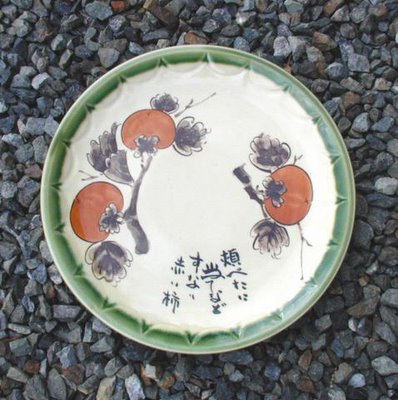
Kaki-Plate by Gabi Greve

. WASHOKU - food with persimmons .
There are more than 1000 different kinds of KAKI in Japan.
渋柿と甘柿 shibugaki and amagaki, bitter and sweet kaki.
hoshigaki 干し柿 dried persimmons

..............................................................................................................................................

kakishibu 柿渋(かきしぶ)"persimmon dye"


quote
Calling kakishibu a "dye" is a bit of a misnomer.
Made from the fermented juice of unripe astringent persimmons, the color comes from the tannin molecules linking together and forming a coating. More than a coloring agent, kakishibu also has strengthening, antibacterial and waterproofing properties. Kakishibu was used in China and Korea, but reached its ultimate utilization in Japan. It was used as a wood preservative, waterproofer, insect repellent, folk medicine, and on washi (Japanese paper), fans, parasols, clothing and in sake production.

MORE
- source : 2006 Kakishibui -


under construction
:::::::::::::::::::::::::::::::::::::::::::::::::::::::::::::::::::::::::::::::::::::::::::::::::::::::::::::::::::::::::::::::::::::::::::::::::::::::::::::::::::::::::::

. hariko 張子 papermachee dolls .


kakinori saru 柿乗り猿 monkey on a persimmon

CLICK for more samples !


:::::::::::::::::::::::::::::::::::::::::::::::::::::::::::::::::::::::::::::::::::::::::::::::::::::::::::::::::::::::::::::::::::::::::::::::::::::::::::::::::::::::::::


. tsuchi ningyoo 土人形 tsuchiningyo clay dolls .


CLICK for more samples !


:::::::::::::::::::::::::::::::::::::::::::::::::::::::::::::::::::::::::::::::::::::::::::::::::::::::::::::::::::::::::::::::::::::::::::::::::::::::::::::::::::::::::::


. dorei どれい / 土鈴 clay bells .


CLICK for more samples !

:::::::::::::::::::::::::::::::::::::::::::::::::::::::::::::::::::::::::::::::::::::::::::::::::::::::::::::::::::::::::::::::::::::::::::::::::::::::::::::::::::::::::::


. maneki neko, manekineko 招き猫 beckoning cat .


CLICK for more samples !


:::::::::::::::::::::::::::::::::::::::::::::::::::::::::::::::::::::::::::::::::::::::::::::::::::::::::::::::::::::::::::::::::::::::::::::::::::::::::::::::::::::::::::

. tsurushibina つるし雛 / 吊るし雛 small hanging hina dolls .


CLICK for more samples !


:::::::::::::::::::::::::::::::::::::::::::::::::::::::::::::::::::::::::::::::::::::::::::::::::::::::::::::::::::::::::::::::::::::::::::::::::::::::::::::::::::::::::::

More art motives


. Six Persimmons by Mu Chi .


..............................................................................................................................................


source : izucul.cocolog-nifty.com

kaki and autumn moon - 柿に月図'
Suzuki Ki-Itsu - 鈴木其一


:::::::::::::::::::::::::::::::::::::::::::::::::::::::::::::::::::::::::::::::::::::::::::::::::::::::::::::::::::::::::::::::::::::::::::::::::::::::::::::::::::::::::::

- ABC - List of persimmon art motives from the Prefectures

..............................................................................................................................................
. . . . . . . . . . Shizuoka

. kakinori saru 柿乗り猿 monkey on a persimmon .
(see hariko, above)


:::::::::::::::::::::::::::::::::::::::::::::::::::::::::::::::::::::::::::::::::::::::::::::::::::::::::::::::::::::::::::::::::::::::::::::::::::::::::::::::::::::::::::

- Legends about persimmons from the Prefectures

. Legends and Tales from Japan 伝説 - Introduction .
- Introduction -

..............................................................................................................................................
. . . . . . . . . . Toyama

三日市

親鸞聖人は、立ち寄った家で串柿を食した。その種を三つ植えると、一夜にして芽を出した。それを三本柿と呼び、その地を柿木町とした。木を切ってしまった人は、お叱りをうけた。今では柿の木は芽生であるが、その木と徳法寺の柿の種には、全て焼いたような黒い斑点がある。

.......................................................................

yokai database - reference
- source : www.nichibun.ac.jp -
133 (01)

:::::::::::::::::::::::::::::::::::::::::::::::::::::::::::::::::::::::::::::::::::::::::::::::::::::::::::::::::::::::::::::::::::::::::::::::::::::::::::::::::::::::::::


persimmon tree -
Hiroshige hangs
in the branches


© Gabi Greve


:::::::::::::::::::::::::::::::::::::::::::::::::::::::::::::::::::::::::::::::::::::::::::::::::::::::::::::::::::::::::::::::::::::::::::::::::::::::::::::::::::::::::::


. Join the MINGEI group on facebook ! .  


. Regional Folk Toys from Japan .

. Japan - Shrines and Temples .


. Tohoku after the BIG earthquake March 11, 2011

[ . BACK to WORLDKIGO . TOP . ]
[ . BACK to DARUMA MUSEUM TOP . ]
- #kaki #persimmon #kakipersimmon -
:::::::::::::::::::::::::::::::::::::::::::::::::::::::::::::::::::::::::::::::::::::::::::::::::::::::::::::::::::::::::::::::::::::::::::::::::::::::::::::::::::::::::::

--
Posted By Gabi Greve to Omamori - Japanese Amulets on 12/08/2015 09:27:00 am

MINGEI - tako kites from Shizuoka


[ . BACK to DARUMA MUSEUM TOP . ]
. Shizuoka Folk Art - 静岡県  .
:::::::::::::::::::::::::::::::::::::::::::::::::::::::::::::::::::::::::::::::::::::::::::::::::::::::::::::::::::::::::::::::::::::::::::::::::::::::::::::::::::::::::::

Shizuoka no tako 静岡の凧 Kites from Shizuoka


. tako 凧 Kites of Japan .
- Introduction -

:::::::::::::::::::::::::::::::::::::::::::::::::::::::::::::::::::::::::::::::::::::::::::::::::::::::::::::::::::::::::::::::::::::::::::::::::::::::::::::::::::::::::::

Fukuroi 袋井

Fukuroi no marudako 袋井の丸凧 round kite from Fukuroi


With a painting of the 53 stations of the Tokaido.


..................................................................................................................................................................
Hamamatsu tako 浜松凧 kite from Hamamatsu

Hamamatsu is famous for its rokkakudako 六角凧 Rokkaku hexagon-shaped kites.


Hamamatsu has a great kite festival with more than 2 million onlookers.
Its kites show a machijirushi. Machi means town and Jirushi means symbol. This type of kite is a kind of symbol of a town.

- quote -
Hamamatsu Festival
A spectacular festival of some 100 large kites flying over sand dunes.

More than 100 kites are flown in the sky over the Nakatajima Dunes, one of the three largest sand dunes in Japan, which overlooks the Enshunada Sea. Here you can see many large kites measuring 3.5 meters by 3.5 meters. Then to the sound of the trumpet, the fighting starts. Making the 5-mm thick hemp strings intertwine, the kite-fliers try to cut their opponents' strings by friction, which is very exciting to watch. The strings burn, giving off a scorched smell. You can try flying a kite yourself in the grounds adjoining the shuttle bus terminal. Don't miss this opportunity of experiencing the actual sensation of flying a kite high in the sky.

This festival dates back to the 16th Century when large kites were flown in celebration of the birth of a baby son to the Lord of Hamamatsu Castle. Even today, kites are flown at Hamamatsu when a baby boy is born, a custom known as hatsudako. On May 5th, a festive day to pray for boys' good health and a bright future, it is the custom in Japan to fly decorations called koinobori, which are carp-shaped streamers. Carp are known to swim up waterfalls and this powerful image of the carp overlaps with the image of advancing in one's career. In Hamamatsu City, koinobori are displayed in a grand style, with the carp streamers flying on wooden poles as tall as 10 meters.
- source : jnto.go.jp/eng -

..................................................................................................................................................................
井川 Ikawa - a village located in Abe District

Ikawa no ogi tako 井川の扇凧 handfan kite from Ikawa


- More photos of local kites
- source : yahoo.co.jp/yonechan5088 -


..................................................................................................................................................................
Mori village 周智郡森町 Mori

bukadako, buka tako ぶか凧 Buka fighting kite
Mori no bukadako, tako 森のぶか凧 Buka kite from Mori village

From Sejiri in the the Terao district 瀬尻の寺尾地区, a region in the moutains with many slopes, so it needs a lot of skill to fly it. Made for the birth of a baby boy since the late Edo period. Some are mroe than 20 Tatami mats in size and the string can be up to 600 meters.
As a symbol for long life many are decorated with a crane and turtle (tsurukame 鶴や亀).


A rectangular kite for fighting festivals. It has two bridles and has no tail.
source - BUKA


..................................................................................................................................................................
Ooikawa town 大井川町 Oikawa

Munadaka tako 宗高凧 kite from Munadaka village


..................................................................................................................................................................
相良 Sagara

Sagaradako 相良凧 kite from Sagara town


Sagara kites were introduced in the early eighteen century. It is made for the Boy's festival on May 5 and comes in various patterns, even Daruma san.
This kite has two bridles and no tail and a kind of fighting kite.


source - SAGARA

..................................................................................................................................................................
Surugadako, Suruga tako 駿河凧 kite from Suruga


Ushiwakamaru 牛若丸

This dates back to the local regent Imagawa Yoshimoto, who flew this kite over his Suruga castle.
. Imagawa Yoshimoto 今川義元 (1519 – 1560) .

Bboth sides of the kite have a branchia. This kite can be build from square paper sheet without any idle by cutting.
- source : reference -


..................................................................................................................................................................
Toyooka village 豊岡村 Toyooka

Hirosedako, tako 広瀬凧 kite from Hirose store
Made by the kite store Hirose 広瀬タコヤ since 1892.
伊藤篤男 is now in the 3rd generation.
One sample of his collection is the

gunjindako 軍人凧 kite with a soldier
It evolved from kites for the Boy's festival with Samurai faces.


3代目の伊藤篤男(75)さんによれば、「伝統と言ってもなぁ、子供の頃からずっと見てきたことを続けてるんだよ。」と言う裏側には114年の歴史の重みを感じます。ここでは軍人凧をはじめ武者凧などさまざまな種類の凧を製作しています。広瀬凧と軍人凧、そして日露戦争で軍神第1号となった広瀬中佐との関係を聞くと、「よく言われるよ。広瀬製と書いてあるように、広瀬村の製作ということで、関係ないんだよ。」とのこと。凧の注文は、と問うと「子供が少なくなって注文も少なくなったよ。遠くから注文もあるけど、昔ほどはなぁ。」と寂しげ。
浜松の凧揚げもいいですが、やはり、初節句の磐田の空では磐田の凧へ発展を遂げた広瀬の凧を多く見たいものです。
- source : city.iwata.shizuoka.jp -

..................................................................................................................................................................
Yaizu town 焼津市 Yaizu

Yaizu is a busy fishing port.


- source : www.asahi-net.or.jp

Yaizu sakana tako 焼津魚凧 fish kite
maguro tako まぐろ凧 Bonito kite


..................................................................................................................................................................
遠州横須賀 Yokosuka district

Yokosukadako 横須賀凧 Kite from Yokosuka
Toward the end of the Edo period, the local lord supported the making of kites and had his craftsmen go as far as Nagasaki to learn about it. Now the craft has reclined and only one shop in town makes them, 柳瀬提灯店 Yanase Chochin-Ten, in the fourth generation, beside of making paper lanterns as the main business..


Tongari とんがり


They come in many forms:
とんがり tongari / べっかこう bekkakoo / やつ花 yatsubana / 巴(ともえ)tomoe / 庄助奴 Yakko names Shosuke
noshi のし gratulation paper / semi せみ cicada / tonbi とんび/ 鳶 Tombi kite / toogire (tookire) 頭ぎれ "without a head" / beka べか


bekkakoo べっかこう Bekkako
The eyes of are painted with silver color and have a rotating mechanism when the wind blows.
The tongue is sticking out.


yatsubana やつ花 "flower with six corners"


tomoe 巴(ともえ)Tomoe pattern


shoosuke yakko 庄助奴凧 Yakko names Shosuke


There is also a kite festival
「遠州横須賀凧揚げまつり」 Enshu Yokosuka Tako-age Matsuri

- Look at them all here:
- source : chigumi/yokosuka -
- images tba -


ashinagayakkodako, ashinaga yakko 足長奴凧 kite with a "long-legged Yakko"


This kite is a kind of Yakko and it has long legs which act as a stabilizer or tail for balance. "Ashi" means 'legs' , "Naga" means 'long' and "Yakko" means 'a servant' in ancient era. Many kinds of Yakko-dako are produced in in Shizuoka prefecture.
- source - ASHINAGAYAKKO


. yakkodako, yakko tako 奴凧 kite with a Yakko .
- Introduction -

..................................................................................................................................................................
吉田 Yoshida

Sumiyoshidako 住吉凧 kites from Yoshida - Sumiyoshi


Nasu no Yoichi 那須与一 (c. 1169 – c. 1232) Samurai


SUMIYOSHI-dako has been handed down over 500 years ago. They are very colorful and have patterns of historical figures on a simple square.
This kite was used as a signal in war time.

- Look at them all here:
source - SUMIYOSHI

:::::::::::::::::::::::::::::::::::::::::::::::::::::::::::::::::::::::::::::::::::::::::::::::::::::::::::::::::::::::::::::::::::::::::::::::::::::::::::::::::::::::::::

- - - - - further reference - - - - -


- source : yahoo.co.jp/yonechan5088 -

.......................................................................

. gangu 玩具 伝説, omochcha おもちゃ  toy, toys and legends .
- Introduction -


. Legends and Tales from Japan 伝説 - Introduction .

- - - #kitesshizuoka #shizuokakites - - - - -
:::::::::::::::::::::::::::::::::::::::::::::::::::::::::::::::::::::::::::::::::::::::::::::::::::::::::::::::::::::::::::::::::::::::::::::::::::::::::::::::::::::::::::


. Join the MINGEI group on facebook ! .  


. Regional Folk Toys from Japan - List .

. Japan - Shrines and Temples .


. Tohoku after the BIG earthquake March 11, 2011

[ . BACK to WORLDKIGO . TOP . ]
[ . BACK to DARUMA MUSEUM TOP . ]

:::::::::::::::::::::::::::::::::::::::::::::::::::::::::::::::::::::::::::::::::::::::::::::::::::::::::::::::::::::::::::::::::::::::::::::::::::::::::::::::::::::::::::

--
Posted By Gabi Greve to Omamori - Japanese Amulets on 12/04/2015 02:27:00 p.m.

PERSON - Yuzuru Hanyu and Nomura Mansai

http://omamorifromjapan.blogspot.jp/2011/06/abe-no-seimei.html

:::::::::::::::::::::::::::::::::::::::::::::::::::::::::::::::::::::::::::::::::::::::::::::::::::::::::::::::::::::::::::::::::::::::::::::::::::::::::::::::::::::::::::

Onmyooji 陰陽師 Onmyoji


- quote -
Onmyouji (陰陽師) is a Japanese movie
that was released in 2001 and sent to the US in 2004. Directed by Yōjirō Takita, it tells of the exploits of Abe no Seimei, in Middle Ages, the Onmyouji (also known as: The Yin Yang Master) from the court of the Emperor. He befriended bungling court noble, Minamoto no Hiromasa, who enlists his aid to defend the Heian emperor. Meanwhile, an opposing onmyoji Doson is plotting the downfall of the emperor, while attempting to frame Seimei by unleashing a horde of yōkai to do his bidding.
Mansai Nomura Mansai 野村萬斎 - Abe no Seimei

Nomura Mansai II / 二世 野村 萬斎 Nisei Nomura Mansai
born April 5, 1966 under the name Takeshi Nomura (野村 武司 Nomura Takeshi)), is a well known Kyogen stage actor, and film actor. He played Abe no seimei in Onmyoji and Onmyoji 2, an original work by Baku Yumemakura. He received the Best Actor prize at the Blue Ribbon Awards for his work in Onmyoji.
- - - More in the WIKIPEDIA !

Nomura Mansai had an interview with the upcoming figure skater Hanyu Yuzuru Hanyu, who uses the music of the movie Seimei for his performance.
Mansai showed him how to act his feelings . . . and much more in a memorable TV interview.
Later Yuzuru improved his style a lot and made it to the top in December 2015.


Yuzuru visiting Seimei Jinja on July 2.

Yuzuru Hanyu . Hanyuu 羽生結弦 Hanyū Yuzuru
(born 7 December 1994) is a Japanese figure skater who competes in the men's singles discipline.
- snip -
2015–16 season
For the 2015–16 season, Hanyu decided to expand on his performing scale and skate to a Japanese-themed free skating with music from the film soundtrack of Onmyoji where he would try portraying 10th century astronomer, Abe no Seimei. He also met up with Mansai Nomura, the actor who portrayed Seimei in the film to get advice on how to portray him.
At the 2015 NHK Trophy, Yuzuru Hanyu placed first in the short program with a world record score of 106.33.
At the 2015–16 Grand Prix Final in Barcelona, Hanyu broke his short program record, totaling a score of 110.95 points.
- - - More in the WIKIPEDIA !


:::::::::::::::::::::::::::::::::::::::::::::::::::::::::::::::::::::::::::::::::::::::::::::::::::::::::::::::::::::::::::::::::::::::::::::::::::::::::::::::::::::::::::  

[ . BACK to WORLDKIGO . TOP . ]
[ . BACK to DARUMA MUSEUM TOP . ]
- #abenoseimei #onmyoji #nomuramansai -
:::::::::::::::::::::::::::::::::::::::::::::::::::::::::::::::::::::::::::::::::::::::::::::::::::::::::::::::::::::::::::::::::::::::::::::::::::::::::::::::::::::::::::  

13 Dec 2015

MINGEI - kani botan and other kamon crests

http://darumasan.blogspot.jp/2011/01/kamon-family-crest.html

Family Crest 家紋 kamon

:::::::::::::::::::::::::::::::::::::::::::::::::::::::::::::::::::::::::::::::::::::::::::::::::::::::


CLICK for more photos !

kani botan, kani-botan 蟹牡丹 crab and peony
A crest where the blossoms and leaves of a peony are formed in a way to represent a crab.
It was often used for cloths and carpets.


. Kani Yakushi 蟹薬師 "Crab Yakushi" Temple .
Ochiai, Gifu


Sendai Botan 蟹牡丹(仙台牡丹)- Date clan
牡丹紋は延宝8年(1680)20世綱村が近衛家ら拝領、21世吉村は手を加えて蟹牡丹(仙台牡丹)としている。


鍋島緞通 carpet from Nabeshima
蟹牡丹唐草文


Carpet with kani botan pattern.
- source : bunka.nii.ac.jp/heritages -

.......................................................................


source : cocomiura3.cocolog-nifty.com
色絵牡丹文変形皿 kanibotan pattern - Nabeshima
鍋島  
左右の葉が中央の牡丹の花を抱き込むように描かれています
蟹の姿を思わせるので"蟹牡丹"と呼ばれるそうです

:::::::::::::::::::::::::::::::::::::::::::::::::::::::::::::::::::::::::::::::::::::::::::::::::::::::::::::::::::::::::::

. Legends and Tales from Japan 伝説 - Introduction .

kamon 家紋 family crest

If people fought about the parents of a child, in former times, they used to wash the 胞衣placenta in water and when it floated up, the proper Kamon would show.

.......................................................................
愛知県 Aichi 岩倉町 Iwakura

daija 大蛇 big serpent
じいさんが神社の裏を通りかかったとき、大蛇が這っていくのにでくわした。鳥肌が立って、3年間はこのことを口外しないので行ってくれと言うと、大蛇は 去った。その大蛇は尾が切れていて、先のところに丸に太いと書いた文字がついていた。その字は神明様の御神紋だったので、大蛇は神明様のお使いと分かっ た。


.......................................................................
青森県 Aomori 大間町 Oma

hotoke no zaisho ホトケの罪障 Buddhist attonement for sins
Once a man about 38 years of age came to the temple asking what to do. He felt very weak and could not go to work any more. After some explanation this became clear:
In former times at this fisherman's home a dead body got caught in the net. The family had taken care of it in a funeral, but since the family crest was different, the man's sould could not go to the Buddhist paradise. So they performed a special ritual and he was healed.

.......................................................................
愛媛県 Ehime 成妙村 Narutaemura

shirohebi 白蛇 white serpent
昔、太宰家で紋付を出そうとしたが、櫃がどうしても開かない。櫃を叩き壊すと白蛇がいたので殺した。それからは、生まれる子みなに三つ鱗がついていた。太夫さんに祈祷してもらい怪異はやんだが、それから紋所を三つ鱗にした。

.......................................................................
岐阜県 Gifu 池田町 Ikeda

yamanba 山姥 old woman in a mountain
山姥の危急を救ってやった男がいた。染物屋が紋付の着物を男のところにもってきたが覚えが無い。家紋に間違いが無いので受け取ったが、後日なくなっていた。山姥が持ち去ったのだといわれた。

.......................................................................
神奈川県 Kanagawa 小田原市 Odawara

hato 鳩 dove
小田原侯の御先手頭である山本源八郎の家紋は鳥居に鳩であるが、吉事がある前には鳩が集まるという。元は新御番という役目だったが、鳩が家に入ってくる度に出世していったという。

.......................................................................
鹿児島県 Kagoshima 伊佐郡 Isa district

Garappa, the Kappa ガラッパ / 河童
If people wear a robe with a family crest, put up a candle and look through the long sleeve of the kimono, they could see a Garappa.
.


Gataro ガタロ Kappa
If people went swimming in the river during the 祇園さん(天王さん Gion Festival, the Gataro would pull them in the water, so swimming was not allowed during that time.
The Shrine crest of the Gion shrine was a cucumber cut in slices, a favorite food of the Kappa. So during that festival people were not allowed to eat cucumbers.


祇園さんの神紋 Gion Shrine Crest

. Kappa Legends from Kyushu  河童伝説 - 九州 .

.......................................................................
宮城県 Miyagi 東松島市 Higashi Matsushima

kitsune 狐 the fox
Once upon a time
at a place called Ipponsugi 一本杉 (one cedar tree) a fox used to come out clad as a human in a 紋付羽織 haori coat with a family crest.

.......................................................................
島根県 Shimane 鹿島町 Kashima

ryuuja 竜蛇 dragon-serpent and shinmon 神紋 Shrine crest
佐太神社の西北にある恵曇(えとも)湾のイザナギ浜で竜蛇が上がった。板橋という社人が竜蛇上げを職掌としていた。今は恵曇や島根半島の漁師が9月末から 11月にかけて沖合であげることが多い。竜蛇はサンダワラに神馬藻を敷いた上に乗せ、床の間に飾り、祝いをしたあと、佐太神社に奉納する。大きさは1尺2 寸前後、背が黒く、原は黄色を帯びている。尾部に扇模様の神紋が見えると言われている。大漁、商売繁盛、火難・水難除けの守護神と信じられている。
.
神在祭の「お忌みさん」期間中、「お忌み荒れ」と言って海が非常に荒れる時がある。翌朝、1尺から1丈ほどの竜蛇が海岸に打ち上げられる。見つけた者は神社に奉納などする。竜蛇は竜宮からの使令で背には神紋があり、上がると豊年・豊漁だとされる。

.......................................................................

- source : nichibun yokai database -

:::::::::::::::::::::::::::::::::::::::::::::::::::::::::::::::::::::::::::::::::::::::::::::::::::::::::::::::::::::::::::

[ . BACK to DARUMA MUSEUM TOP . ]
[ . BACK to WORLDKIGO . TOP . ]
- #tomoe #familycrest #kanibotan -
:::::::::::::::::::::::::::::::::::::::::::::::::::::::::::::::::::::::::::::::::::::::::::::::::::::::::::::::::::::::::::