22 Apr 2016

PERSONS - - Chosokabe Motochika


[ . BACK to DARUMA MUSEUM TOP . ]
. - - - PERSONS - ABC - LIST of this BLOG - - - .
::::::::::::::::::::::::::::::::::::::::::::::::::::::::::::::::::::::::::::::::::::::::::::::::::::::::::::::::::::::::::::::::::::::::::::::::::::::::::::::::::::::::::::::::

Choosokabe - Chōsokabe Motochika 長宗我部元親 Chosokabe Motochika
(1539 - 1599)


- quote
..... a Sengoku period daimyo in Japan.
He was the 21st chief of the Chōsokabe clan of Tosa Province (present-day Kōchi Prefecture). He was the son and heir of Chōsokabe Kunichika and his mother was a daughter of the Saitō clan of Mino Province.
In the 1562 Battle of Asakura 朝倉
Chosakabe Motochika defeated Motoyama Shigetoki and gained control of Shikoku Island. He then went on to take Aki Castle in the 1569 Siege of Aki.
In 1575,
Motochika was victorious at the Battle of Watarigawa 渡川, gaining control of Tosa Province. Over the ensuing decade, he extended his power to all of Shikoku. However, in 1585, Hashiba (later Toyotomi) Hideyoshi invaded that island with a force of 100,000 men, led by Ukita Hideie, Kobayakawa Takakage, Kikkawa Motonaga, Hashiba Hidenaga, and Hashiba Hidetsugu. Motochika surrendered, and forfeited Awa, Sanuki, and Iyo Provinces; Hideyoshi permitted him to retain Tosa.
Under Hideyoshi,
Motochika and his son Nobuchika participated in the invasion of neighboring Kyūshū, in which Nobuchika died. In 1590, Motochika led a fleet in the Siege of Odawara, and also fought in the Japanese invasions of Korea in 1592.
Motochika died in 1599
at age 61 at his mansion in Fushimi. His successor was Chōsokabe Morichika.
© More in the WIKIPEDIA !


- quote -
Daimyô of the Chosokabe family and eventual vassal to Toyotomi Hideyoshi, Motochika rose to rule Tosa and, for a short time, the whole of Shikoku. The Chosokabe were respected Jito (deputy administrators) of Tosa from the 12th century and entered the 16th Century as vassals of the Ichijô Clan, who were based in western Tosa.
- snip -
Unification of Shikoku

Following his conquest of Tosa, Motochika turned north and prepared for an invasion of Iyo. The lord of that province was Kôno Michinao, a daimyo who had once been driven from his domain by the Utsunomiya clan, returning only with the assistance of the powerful Môri. It was unlikely that Kôno could count on that sort of help again, however-presently the Môri were embroiled in a war with Oda Nobunaga. Nonetheless, Chosokabe's campaign in Iyo did not go off without a hitch. In 1579, a 7,000-man Chosokabe army, commanded by Hisatake Chikanobu, attacked the strongest fortress in Southern Iyo, Okayama castle, held by Doi Kiyoyoshi. During the ensuing siege of Okayama castle, Chikanobu was shot and killed by an arquebus and his army defeated, though the loss proved little more than an unfortunate delay. The next year, Motochika led some 30,000 men into Iyo, and forced Kôno to flee to Bungo province. With little interference from either the Môri or the Ôtomo, Chosokabe was free to press onwards, and in 1582 he stepped up ongoing raids into Awa and defeated the Sogo clan. By 1583, Chosokabe troops had subdued both Awa and Sanuki, making Motochika's dream of ruling all of Shikoku a reality.
Sometime around 1579,
Motochika entered into communication with Nobunaga, whom he fancied an ally. For his part, Nobunaga appears to have humored Motochika, though in private he referred to him as 'a bat on a birdless island' and planned to take Shikoku at some point (in fact naming his son Nobutada commander of the future invasion). This was averted by Nobunaga's death in 1582, and Motochika, whether he was aware of it or not, was given a new lease on life. By now he was something of a national power and became involved in the struggle between Toyotomi Hideyoshi and Tokugawa Ieyasu the following year. He promised the latter support, though made no direct moves to that end. Hideyoshi, to make sure, sent Sengoku Hidehisa (1551-1614) to block any efforts on Motochika's part, though these troops seem to have been roughly treated by the Lord of Shikoku upon arrival on the island. The so-called Komaki Campaign between Hideyoshi and Ieyasu ended in a peace treaty, which bode ill for Chosokabe.
In May 1584 Hideyoshi ordered a full-scale invasion of Shikoku, spear headed by 30,000 troops from the Môri clan and 60,000 more under Hashiba Hidenaga. Evidently, the late Nobunaga's assessment of the Chosokabe was accurate enough, for the invaders found a small army with such equipment as was available in poor condition. After desultory resistance, Motochika expressed a desire to negotiate. Hideyoshi's terms were generous. Motochika would get to keep his head and his hard-earned province of Tosa, an offer Motochika did not feel inclined to refuse.
- snip -
Leadership
In addition to his leadership, Motochika is remembered for his 100-Article Code of the Chosokabe and his struggle to found an economically strong castle town, moving in the course of his career from Oko to Otazaka and on to Urado.
- snip -
The Chosokabe were served by the Kosokabe, Kira (both of whom were led in Motochika's time by his brothers), Yoshida, Kumu, Kagawa (into which Motochika adopted a son, Chikakazu), Yumioka, and others.
- source : wiki.samurai-archives.com-

::::::::::::::::::::::::::::::::::::::::::::::::::::::::::::::::::::::::::::::::::::::::::::::::::::::::::::::::::::::::::::::::::::::::::::::::::::::::::::::::::::::::::::::::

Chōsokabe Nobuchika 長宗我部信親 Chosokabe Nobuchika
(1565 – January 1, 1587)
was the eldest son of samurai lord Chōsokabe Motochika, and lived during the late Sengoku Period of Japanese history. After the subjugation of Shikoku by Toyotomi Hideyoshi, Nobuchika and his father followed the Toyotomi into Kyushu. Nobuchika was caught in an ambush during the campaign against the Shimazu in Battle of Hetsugigawa 戸次川の戦い and died.
- reference source : -

- quote -
Chosokabe Nobuchika
Nobuchika was Chôsokabe Motochika's eldest and favorite son, and was popular with the Chôsokabe retainers owing to his warm and genial nature. His coming of age ceremony coincided with Motochika's communications with Oda Nobunaga, who provided the 'nobu' in Nobuchika's name, along with a sword and his ceremonial headgear. He was struck down in the retreat from the defeat at Hetsugigawa, on 1/20/1587.
The Shimazu honored Motochika by sending the body of his son to him and allowing him to flee to Shikoku. Nobuchika's death was lamented by the Chôsokabe, and especially Motochika, who had now to chose a successor. His decision to name Morichika as his heir would create deep rifts within the clan that contributed to its ultimate fall. - source : wiki.samurai-archives.com -

::::::::::::::::::::::::::::::::::::::::::::::::::::::::::::::::::::::::::::::::::::::::::::::::::::::::::::::::::::::::::::::::::::::::::::::::::::::::::::::::::::::::::::::::

. shichinin misaki 七人ミサキ "Misaki of seven people" .
a group of persons who died in an accident or in unnatural circumstances
- Introduction -

..... the most well-known is the ballad of the vengeful spirit of the Sengoku military commander of Tosa Province (now Kochi Prefecture), 吉良親実 Kira Chikazane, told about in classics like the "Rooho Kidan" (老圃奇談) and the "Shin'i Kaii Kidan" (神威怪異奇談).

- - - - - At 吉良神社 Kira Jinja
During the Azuchi–Momoyama period, after the death of the 長宗我部元親 Chōsokabe Nobuchika, the eldest son of Kira Chikazane's uncle Chōsokabe Motochika, since he opposed Motochika in supporting Chōsokabe Morichika as the successor, he was ordered to commit seppuku. At that time, several vassals also followed suicide (and thus 7 people in total), but afterwards, various strange events started happening at their graves, and the vengeful spirits of Chikazane and the rest were feared as the shichinin misaki. Motochika, who heard of this, held a memorial for them, but there was no effect, and in order to pacify the vengeful spirits, Kizuka Myojin (木塚明神) was deified at the gravesite of 西分村 Nishibun Village, 益井 Masui (now Kōchi). This is the currently existing Kira Shrine.

Also, according to the "Doyooiken Kidan" (土陽陰見奇談) and the 神威怪異奇談 "Shin'i Kaii Kidan," 比江山親興 Hieyama Chikaoki, who also opposed Motochika along with Chikazane, was also made to commit seppuku, and all 6 of his wife and children were also given the death penalty, and it is said that the total of 7 people became
the 比江村七人ミサキ Hie Village shichinin misaki.

:::::::::::::::::::::::::::::::::::::::::::::::::::::::::::::::::::::::::::::::::::::::::::::::::::::::::::::::::::::::::::::::::::::::::::::::::::::::::::::::::::::::::::::::: 

Kira Jinja 吉良神社 Kira Shrine
高知県高知市山ノ端町 - Kochi, Yamanohana
in the precincts of Shrine 若一王子宮.

Deity in residence is
Kira Chikazane 吉良親実
(1563 - 1598 ?1588)
a Chosokabe retainer

- quote -
Chikazane was a son of Kira Chikasada and a nephew of Chosokabe Motochika.
He was married to a cousin, the daughter of Chosokabe Motochika. He showed much promise from an early age but was hot-tempered and combative. In 1586 he protested the demands placed on him as part of the building of Toyotomi Hideyoshi's Great Buddha (which called for lumber from Tosa).
When Chosokabe Nobuchika was killed (1587), Motochika named his 4th son Chosokabe Morichika as his heir. Chikazane protested this decision and demanded that Kagawa Chikazane be chosen instead. He had by this time made enemies with Hisatake Chikanao, a leading Chosokabe retainer, and this most probably worked against him. Motochika responded to his vocal complaints by having him placed under confinement.
Chikazane was then ordered to commit suicide.
- source : wiki.samurai-archives.com -

Kubiarai hachi 首洗い鉢 basin for washing the head
of Chikazane, who committed suicide and his seven retainers followed him.
- See the story above.


- reference : japanmystery.com/koti -


::::::::::::::::::::::::::::::::::::::::::::::::::::::::::::::::::::::::::::::::::::::::::::::::::::::::::::::::::::::::::::::::::::::::::::::::::::::::::::::::::::::::::::::::

. Legends and Tales from Japan 伝説 - Introduction .

..............................................................................................................................................
Ehime 東宇和郡

Kappa 河童 and Utsunomiya Masatsuna 宇都宮正綱

. Utsunomiya Masatsuna and Kappa at Wakamiya Jinja .
Wakamiya Jinja 若宮神社 - The shrine is dedicated to Masatsuna (1447 - 1477).

- - - - - and a haiku

ike harete yamamizu samushi yuki no kage

Soogi, Sogi (Sōgi Jinensai hokku 1519)
Utsunomiya Masatsuna: head of the Utsunomiya house, based in the city of that name in Shimotsuke Province (modernday Tochigi Prefecture) ...

Come summer, pond water will be stagnant and murky, but a fresh infusion of snowmelt from the mountains makes it clear enough to reflect snow of the peaks.

Haiku Before Haiku: From the Renga Masters to Basho
By Steven D. Carter
- source : books.google.co.jp -


..............................................................................................................................................
Kagawa 香川県 三豊郡 詫間町

shirikiri uma しりきり馬
choonaisan チョウナイサン, a five-tired stone monoumet
a man called Akiyama Chonai 秋山チョウナイという人物
チョウナイサンという五輪が祀られている。これは元亀・元正の頃に長宗我部元親に追われた秋山チョウナイという人物が土着した。その屋敷跡に祠を祀ったものである。今でもチョウナイが乗ってきたしりきり馬が夜に歩き回るという。
.
チョウナイサンという五輪が祀られている。これは元亀・元正の頃に長宗我部元親に追われた秋山チョウナイという人物が土着した。その屋敷跡に祠を祀ったものである。昔、法事のときに膳椀が無いのでこれにお願いした、すると、翌日には揃っていたという。


.......................................................................
Kochi 高知県 幡多郡 大月町

When the eldest son of 長宗我部元親 Chōsokabe Nobuchika was killed in the war against the Shimazu clan 島津征伐, his second and third son begun to fight for the right to the family head (which was usually the eldest son). The second son and seven of his followers got killed. These seven could not go to heaven and became a storm, later to be venerated as Seven Misaki.

. shichinin misaki 七人ミサキ "Misaki of seven people" .

.......................................................................

- reference : nichibun yokai database -

::::::::::::::::::::::::::::::::::::::::::::::::::::::::::::::::::::::::::::::::::::::::::::::::::::::::::::::::::::::::::::::::::::::::::::::::::::::::::::::::::::::::::::::::

- Reference - 長宗我部元親 -
- Reference - Chosokabe Motochika -


. Introducing Japanese Haiku Poets .

- - - #chosokabenobuchika #nobuchika - - -
::::::::::::::::::::::::::::::::::::::::::::::::::::::::::::::::::::::::::::::::::::::::::::::::::::::::::::::::::::::::::::::::::::::::::::::::::::::::::::::::::::::::::::::::


Join the friends on facebook !


. - - - PERSONS - ABC - LIST of this BLOG - - - .

[ . BACK to DARUMA MUSEUM TOP . ]
[ . BACK to WORLDKIGO . TOP . ]

::::::::::::::::::::::::::::::::::::::::::::::::::::::::::::::::::::::::::::::::::::::::::::::::::::::::::::::::::::::::::::::::::::::::::::::::::::::::::::::::::::::::::::::::

--
Posted By Gabi Greve to PERSONS - index - PERSONEN on 4/14/2016 09:29:00 am

EDO - Tenpura Tempura in Edo


[ . BACK to DARUMA MUSEUM TOP . ]
. Food in Edo  江戸の食卓 .
::::::::::::::::::::::::::::::::::::::::::::::::::::::::::::::::::::::::::::::::::::::::::::::::::::::::::::::::::::::::::::::::::::::::::::::::::::::::::::::::::::::::::::::::::::

tenpura てんぷら . 天婦羅 . 天麩羅 . 天ぷら Tenpura, Tempura
deep-fried battered food


The name "Tempura" was only used to describe fish Tempura.
agemono 揚げ物 deep fried food
shoojin age 精進揚げ deep-fried vegetables


- quote -
"Agemono", or deep-fried foods, are of three basic types.
"Suage", in which foods are fried without a coating of flour or batter, is appropriate for freshwater fish, eggplant, green peppers and other vegetables whose color and shape can be utilized to good effect.
"Karaage", in which food is first dredged in flour or arrowroot starch, preserves the natural water content of the food and produces a crisp outer surface. In "tatsutaage", a variant of "karaage", pieces of chicken are marinated in a mixture of "sake", soy sauce and sugar, lightly covered with arrowroot starch and deep-fried.


"Tempura" belongs to a third type of "agemono", in which foods are coated with batter. For "agemono" a heavy pot with a wide bottom is used. Vegetable oil is poured into the pot to a depth twice the thickness of the foods to be fried and is then heated to a temperature of 160°to 180°C (320°to 360°F). To keep the oil at a constant temperature, it is important that the foods do not cover more than a third of the surface area of the oil.
- reference source : web-japan.org/museum/others/cuisine -

- quote -
Many ingredients are deep-fried. Mostly fish and seafood and vegetables.
Even the new leaves of greet tea are made into tempura during the season 新茶の天婦羅.
..... The recipe for tempura was introduced to Japan by Portuguese Jesuit missionaries particularly active in the city of Nagasaki also founded by the Portuguese, during the sixteenth century (1549).
Tokugawa Ieyasu, founder and first shogun of the Tokugawa shogunate of Japan, reportedly loved tempura. Originally, tempura was a popular food eaten at street vendors called 'yatai'(屋台) since the Genroku era.


Tempura yatai (stall) - (Fukagawa Edo Museum)

Today, tempura is still a popular side dish at home, and is frequently eaten as a topping at soba stands.
..... In Japan, restaurants specializing in tempura are called tenpura-ya and range from inexpensive fast food chains to very expensive five-star restaurants. Many restaurants offer tempura as part of a set meal or a bento (lunch box), and it is also a popular ingredient in take-out or convenience store bento boxes. The ingredients and styles of cooking and serving tempura vary greatly through the country, with importance being placed on using fresh, seasonal ingredients.
© More in the WIKIPEDIA !

frittierter Fisch, frittiertes Gemüse

WASHOKU : Tenpura Tempura dishes in our BLOG

basu tenpura バス天ぷら tempura from black bass
ブラックバス天ぷら付のうどん
From Lake Biwa

Maple leaves tempura (momiji tenpura)


kinpura きんぷら 【金麩羅】Kinpura
the coating is made with buckwheat flour. Oil from torreya nuts (kaya 榧(かや) is used for frying.
. . . CLICK here for Photos !

::::::::::::::::::::::::::::::::::::::::::::::::::::::::::::::::::::::::::::::::::::::::::::::::::::::::::::::::::::::::::::::::::::::::::::::::::::::::::::::::::::::::::::::::::::


江戸前天ぷら Edo-mae tempura, made with local seafood from Tokyo Bay.
The most favorite were shrimp and tiger prawns, ika 烏賊 squid, anago 穴子 sea eel and megochi めごち eel,
kohada 小鰭 spotted shad and kisu 鱚 smelt-whiting, Sillago japonica.

The fried ingredients were picked up with a small bamboo stick, dipped in a sauce of soy sauce with grated radish (daikon) and enjoyed outside, from spring to autumn.

In Edo, only goma-abura ごま油 sesame oil was used for Tempura. It kept longer tasty when re-heated.
Tempura stalls were only allowed to fry outside homes to prevent fires. Inside a home or restaurant it was forbidden to prepare Tempura.

::::::::::::::::::::::::::::::::::::::::::::::::::::::::::::::::::::::::::::::::::::::::::::::::::::::::::::::::::::::::::::::::::::::::::::::::::::::::::::::::::::::::::::::::::::

tenpuraya 天麩羅屋 vendor of tenpura in Edo
They were the beginning of small stalls selling "fast food" to be eaten while standing, for the fast-living workers of Edo.


source : homepage3.nifty.com/shokubun

. Food vendors in Edo .

天麩羅の指をぎぼしへ引きなすり
tenpura no yubi o giboshi e hikinasuri

he wipes his fatty tempura fingers
on the giboshi decoration
of the bridge


This Senryu tells us about the carefree behaviour of the tempura cooks.
Tempura was made with some flavor on the food items, but not served with sauce as it is today.
Some sources say Tempura dipping sauce was introduced much later in the Meiji period.

. senryu, senryū 川柳 Senryu in Edo .

. giboshi 擬宝珠 metal decoration of a railing .

::::::::::::::::::::::::::::::::::::::::::::::::::::::::::::::::::::::::::::::::::::::::::::::::::::::::::::::::::::::::::::::::::::::::::::::::::::::::::::::::::::::::::::::::::::


source : togetter.com/li

Tsukioka 月岡芳年「風俗三十二相  むまさう 嘉永年間女郎之風俗」
A prostitute eating shrimp tempura

mumasao むまさう Umaso, this is so delicious !

. Tsukioka Yoshitoshi 月岡芳年 (1839 – June 9, 1892) .


The pose of the lady, turning to the side to wipe her face, is the same as in a favorite ukiyo-e by Utagawa Kuniyoshi, which was used to put on a handfan for some cooling in summer.


歌川国芳- 園中八撰花 Enchu Hassenka (Eight flowers of the garden)
- 松 Matsu (with pine in the background)

:::::::::::::::::::::::::::::::::::::::::::::::::::::::::::::::::::::::::::::::::::::::::::::::::::::::::::::::::::::::::::::::::::::::::::::::::::::::::::::::::::::::::::::::::::

. Legends and Tales from Japan 伝説 - Introduction .

The kitsune 狐 Fox likes tempura and tempura oil . . .

................................................................................. Ibaraki 茨城県

In the 稲敷郡 Inashiki district at 江戸崎町 Edosaki village there are many fox legends, when people have to walk along the paths of the fields, were foxes and badgers play their tricks on the humans.
Sometimes the fox steals the tempura of someone returning from town and bringing it home as a present for the family 土産の天ぷら.


................................................................................. Miyazaki 宮崎県

In えびの市 Ebino town, in 尾八重野 Obeno, there was a lady fox called おせん狐 O-Sen.
西郷軍の塹壕の跡に棲み、当地の狐の王様だった。浜川原の人が白鳥を訪ねての帰り、道の真ん中に大きな松の枝が出てきて通行できなくなったので、おせん狐の仕業だと悟っててんぷらを投げてやったら、松の枝は消え、大きな尻尾の大狐が道を横切って去っていった。

................................................................................. Nagano 長野県

Offerings for the ancestors on the family altar (butsudan 仏壇) for the O-Bon rituals contain many things, among them 野菜や天ぷら vegetables and tempura.
.
In the 上伊那郡 Kamiina district sometimes people get bewitched by a fox.
They behave quite wild and strange, walk on all four's an want only Tempura to eat.
To get rid of the spell they have to be kept in one room over night and hit with branches of a peach tree 桃の枝. That will bring them back to normal.
.
To get rid of the bewitchment of a fox, among other things, people say prayers and have to eat Tempura.
.
In the 東筑摩郡 Higashichikuma district there was a fox.
昔、養蚕をしていた頃は、蚕に天ぷら油の臭いがつくと不作になると言われ、河原で揚げた。夕方になるときつねがやって来て、尻尾で川の水を天ぷら鍋の中にふりかけて、天ぷらができないようにした。また、油を入れた瓶を忘れていったら、全部なめられた。

................................................................................. Niigata 新潟県

In 十日町市 Tokaichi town there was a fox called サンクロウギツネ Sankurogitsune, living between the hamlets of 蒲生集落 Gamo and 室野集落 Murono. If people walked there he would steal their 天ぷらや油揚 tempura and Aburaage Tofu.


................................................................................. Osaka 大阪府

In 堺市 Sakai town there was a fox
At the 城蔵稲荷 Inari Fox Shrine they tell this story:
An old priest once kept a White Fox with three legs. The brother of the priest was a hunter and the fox feared him. The fox shape-shifted into the old priest and pretended his brother had killed someone and wanted to have him punished. But the brother understood the trick, put some Tempura of a rat on the ground, tricked the White Fox to catch it and killed the fox.

.......................................................................

- reference : nichibun yokai database -

::::::::::::::::::::::::::::::::::::::::::::::::::::::::::::::::::::::::::::::::::::::::::::::::::::::::::::::::::::::::::::::::::::::::::::::::::::::::::::::::::::::::::::::::::::

- - - - - H A I K U and S E N R Y U - - - - -

天麩羅にかぎる魚や花曇
tenpura ni kagiru sakana ya hanagumori

this fish is best
as Tempura . . .
cherry blossom haze


綾部仁喜 Ayabe Jinki (1929 - 2015)

. WKD : "hanagumori" 花曇, .
- - kigo for late spring - -
A clouded sky during the Cherry blossom season, blossom haze, is "hanagumori", 花曇, only in this season used as a kigo for late spring and never used for other flowers in haze or clouds.

..............................................................................................................................................

歳晩や親身のような天婦羅蕎麦
長谷川かな女 Hasegawa Kanajo

天麩羅にからりと揚げて春告げ草 高澤良一
天麩羅の種のねずつぽ石鼎忌 石川桂郎
てんぷらの揚げの終りの新生姜 草間時彦
てんぷらやすでに鰭張る今年鯊 水原秋櫻子

たらの芽の天麩羅の棘食べにけり 長谷川公二
人獣の舌の天麩羅花ぐもり 磯貝碧蹄館
刀豆の天麩羅といふごわつけり 高澤良一
土用入り天麩羅箸の先焦げて 荒巷樹(野火)
活鯊に天麩羅油ぱちぱちと 長谷川櫂 蓬莱
竹の春吹かれとてとて天麩羅食ふ 攝津幸彦
草餅に草の天麩羅みどりの日 御子柴弘子
落葉降るさなか天麩羅匂ひけり 中嶋秀子
退屈も*たらの芽も天麩羅にせり 櫂未知子
餅あはひ天麩羅そばを皆たのむ 櫻井康敞
餅花の下を天麩羅そば通る 鈴木鷹夫 春の門
鱚天麩羅に笑ひ納めをいたしけり 辻桃子
稲の秋てんぷらの鍋鳴りはじむ 長谷川櫂
蓮枯れたりかくててんぷら蕎麦の味 久保田万太郎
長月のてんぷらあぶら古りにけり 辻桃子
黄菊白菊てんぷら揚がる市場の中 穴井太

- reference : haikureikudb -

..............................................................................................................................................


source : yoshi43.blog97.fc2.com

even the cats
enjoy their Tempura -
Spring in Edo


Gabi Greve, April 2016

..............................................................................................................................................


- Senryu -

てんぷらの店に筮(めどき)を立てて置き
tenpura no mise ni medoki o tatete oki

at the Tempura shop
they put up bamboo stick containers
for all to use


The bamboo sticks were put into a bamboo container and customers could take one out to eat their fill of Tempura.

.......................................................................


筮竹で判断させる天麩羅屋
seichiku de handan saseru tenpura ya

the Tempura cook
judges the food
by the bamboo stick


Since the fish was covered in batter and put in hot oil, the cook had no other choice to guess the situation by the babmoo stick still sticking out of the oil.

.......................................................................

小平次を竹鑓(たけやり)で突く天麩羅屋
koheiji o takeyari de tsuku tempuraya

at the Tempura shop
the spotted shad is pierced
by a bamboo spear


koheiji 小平次 is another word for kohada 小鰭 spotted shad

.......................................................................

- reference : wheatbaku.exblog.jp -

::::::::::::::::::::::::::::::::::::::::::::::::::::::::::::::::::::::::::::::::::::::::::::::::::::::::::::::::::::::::::::::::::::::::::::::::::::::::::::::::::::::::::::::::::::


source : www.6128080.com/sun/edo/ - Onodera Nenryou

To make good tempura, the heat of the oil has to be adjusted.
for fish, about 180 - 185℃, for vegetables only 160 - 180℃.

::::::::::::::::::::::::::::::::::::::::::::::::::::::::::::::::::::::::::::::::::::::::::::::::::::::::::::::::::::::::::::::::::::::::::::::::::::::::::::::::::::::::::::::::::::


- - - To join me on facebook, click the image !

:::::::::::::::::::::::::::::::::::::::::::::::::::::::::::::::::::::::::::::::::::::::::::::::::::::::::::::::::::::::::::::::::::::::::::::::::::::::::::::::::::::::::::::::::::::

. Japanese Architecture - Interior Design - The Japanese Home .

. Edo bakufu 江戸幕府 The Edo Government .

. Famous Places and Powerspots of Edo 江戸の名所 .

. Doing Business in Edo - 商売 - Introduction .

. shokunin 職人 craftsman, craftsmen, artisan, Handwerker .

. senryu, senryū 川柳 Senryu poems in Edo .

. Legends and Tales from Japan 伝説 - Introduction .


[ . BACK to DARUMA MUSEUM TOP . ]
[ . BACK to WORLDKIGO . TOP . ]- - - - - #tempura #edomaetempura #tenpura #foodinedo - - - -
::::::::::::::::::::::::::::::::::::::::::::::::::::::::::::::::::::::::::::::::::::::::::::::::::::::::::::::::::::::::::::::::::::::::::::::::::::::::::::::::::::::::::::::::::::

--
Posted By Gabi Greve to Edo - the EDOPEDIA - on 4/20/2016 09:46:00 am

14 Apr 2016

GOKURAKU - senshin cleansing the heart mind

http://gokurakuparadies.blogspot.jp/2016/04/senshin-cleansing-heart.html


senshin cleansing the heart

[ . BACK to DARUMA MUSEUM TOP . ]
::::::::::::::::::::::::::::::::::::::::::::::::::::::::::::::::::::::::::::::::::::::::::::::::::::::::::::::::::::::::::::::::::::::::::::::::::::::::::::::::::::::::::::::

senshin 洗心 cleansing the heart / mind


source : rakuten.co.jp/ikata47/diary

Many visitors of our GokuRakuAn hermitage and the Daruma-Do stand in the garden overlooking the Mandala Valley, saying

Kokoro ga arawareru naaa 心が洗われるなーーー
The heart / mind gets purified just looking at the scene here !


::::::::::::::::::::::::::::::::::::::::::::::::::::::::::::::::::::::::::::::::::::::::::::::::::::::::::::::::::::::::::::::::::::::::::::::::::::::::::::::::::::::::::::::


洗心 -"washing" (or "inquiring into") the "heart"
Senshin "cleansing the mind"


一掬洗心(一掬いの水は心を清める)

at the Rikyu Hachimangu (formerly Iwashimizu Hachimangu) from 1634
by 林羅山 Hayashi Razan
- reference : rikyuhachiman.org/temizuhachi -

- - - - - Thanks for the inspiration to the PMJS group
and more discussion about the subject
- source : groups.google.com/forum/#!topic/pmjs -


source : mickeyclub.seesaa.net

不忍池 Shinobazu Pond in Ueno, Bentenjima

::::::::::::::::::::::::::::::::::::::::::::::::::::::::::::::::::::::::::::::::::::::::::::::::::::::::::::::::::::::::::::::::::::::::::::::::::::::::::::::::::::::::::::::


Kokoro Ga Arawareru Budda No Kotoba
- reference : Liberal Sha / Henshu -


- reference : 心が洗われる -
- reference : kokoro arawareru -


::::::::::::::::::::::::::::::::::::::::::::::::::::::::::::::::::::::::::::::::::::::::::::::::::::::::::::::::::::::::::::::::::::::::::::::::::::::::::::::::::::::::::::::

- - - - - H A I K U - - - - -

達磨寺の洗心池の擬宝珠かな
Darumaji no senshin-ike no giboshi kana

the Giboshi flowers
at the Senshin Pond
of this Daruma Temple . . .


手島南天 Tejima Nanten


source : fmbo.blog84.fc2.com/blog-entry-1310

. gibooshi ギボウシ(擬宝珠) Hosta fortunei .
A mountain vegetable (sansai)
- kigo for spring -


There is also a rest place called 洗心亭 at some Daruma temples.

.......................................................................

繰り返すのみの洗心薫風過ぐ
香西照雉

日曜は洗心のとき梅もどき
井沢正江

洗心の一刻を措く初硯
西岡伸実


source : mayumiの一言メモメモ

::::::::::::::::::::::::::::::::::::::::::::::::::::::::::::::::::::::::::::::::::::::::::::::::::::::::::::::::::::::::::::::::::::::::::::::::::::::::::::::::::::::::::::::


- 洗心 - To cleanse the heart / mind with some Sake !


「洗心」とは初心に戻り、人を尊びきらめき生きる様を言います。
- source : asahi-shuzo.co.jp -

::::::::::::::::::::::::::::::::::::::::::::::::::::::::::::::::::::::::::::::::::::::::::::::::::::::::::::::::::::::::::::::::::::::::::::::::::::::::::::::::::::::::::::::

. Japan - Shrines and Temples - ABC .


[ . BACK to DARUMA MUSEUM . TOP . ]
[ . BACK to WORLDKIGO . TOP . ]
- - #senshin #darumawashingheart #kokoroarawareru #zenshin
-

::::::::::::::::::::::::::::::::::::::::::::::::::::::::::::::::::::::::::::::::::::::::::::::::::::::::::::::::::::::::::::::::::::::::::::::::::::::::::::::::::::::::::::::

WASHOKU - eel unagi and ukiyo-e

http://washokufood.blogspot.jp/2008/09/unagi.html


[ . BACK to WORLDKIGO TOP . ]
::::::::::::::::::::::::::::::::::::::::::::::::::::::::::::::::::::::::::::::::::::::::::::::::::::

Eel (unagi)

***** Location: Japan
***** Season: See below.
***** Category: Humanity


*****************************
Explanation

eel, unagi, 鰻、うなぎ, Aal
Anguilla japonica
. . . CLICK here for Photos !


Utagawa Kuniyoshi 歌川国芳

pike conger eel, hamo 鱧
..... Hamo sashimi, a speciality of the Kyoto area in Summer. It is hacked very finely because of the many small bones and takes an experienced cook to prepare it properly.
Hamo 鱧 pike conger eel History and Food

both are kigo for all summer

:::::::::::::::::::::::::::::::::::::::::::::::::::::::::::::::::::::::::::::::::::::::::::::::::::


Doyo eel, doyoo unagi 土用鰻 (どよううなぎ)
day of the eal, unagi no hi 鰻の日(うなぎのひ)
kigo for late summer
and doctor Hiraga Gennai 平賀源内

:::::::::::::::::::::::::::::::::::::::::::::::::::::::::::::::::::::::::::::::::::::::::::::::::::


ochiunagi, ochi unagi 落鰻 (おちうなぎ)
eel coming downriver
kudari unagi 下り鰻(くだりうなぎ)
kigo for late autumn


:::::::::::::::::::::::::::::::::::::::::::::::::::::::::::::::::::::::::::::::::::::::::::::::::::


Yatsume unagi 八目鰻 (やつめうなぎ, 八つ目鰻) lamprey (eel)
Lampetra japonica
Despite its name, this in not a member of the eel family.
kigo for all winter


:::::::::::::::::::::::::::::::::::::::::::::::::::::::::::::::::::::::::::::::::::::::::::::::::::::
:::::::::::::::::::::::::::::::::::::::::::::::::::::::::::::::::::::::::::::::::::::::::::::::::::::

- - - - - The following are NOT kigo.

aounagi, ao-unagi アオウナギ, アオ鰻、青鰻
blue eel

a speciality of the Bizen Kojima Bay, Okayama prefecture
It has been eaten in Osaka since olden times. This eel can be caught all year round, but it is hard nowadays to feed them properly. The fish likes the mix of seawater and river water that he has in the wetlands of the bay. Fishermen go out to catch small prawns during the ebb tide and put it back into the water to feed the eels, but this is very hard work.
(I was lucky to meet Mr. Shimizu who is a famous fisherman and catches them.)
. . . CLICK here for Photos !


::::::::::::::::::::::::::::::::::::::::::::::::::::::::::::::::::::::::::::::::::::::::::::::::::::

mizore-ae みぞれあえ (霙和え) with grated radish
The fish is blanched. A dressing is of vinegar and soy sauce. Decorated with grated rasish and cucumbers.
Mizore-ae is also used for other ingredients like chicken meat.


CLICK for more photos

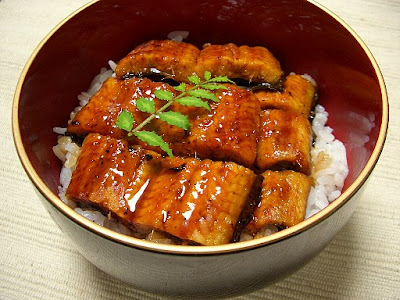
unagidon, unagi don, unagi donburi うなぎどんぶり ( 鰻丼/ うなぎ丼) grilled eel on rice
One of the most famous eel dishes. Here the sauce is poored directly over the eel and the rice.
. . . CLICK here for Photos !
gegrillter Aal auf einer Schüssel mit Reis.


unagimeshi, unagi meshi うなぎめし(鰻飯) eel with rice
manmeshi 鰻飯(まんめし)
. . . CLICK here for Photos !


.................................................................................


kabayaki in Edo

unagi no kabayaki うなぎのかばやき ( 鰻の蒲焼き/ うなぎの蒲焼)
skewered grilled eel with a soy and mirin sauce, charcoal-broiled eel
Sometimes the eel is served in a separate laquer box and the rice, soup and pickles come in separate dishes.
Kabayaki was already prepared in the Muromachi period. First the whole fish was put on a pole and grilled (Ujimaru kabayaki 宇治丸, uchimaru うちまる), but that did not go well so it was cut open and put on skewers.
Sometimes it was also grilled with salt only (shioyaki 塩焼) or (shirayaki 白焼, white grilling).
or
covered with miso, a kind of fish dengaku
uo dengaku 魚田楽(うおでんがく)
. . . CLICK here for Photos !
Grillaal, gegrillter Aal
more :  japanesefood.about.com: Japanese Eel Recipes


Preparing kabayaki in Edo

This dealer, kabayaki uri 蒲焼売 could carry his "shop" on a pole over the shoulders.
He could set up shop at any place. Other dealers grilled the fish at home and sold only the pieces.

In Edo, eel was cut open from the backside, whereas in Osaka (Kamigata) and Kyoto it was sliced open from the stomach.
In Edo there lived many Samurai and "harakiri", cutting the stomach, was notfavored.
In Edo the bones are taken out, then the fish is cut in three pieces, which are put on skewers and grilled separately. They are served with the skewers.
In Kamigata / Osaka fish is cut from the stomach, the bones are taken out, the whole fish is put on skewers from head to tail, and after grilling the skewers are taken out and the pieces placed on a broad dish.

In Tokyo it is first simmered, then grilled.
In Osaka it is not simmered.

Unagi was often featured in Ukiyo-e prints of Edo.


CLICK for more photos !


猫の当て字 うなぎ - cats forming the letters for u na gi うなぎ
Utagawa Kuniyoshi 歌川国芳


. Food vendors in Edo .

The fishing ground for Unagi in Edo was in the river around Asakusa, at that time called
Miyatogawa 宮戸川, now Sumidagawa. Eel was taken out with poles.
This river fish was called Edomae Unagi 江戸前うなぎ, here meaning "The best Unagi of Edo"。


source : kabuki-za.com/syoku/2
歌川国芳 Utagawa Kuniyoshi

In a book published in 1697, the author already praized the eel from Miyatogawa in Edo 江都(えど)as the best in all Japan.
『本朝食鑑』(1697 年刊)

.................................................................................


unagi manjuu うなぎ饅頭 bun with eel filling
from Mishima, Shizuoka.
. . . CLICK here for Photos !


unagisuupu, unagi suupu うなぎスープ 鰻スープ eel soup
unagijiru ウナギ汁, kimo sui 肝吸い
Often with red miso. Or a clear broth with some eel liver.
. . . CLICK here for kimosui clear broth Photos !
Aalsuppe


unagi no tare うなぎのたれ (鰻のたれ)
sauce for eel
Many restaurants have a sauce which is the strict secret of the generations.
Ready-made sauces are also available in the stores.
. . . CLICK here for Photos !

.......................................................................

unagiya うなぎ屋 (鰻屋) eel restaurant


There were quite a few in Edo where women prepared the fish, from cutting it to grilling it.
The Ukiyo-E prints were often in the format of a summer hand-fan, to be used to feel cool, spread the delicious smell of grilled fish and attract customers.


source : blog.goo.ne.jp/yousan02/e
by 近藤清春 - Unagiya in Edo - around 1720

The characters on their kanban shop signs are usually very typical.
. . . CLICK here for Photos !
Aalrestaurant

.......................................................................


unajuu うな重 (うなじゅう)
grilled eel on rice in a square box, grilled eel on a rice bed
. . . CLICK here for Photos !
gegrillter Aal auf Reis in einer Lackschachtel
gegrillter Aal auf Reis in viereckigem Kasten


Uzaku うざく(鰻ざく) Uzaku eel with vinegar dressing
CLICK for more photos A dish from the Kansai area.
Similar to mizore-ae, but the fish has been broiled. The sauce is quite sweet. Sanbaizu vinegar is used.


Yahata-maki. Yawatamaki やはたまき (八幡巻き) anago roll
The fish is rolled around pieces of goboo burdock.
. . . CLICK here for Photos !
yahata maki can also be made with other ingredients like pork meat or dojoo loach.
Fresh burdock from the area of Iwashimizu Hachimangu 石清水八幡宮 is usually used. A speciality of Yahata town, Kyoto.
In the beginning it was the other way around, on days when fish was not to be eaten for religious regions during the Hojo-e ritual of releasing fish into the river. cooks prepared small river fish and wrapped it in stripes of burdock to hide it. The river where the fish were released often clogged and was cleaned. The mud was taken to the nearby fields as compost for the burdock.
The preparation of Yawata maki dates back to the area of the warring states, maybe invented by the merchant Yodoya Joan (Yodoya Jooan)
淀屋常安 (よどやじょうあん).


Many eel dishes are flavored with
Sansho, Sanshoo, Japanese pepper, "Mountain pepper"


Lake Hamanako 浜名 near Hamamatsu, Shizuoka is famous for its eel farming. Many shirasu elvers are raised here.

shirasu no kama-age しらすの釜揚げ boiled shirasu.
they are boiled in salt water, which can be heated a bit higher than 100 degrees centigrade. After skimming off the foam various times they are put on nets to dry.
CLICK here for PHOTOS !


*****************************
Worldwide use

It seems eel is not eaten much in America.

The American eel, Anguilla rostrata, is a catadromous fish found on the eastern coast of North America. It has a snake-like body with a small sharp pointed head. It is brown on top and a tan-yellow color on the bottom. It has sharp pointed teeth but no pelvic fins. It is very similar to the European eel, but the two species differ in number of chromosomes and vertebrae.

In 2010, Greenpeace International has added the american eel to its seafood red list. "
The Greenpeace International seafood red list is a list of fish that are commonly sold in supermarkets around the world, and which have a very high risk of being sourced from unsustainable fisheries."
© More in the WIKIPEDIA !


Aal in Deutschland
Aal auf Stroh - eel on straw
Hamburger Aalsuppe - eel soup
Kräuteraal - eel in herb sauce
... Grüner Aal in Kräutersauce
Räucheraal - smoked eel
source : www.chefkoch.de


Spickaal (smoked eel)
Schillerlocke (strip of smoked rock salmon)
Räucheraal, smoked eel, was especially popular during the Christmas holidays.
kigo for all winter


*****************************
Things found on the way


. Eel catch problems .
February 2012


*****************************
HAIKU


なぎやのうの字 鰻のように書き 
unagiya no u no ji man no yoo ni kaki

the letter U
of the unagi restaurant
written just like the fish


Kaboo 佳宝


鰻屋のうの字 三尺余り伸び   
unagiya no u no ji sanshaku amari nobi

the letter U
of the unagi restaurant ...
almost one meter long    
 

Tennan 天南


:::::::::::::::::::::::::::::::::::::::::::::::::::::::::::::::::::::::::::::::::::::::::::::::::::::


サービスの肝吸い肝が見当たらず  
saabisu no kimosui kimo ga miatarazu

this free liver soup
does not have one bit
of eel liver ! 
   

Ganjiroo 頑治郎


*****************************
Related words

***** Donburi丼 Bowl of rice with topping

***** hamo 鱧 (はも) pike conger pike, pike eel
Muraenesox cinereus. dragontooth


***** WASHOKU : FISH and SEAFOOD SAIJIKI

:::::::::::::::::::::::::::::::::::::::::::::::::::::::::::::::::::::::::::::::::::::::::::::::::::::::::::::::::::::::::::

[ . BACK to DARUMA MUSEUM TOP . ]
[ . BACK to WORLDKIGO . TOP . ]
- #unagi #eelunagi -
:::::::::::::::::::::::::::::::::::::::::::::::::::::::::::::::::::::::::::::::::::::::::::::::::::::::::::::::::::::::::::

11 Apr 2016

MINGEI - Oita prefecture

http://omamorifromjapan.blogspot.jp/2011/08/oita-folk-toys.html

. Oita Folk Toys

[ . BACK to DARUMA MUSEUM TOP . ]
:::::::::::::::::::::::::::::::::::::::::::::::::::::::::::::::::::::::::::::::::::::::::::::::::::::::::::::::::::::::::::::::::::::::::::::::::::::::::::::::::::::::::::::::::::::

Oita Folk Art - 大分県 Ōita


Part of the former districts of 豊後国 Bungo and 豊前国 Buzen.
Toyo no Kuni 豊国 Land of Abundance


. eto kago nori shusse koma 干支かごのり出世駒
horses for a career 

in a basket, one for each of the 12 zodiac animals

:::::::::::::::::::::::::::::::::::::::::::::::::::::::::::::::::::::::::::::::::::::::::::::::::::::::::::::::::::::::::::::::::::::::::::::::::::::::::::::::::::::::::::::::::::::
..................................................................................................................................................................
Beppu town 別府市
part of former Bungo province 豊後. Famous for its hot springs

. Komatsu Nyoin Daruma 小松女院だるま .
Kusu village

.......................................................................

. akaheko tenjin 赤へこ天神 Tenjin sama with a red robe . - clay doll

.......................................................................


fukujishi, fuku shishi 福獅子 auspicious lion
Bungo no Fukujishi 豊後の福獅子


They are made from wood by Isobe Ouson 磯辺鴎村. They look almost like small robots, just 5 cm high. See also dove mikuji, below.

They come in auspicious red and white to ward off evil.
They are sold during the lion dance festivities at the beginning of the rainy season to ward off evil and bring a good harvest. This dates back more than 400 years to the first regent, Ootomo Yoshinao 大友能直.

. Lion Head Amulets .

.................................................................................

. kideko, ki deko 木でこ head made from wood
Ootomo ningyoo 大友人形 Otomo dolls .

- - - - - 朝鮮の将軍標 shogunhyo dolls from Korea
Ootomo Soorin, Ōtomo Sōrin 大友宗麟 Otomo Sorin (1530 - 1587)

An amulet to ward off evil.

.................................................................................

mikuji hato みくじ鳩 dove with a fortune-telling lot


At Usa Hachimangu 宇佐八幡 / Shrine Usa Jinja 宇佐神社 a white clay dove was given as a present to people with good luck at their mikuji. Now it has become a well-loved clay doll.
They have been made in Isobe Ouson 磯辺鴎村, like the auspicious lions, see above.
They are about 7 cm long and 6 cm high.

They were first made by 溝口興四郎, a papermachee-doll maker. At the breast of the dove there stuck a paper with the inscription 県指定宇佐神社みくじ鳩 (Official dove sacred lot from Usa Shrine). When the paper was torn away, the mikuji paper could be taken out of an opening in the dove's breast.
After the war, these doves were made in Isobe Ouson 磯辺鴎村 as clay dolls. But when their maker was no longer able to produce them for the shrine, this custom died out.
To revive it, 豊泉堂 Bunsendo begun to make them again as souvenirs.


CLICK for more photos !

宮脇弘至「豊泉堂」:別府市小倉一組1
- source : More toys from Bunsendo -


. mikuji 御籤 fortune-telling with sacred lots .

.................................................................................


nanbansen, nanban no fune 南蛮船 boat of foreigners
(also known in Nagasaki)


*** shinme suzu 神馬鈴 clay bell with sacred horse
. . . CLICK here for Photos !


take gangu 竹玩具 bamboo toys

toribue, tori fue 鳥笛 bird whistle


. yokanbee よかんべえ Yakko kite .
from Takeda 竹田, Usuki臼杵 and Bungo Takata 豊後高田.

..................................................................................................................................................................
Hiji village 日出町
(not Hinode)


Hiji ningyoo 日出人形 Hiji dolls
Hiji 日出(ひじ) is a small village at the edge of Kunisaki hanto peninsula 国東半島. They were made by Monjoo Osamu san 門上修, a designer from Oita, who started making dolls in 1988 together with his wife. Apart from clay bells he made about 100 different figures.

..................................................................................................................................................................
Hita town 日田市

. Hita 日田市 - Bungo no Kuni Hita 豊後国日田 .
former 天領 Tenryo government land, with a rich cultural heritage !

..................................................................................................................................................................
Kusu village 玖珠町

Kitayamada no kijiguruma, kiji kuruma 北山田のきじ車

. Kiji-guruma きじ車 pheasant on wheels Kyushu


..................................................................................................................................................................
Tsunomure jinja no uso 角埋神社のウソ
bullfinch from shrine Tsunomure


This is a very simple carving for exchanging bullfinches. It almost looks like the "spirit of the forest" .

The shrine Tsunomure jinja 角埋神社 is located in the compound of the old castle of Tsunomure 角牟礼城跡 on the foot of Mount Tsunomure (577m) in Kusu village.
Minamoto no Tametomo 八郎源為朝 is venerated in this shrine.


The castle was built by Mori Tomomichi in the Koan period (1280).
During Japan's period of civil war, Tsunomore held a key position between various states and was fortified by the people of Kusu. In the 14th year of the Tensei period (1586), the castle withstood an attack by Shimazu Yoshihiro.
Today, stone walling some 7m high and 100m long still remains. Moreover, excavation since 1993 has found traces of a watchtower and a gateway dating to the period of Mori Takamasa, who ruled from the castle in the Toyotomi period. There are also remains of another stone gateway and a stone building measuring 10m by 6m. In 2004, Tsunomure Castle Ruin was designated a national historic site.
source : nippon-kichi.jp


Minamoto no Tametomo (源 為朝)
(1139 – April 23, 1170)
(also known as Chinzei Hachirō Tametomo (鎮西 八郎 為朝)
was a samurai who fought in the Hōgen Rebellion of 1156. He was the son of Minamoto no Tameyoshi, and brother to Yukiie and Yoshitomo.
... Tametomo is known in the epic chronicles as a powerful archer and it is said that he once sunk an entire Taira ship with a single arrow by puncturing its hull below the waterline.
© More in the WIKIPEDIA !


. Tametomo in the Daruma Museum .


. usokae うそ替え exchanging bullfinches .

..................................................................................................................................................................
Nakatsu town 中津市

. Nakatsu mikoshi 中津神輿 Nakatsu Festival Float .
Nakatsu Gion Festival 中津祇園祭り


..................................................................................................................................................................
Oita town 大分市

hina ema 雛絵馬 votive tablets with Hina dolls


from 長浜神社 Nagahama Shrine, with a special hall for these dolls, 絵馬堂.
Made in a long format to stand, from cedar wood 杉板, about 18 x 11 cm.
The wooden plates are painted with the Hina dolls.

The two deities of the Shrine, 大国主命 Oonmuchi no mikoto and 小彦名命 Sukunahikona no Mikoto are seen as 医道の祖神 deities of Medicine. The larger figure on the plate is Oonomuchi, the smaller one Sukunakikona.
These two were also printed on paper as amulets, to protect from fire and disasters.

Nagahama Shrine, 長浜神社:別府市長浜町1-8-9.

.......................................................................

. kubi ningyoo 首人形 head dolls / kushi ningyoo 串人形 dolls on a stick .
ichibun ningyoo 一文人形 head dolls with one letter
from 柞原八幡宮 Yusuhara Hachimangu at Hamanoichi 浜の市


. oni ema, oni-ema 鬼絵馬 votive tablet with demons .
白木浜の天満社 Tenman Shrine of Shirakihama

.................................................................................

yusubue 柞(ゆす)笛 flute (whistle) from Yusu tree seeds
From Usa Hachimangu - 柞笛(ゆすぶえ)


source : ameblo.jp/tsukimi3110

yusu, isu no ki イスノキ - 柞 / or ハハソ 蚊母樹, a kind of oak or mansaku. The seed of the tree is eaten up by insects and the empty shell used as an amulet and toy for children..


Usa Hachimangu craft 宇佐八幡の神玩 - clay bell


. Usa Hachimangu, Oita 宇佐八幡宮 .
宇佐八幡宮弥勒寺, 八幡宇佐宮


..................................................................................................................................................................
Takeda town 竹田市

. Takeda Hime Daruma 竹田の姫達磨 Princess Daruma


tamago ningyoo 玉子人形 egg dolls
Hime Daruma in a bamboo container
Chikuden 竹田玉子人形


Click for more Egg dolls from Takeda town.

. Egg dolls from Fukui .

.......................................................................

unarigoma, unari-goma うなりごま / 唸り独楽 spinning top making a sound
a kind of
takegoma, take-goma 竹ごま bamboo spinning top.


Made from round bamboo, with holes to let the wind blow through for a sound, ブーン buuun.
Most are not colored.
Made by Hatano san - 波多野晃郎:竹田市玉来733-1.

. unarigoma うなりごま from Kyushu .

..................................................................................................................................................................
Ume village 宇目町

kenkagoma, kenka-goma けんかごま spinning top for fighting


Made from wood, on a spinning wheel. The stick is made from metal. The fight aims at destroying the top of the adversary.
Made by Taniguchi san 谷口喜三郎「梅喜工房」:海南郡宇目町千束3062-3.
Taniguchi san also makes other tops, 「ひねりごま」「平ごま」
in the form of a gourd, hyootankarakoma 「瓢箪からこま」

. Spinning Top 独楽(コマ) koma - Introduction .

..................................................................................................................................................................
Usuki 臼杵

. magaibutsu 磨崖仏 cliff Buddha statues .
Stone Buddhas from Kunisaki 国東半島 in Oita prefecture

. ura yakko tako 裏奴凧 Yakko from the backside .


:::::::::::::::::::::::::::::::::::::::::::::::::::::::::::::::::::::::::::::::::::::::::::::::::::::::::::::::::::::::::::::::::::::::::::::::::::::::::::::::::::::::::::::::::::::

. Reference and Photos . Gangu Guide .
. Reference and Photos . Isamu Folk Toys .
. Reference and Photos . Yama no Ie . Folk Toys .

- clay bells from Oita - tba -
国東六郷満山修正鬼会
両子寺 仁王 / 吉四六(きっちょむ)
里芋土鈴 / 深田石仏 / 臼杵石仏・蓮の蕾 / 地獄焼・おんま (horse) / 臼杵石仏 / 禅海和尚 /丸土鈴・獅子頭 / 熊野磨崖仏・不動明王
- source : eonet.ne.jp -


- #oita #oitakyushu #hita #bungo #buzen #beppu-
:::::::::::::::::::::::::::::::::::::::::::::::::::::::::::::::::::::::::::::::::::::::::::::::::::::::::::::::::::::::::::::::::::::::::::::::::::::::::::::::::::::::::::::::::::::

. WASHOKU . Regional Dishes from Japan

MORE
. Oita Folk Toys - this BLOG .


. Japan after the BIG earthquake March 11, 2011


[ . BACK to WORLDKIGO . TOP . ]
[ . BACK to DARUMA MUSEUM TOP . ]
- #oita #kyushu -
:::::::::::::::::::::::::::::::::::::::::::::::::::::::::::::::::::::::::::::::::::::::::::::::::::::::::::::::::::::::::::::::::::::::::::::::::::::::::::::::::::::::::::::::::::::