18 Sept 2015

EDO - ukiyo-E, Edo-E, Azuma-E prints and paintings

LINK
http://darumamuseumgallery.blogspot.jp/2011/12/ukiyo-e-woodblock.html

:::::::::::::::::::::::::::::::::::::::::::::::::::::::::::::::::::::::::::::::::::::::::::::::::::::

Ukiyo-e 浮世絵 "pictures of the floating world"
Ukiyoe

- quote
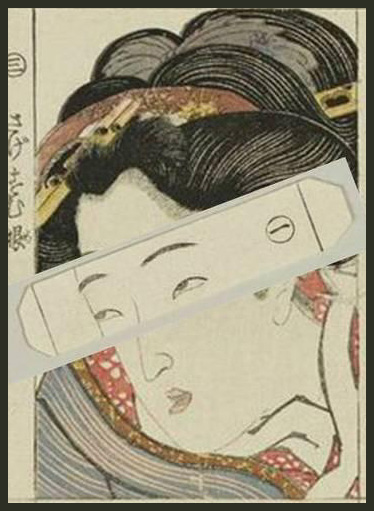
a genre of woodblock prints and paintings that flourished in Japan from the 17th through 19th centuries. Aimed at the prosperous merchant class in the urbanizing Edo period (1603–1867), depictions of beautiful women; kabuki actors and sumo wrestlers; scenes from history and folk tales; travel scenes and landscapes; flora and fauna; and erotica were amongst the popular themes.

3 Production
- - - 3.1 Paintings
- - - 3.2 Print production
Ukiyo-e prints were the works of teams of artisans in several workshops; it was rare for designers to cut their own woodblocks. Labour was divided into four groups: the publisher, who commissioned, promoted, and distributed the prints; the artists, who provided the design image; the woodcarvers, who prepared the woodblocks for printing; and the printers, who made impressions of the woodblocks on paper. Normally only the names of the artist and publisher were credited on the finished print.
© More in the WIKIPEDIA !


. shokunin  職人 craftsmen, artisan, Handwerker .

.......................................................................


There are quite a few Daruma in the world of Ukiyo-E.

. Ukiyo-e in the Daruma Museum .


. Hanga 版画 in the Daruma Museum .


. Woodblock prints with food - hanga 版画 .

.......................................................................


- quote -
ukiyo-e 浮世絵
Lit. pictures of the floating world. Paintings and woodblock prints of genre themes developed from the mid-Edo to early Meiji periods, supported by the people in the middle class of society (shomin 庶民, or common people) mainly in the city of Edo. Because of this locality, ukiyo-e was also called *edo-e 江戸絵 or azuma-e 東絵 (eastern pictures; *azuma nishiki-e 東錦絵) during the Edo period. In the broader sense of the term, however, ukiyo-e includes various local paintings appreciated by common people in the Edo period all over Japan, such as *ootsu-e 大津絵 (comical, folk painting produced in Ootsu, Shiga prefecture), *nagasaki hanga 長崎版画 (woodblock prints depicting foreign people and objects seen in Nagasaki, Nagasaki prefecture), and *kamigata-e 上方絵 (woodblock prints produced in the Kyoto-Osaka area kamigata 上方, mostly portrayals of the *kabuki 歌舞伎 actors popular there).

The term ukiyo-e, which is first found in literature during the first half of the 1680's, derives from the fact that they depict the activities of a transient (floating), but therefore enjoyable world. Pictures of beautiful women *bijinga 美人画 and young boys, particularly the courtesans of the pleasure quarters yuujo 遊女, scenes from kabuki plays shibai-e 芝居絵 and portraits of popular actors *yakusha-e 役者絵, and pornographic pictures *shunga 春画 are the three major subjects of ukiyo-e. Literary themes taken from poems and stories from Japan and China were also popular, pictures of heroic warriors *musha-e 武者絵 being particularly favoured throughout the period. Often the classic themes were parodied or represented in mundane, contemporary circumstances (see *mitate-e 見立絵). Well-known landscape prints fuukei hanga 風景版画 and pictures of birds and flowers *kachouga 花鳥画 form just one of the later phases in the complex development of ukiyo-e.

Ukiyo-e were mass-produced in order to fulfill a great demand among middle-class people, who were their major appreciators. Therefore, the principal form of ukiyo-e were woodblock prints, which were planned by the publisher hanmoto 版元 and produced in collaboration with the painter/designer *eshi 絵師, carver horishi 彫師 and printer surishi 摺師.
Even hand-paintings *nikuhitsuga 肉筆画 were produced in large quantities in workshops under the direction of a master artist who designed the product, supervised its coloring by his pupils and signed them . Because of the vagaries of this studio system several versions of the same painting with slight differences often exist in ukiyo-e.

Art historically, ukiyo-e is placed at the end of the development of *kinseishoki fuuzokuga 近世初期風俗画 (genre painting of the Early Modern period). Although early ukiyo-e artists signed themselves as painters of *yamato-e やまと絵, suggesting that ukiyo-e succeeded the tradition of native Japanese paintings, the influence of various pictorial styles of the period, including that of the *Kanouha 狩野派, *Tosaha 土佐派, *youfuuga 洋風画 (western style painting) and *shaseiga 写生画(realistic painting), can be found in ukiyo-e . The history of ukiyo-e can be devided into three periods.

Period 1) Meireki 明暦 to Houreki 宝暦 eras (1655-1764)
- snip
Period 2) Meiwa 明和 to Kansei 寛政 eras (1764-1801)
- snip
Period 3) Kyouwa 享和 to Keiou 慶応 eras (1801-68)


edo-e 江戸絵
Also azuma nishiki-e 東錦絵.
A general term applied to all full-color woodblock prints ukiyo-e 浮世絵 produced in the city of Edo (modern Tokyo), especially, single-sheet *ichimai-e 一枚絵 or series of such prints offered for sale to the public in commercial editions. Prints of this type that were made in Osaka-Kyoto were called *kamigata-e 上方絵. By the late 1760's full-color woodblock prints, alone or in series, had come to be a popular souvenir or gift from Edo , and the term is thought to have gained popularity among people living in the provinces. Santou Kyouden 山東京伝 (1761-1816) in a short popular novel *kibyoushi 黄表紙 published in 1782 makes an early reference to the term, noting that edo-e 江戸ゑ or azumaya no nishiki-e あづまやのにしきへ were famous products, meibutsu 名物 from Edo.


azuma nishiki-e 東錦絵
Also written 吾妻錦絵, *nishiki-e 錦絵, azuma-e 東絵, edo-e 江戸絵.
Brocade pictures.
Full color woodblock prints in the *ukiyo-e 浮世絵 style. The term nishiki-e is derived from the supposed resemblance of these prints to multicolored brocade fabrics. Azuma-e (Eastern pictures) and edo-e (Edo pictures), derive their names from the fact that full color prints were originally a specialty of the city of Edo, and thus a favorite souvenir for visitors from the provinces. The earliest known full color prints date to 1765. The term azuma nishiki-e (brocade pictures of the East), appears almost immediately on the wrapper for the series, Eight Views of the Household *Zashiki hakkei 座敷八景, by Suzuki Harunobu 鈴木春信 (.1725-70), published around 1766. Other contemporary sources also refer to these prints as azuma nishiki-e, but eventually the term was abbreviated to nishiki-e. With the spread of full color printing to other parts of Japan, especially to the kamigata 上方 area (present day Osaka-Kyoto), the terms azuma-e, azuma nishiki-e, and edo-e came to mean prints produced specifically in Edo as opposed to other cities.

- Read more :
- source : JAANUS -


:::::::::::::::::::::::::::::::::::::::::::::::::::::::::::::::::::::::::::::::::::::::::::::::::::::


Ukiyo-e (浮世絵)
literally "pictures of the floating world"

is a genre of Japanese woodblock prints (or woodcuts) and paintings produced between the 17th and the 20th centuries, featuring motifs of landscapes, tales from history, the theatre, and pleasure quarters. It is the main artistic genre of woodblock printing in Japan.

Usually the word ukiyo is literally translated as "floating world" in English, referring to a conception of an evanescent world, impermanent, fleeting beauty and a realm of entertainments (kabuki, courtesans, geisha) divorced from the responsibilities of the mundane, everyday world; "pictures of the floating world", i.e. ukiyo-e, are considered a genre unto themselves.

The contemporary novelist Asai Ryōi, in his Ukiyo monogatari (浮世物語, "Tales of the Floating World", c. 1661?), provides some insight into the concept of the floating world:

... Living only for the moment, turning our full attention to the pleasures of the moon, the snow, the cherry blossoms and the maple leaves; singing songs, drinking wine, diverting ourselves in just floating, floating; ... refusing to be disheartened, like a gourd floating along with the river current: this is what we call the floating world...
© More in the WIKIPEDIA !

:::::::::::::::::::::::::::::::::::::::::::::::::::::::::::::::::::::::::::::::::::::::::::::::::::::

more

17 Sept 2015

EDO - chin shoobai business


[ . BACK to DARUMA MUSEUM TOP . ]
::::::::::::::::::::::::::::::::::::::::::::::::::::::::::::::::::::::::::::::::::::::::::::::::::::::::::::::::::::::::::::::::::::::::::::::::::::::::::::::::::::::::::::::::::::: 
chin shoobai 珍商売 strange business in Edo

This is part of the main entry about
. Doing Business in Edo - 江戸の商売 .

:::::::::::::::::::::::::::::::::::::::::::::::::::::::::::::::::::::::::::::::::::::::::::::::::::::::::::::::::::::::::::::::::::::::::::::::::::::::::::::::::::::::::::::::::::::

awamochi no kyokutsuki 栗餅の曲つき artistic pounding of foxtail milled dumplings

The artists pounded millet dough for mochi in rhythmical tunes to entertain people during the seasonal festivals. They also used artistic movements of their arms when tearing the mochi dough into bitesize pieces of dumplings to sell.


. awamochi 粟餅(あわもち)foxtail millet mochi dumplings .

..............................................................................................................................................

chinko kiri 賃粉切り cutting leaf tobacco for money


He used a carpenter's kanna 鉋 plain to do his job.
Others just owned a block and a good knife. It was hard labor with pain in the legs and arms from working in a straining position. Sometimes they took a brake, taking a puff themselves. But they had to be careful with open fire with all the tobacco shavings around. Therefore they always had a small tub full of water by the side too, where the rest of the tobacco from the pipe was thrown in. This made a sound like "juu juu".
The water from the tub was also used when sharpening the blade.


ふきがらをじうといわせる賃粉切り
fukigara o juu to iwaseru chinko kiri

the tobacco cutter
lets his pipe leftovers say
"juu juu"


It was a job for poor people living in the smallest and cheapest of the nagaya row houses, working for a tobacco dealer. Some of them were ronin without a master or other job.
Some of them were women, even beautiful ladies who were mistaken for prostitutes, as one story of Ihara Saikaku tells.


. kiseru 煙管 tobacco pipes from Edo .
and rauya, raoya 羅宇屋 repairman of tobacco pipes


. Ihara Saikaku, Ibara Saikaku 井原西鶴 (1624 - 1693).

. nagaya 長屋 ながや row house, long house .

chinko ちんこ /陰茎 is also a children's naming for the male sexual organ.
Therefore chinko kiri 陰茎切り sounded dangerous to children.

ちんこ切りなら怖いよと頑是なさ
chinko kiri nara kowai yo to ganze nasa

cutting chinko -
oh, that sounds dangerous
to an innocent child


きん玉の休む隙無き賃粉切り

煙草屋の娘ちんこが取りたがり

烟草やの娘ちんこを入たがり

..............................................................................................................................................


. heoi bikuni, he-oi bikuni 屁負比く尼 / 屁負比丘尼 fart-pretending nuns .


. kashi setchin 貸雪隠 portable toilet for rent - kawaya 厠 .


..............................................................................................................................................

Edo-neko Ukiyoe Nekotzukushi- (Collected Woodblock Prints of Cats in Edo)
Shinichi Inagaki and Toshihiko Isao


This is the first book in Japan to exclusively collect 'ukiyoe' (woodblock print) images of cats.
The volume features carefully selected works by the most notable wood block print artists of the Edo Period, including Hiroshige Utagawa, Kyosai Kawanabe, Kuniyoshi Utagawa and Harunobu Suzuki. An astoundingly wide variety of felines can be seen in the works, such as humorously adorable dancing cats, frightening ghost-like cats, cats playing with beautiful women and cats at work as if they are humans. Whether it's the Edo Period (1603-1868) or today, cats never seem to lose their free-spirited character. That said, this volume helps us learn more about life in the Edo period.
- source : ilove.cat/en -

Cats were a favorit pet in the town of Edo and also loved by the farmers, because it was chasing away the mice.

. Cats and Haiku - Introduction .

.......................................................................

neko no ekaki 猫の絵描き painter of cats


They painted cats on pictures to hang up in the kitchen or loft where silk worms were kept to chase away the mice.
Raising silk worms was a good business in the Edo period, and mice were the worst enemy of the farmers.


The paintings had to be done very carefully, to have the cat watch
the "eight directions" 八方にらみの猫 (happo nirami no neko).

.......................................................................

neko no nomi-tori 猫の蚤(ノミ)取り picking fleas from cats

They walked the streets of Edo, calling out
neko no nomi toran 猫の蚤取らん "Any fleas to pick from your cat?"

When called to a home, they first put the cat in a warm bath and then wrapped the cat in the fur of a "wild animal" 獣 , most probably a wolf. The fleas then moved from the wet fur to the dry fur . . . and the job was done. The price was 3 mon 三文 (about 30 Yen), which was quite cheap.
But they were only called by rich people wh loved their cats very much and many quit this job soon.


..............................................................................................................................................


. "oya kookoo de gozai" 親孝行でござい selling filial piety .

..............................................................................................................................................

sokuriki 足力 "strong legs" massage
sokuriki anma 足力按摩 / 足力あんま massage with the feet


A kind of massage with the feet, by stepping on the back and kicking the patient.
They used long sticks to support themselves (shumokuzue 撞木杖 crutch)).
Some of them also applied moxabustion (kyuu 灸).


One famous "sokuriki" was Takuetsu 宅悦 in a Kabuki play.

Anma was popularised in the seventeenth century by acupuncturist Sugiyama Waichi, and around the same time the first books on the subject, including Fujibayashi Ryohaku's Anma Tebiki ("Manual of Anma"), appeared.
Anma practices uses common massage techniques such as kneading, rubbing, tapping and shaking.
- - - More in the WIKIPEDIA !


. zatoboo, zato boo 座頭坊 blind priest, doing massage .
anma 按摩 Amma massage

..............................................................................................................................................

sunae, suna-e 砂絵 painting with sand

A kind of street performance with pure white and colored sand, making effects almost like an ink paintings or woodblock prints.
Before they begun the work, they had to clean the road and water it for a while, before applying the sand.
It was quite popular in Edo, Kyoto and Osaka.


This art developed from bonga 盆画 paintings with sand on a tray.
. Bonsai 盆栽 small potted plants and tray art .


There is a novel about Edo with this title.
ときめき砂絵 いなずま砂絵 - なめくじ長屋捕物さわぎ
Tsuzuki Michio 都筑道夫 (1929 - 2003) Mystery Writer

which incorporates a lot of the customs of Edo in a criminal investigation.


..............................................................................................................................................


. yomiuri 読売、lit. "to read and sell" .
kawaraban 瓦版 Edo newspaper, handbill, broadside

This is still the name of a newspaper in our time.


:::::::::::::::::::::::::::::::::::::::::::::::::::::::::::::::::::::::::::::::::::::::::::::::::::::::::::::::::::::::::::::::::::::::::::::::::::::::::::::::::::::::::::::::::::::

. Doing Business in Edo - 江戸の商売 .


[ . BACK to DARUMA MUSEUM TOP . ]
[ . BACK to WORLDKIGO . TOP . ]
- #chinshobai #edostrangebusiness -
::::::::::::::::::::::::::::::::::::::::::::::::::::::::::::::::::::::::::::::::::::::::::::::::::::::::::::::::::::::::::::::::::::::::::::::::::::::::::::::::::::::::::::::::::::: 

--
Posted By Gabi Greve to Edo - the EDOPEDIA - on 12/28/2013 06:37:00 a.m.

EDO - tori-oi chasing away birds ritual


[ . BACK to DARUMA MUSEUM TOP . ]

. - Doing Business in Edo - 商売 - Introduction .
::::::::::::::::::::::::::::::::::::::::::::::::::::::::::::::::::::::::::::::::::::::::::::::::::::::::::::::::::::::::::::::::::::::::::::::::::::::::::::::::::::::::::::::::::::: 
torioi, tori-oi, tori oi 鳥追 "chasing away the birds" ritual

tori oi uta 鳥追唄(とりおいうた)鳥追歌 song to chase away the birds,
bird dispersing songs, a kind of magic incantation


A ceremony held on the "Small New Year", now January 14 or 15.

A troupe of kado geinin 門芸人 "artists by the entrance" walked from house to house, performed their ritual songs with Shamisen and got some money in return.
They were active from the first day till the 15th day of the lunar New Year.


torioi (bird chasing),
a ceremony to pray for a rich harvest, which takes place on January 14. In the ceremony, children eat rice cakes in special torioi huts made of snow and then parade through the city beating wooden clappers while singing traditional songs in order to chase away birds that might damage crops.
City of Tokamachi, Niigata Prefecture
© web-japan.org/

..... tori oi (tori-oi) 鳥追 "Chasing away the birds".
..... hut, tori-oi goya 鳥追小屋(とりおいごや)
..... tower, tori-oi yagura 鳥追櫓(とりおいやぐら)
..... song, tori-oi uta 鳥追唄(とりおいうた)

tori-oi asobi 鳥追遊び enjoying the Torioi rituals

tori-oi boo 鳥追棒 stick to drive off birds


. WKD - Songs for all seasons .

..............................................................................................................................................

torioidayuu, tori-oi dayuu 鳥追大夫 (とりおいだゆう)
bird chasing song performer

..... tataki たたき
tataki no Yojiroo 敲の与次郎(たたきのよじろう)

torioi 鳥追い(とりおい) is an observance performed on January 14 or 15 in the villages. To get the birds (and other unwanted animals) out of the fields.

The torioi performers went from village to villate. They wear a straw sack on the back. They get some money for their performance, also some food like mochi. They were not allowed to wear robes of silk, only simple cotton. They had large straw hats to protect them from the rain.

They had special songs, for example
鶴は千年、亀は万年

"The crane lives thousand years,
the tortoise lives ten thousand years,
when they come together,
we all live long prosperous lives."


..............................................................................................................................................


Torioi Kannon 鳥追観音


The Torioi Kannon statue was made by priest Gyoki with the wish to show people an east pass-over to the paradise of Amida.

at the temple
. Myoohooji 妙法寺 Myoho-Ji . Fukushima, Aizu
The temple was founded by priest Tokuitsu in 807.

..............................................................................................................................................

Tori-oi in the Kazusa region 上総地方, Chiba 千葉県

. hoojari ほうじゃり Hojari amulets .


:::::::::::::::::::::::::::::::::::::::::::::::::::::::::::::::::::::::::::::::::::::::::::::::::::::::::::::::::::::::::::::::::::::::::::::::::::::::::::::::::::::::::::::::::::::

torioibune, torioi-bune 鳥追舟 the Torioi Bird Chasing Boat
a Noh play from the Muromachi period


Tsukioka Kogyo


- reference - torioibune -

..............................................................................................................................................


CLICK for more photos !

:::::::::::::::::::::::::::::::::::::::::::::::::::::::::::::::::::::::::::::::::::::::::::::::::::::::::::::::::::::::::::::::::::::::::::::::::::::::::::::::::::::::::::::::::::::

- - - - - H A I K U and S E N R Y U - - - - -


人絹の鳥追笠の朱ケの紐
jinken no torioigasa no shuke no himo

the vermillion cord
from artificial silk
of the Bird-Chasing straw hat

Tr. Gabi Greve

竹下しづの女 Takeshita Shizunojo (1887 - 1951)
A member of Hototogisu -

:::::::::::::::::::::::::::::::::::::::::::::::::::::::::::::::::::::::::::::::::::::::::::::::::::::::::::::::::::::::::::::::::::::::::::::::::::::::::::::::::::::::::::::::::::::


- - - To join me on facebook, click the image !

:::::::::::::::::::::::::::::::::::::::::::::::::::::::::::::::::::::::::::::::::::::::::::::::::::::::::::::::::::::::::::::::::::::::::::::::::::::::::::::::::::::::::::::::::::::


. - Doing Business in Edo - 商売 - Introduction .

. senryu, senryū 川柳 Senryu poems in Edo .

. densetsu 伝説 Japanese Legends .


[ . BACK to DARUMA MUSEUM TOP . ]
[ . BACK to WORLDKIGO . TOP . ]- - - - - #edotorioi #torioi #chasingbirds - - - -
::::::::::::::::::::::::::::::::::::::::::::::::::::::::::::::::::::::::::::::::::::::::::::::::::::::::::::::::::::::::::::::::::::::::::::::::::::::::::::::::::::::::::::::::::::

--
Posted By Gabi Greve to Edo - the EDOPEDIA - on 9/14/2015 09:40:00 a.m.

15 Sept 2015

MINGEI - kites from Akita

LINK
http://omamorifromjapan.blogspot.jp/2011/07/akita-folk-toys.html
.
..............................................................................................................................................


Akita no tako 秋田の凧 kites from Akita


beraboo tako ベラボー凧 with a face sticking out the tongue
from Noshiro 能代市

They have a long tradtion. It is said Sakanoue Tamuramaro used them during the fights with the Emishi in Tohoku. The kite was a sign for the harbour, seen by ships far away.
During the Edo period, they became "fighting kites" in competitions.

. Sakanoue no Tamuramaro 坂上田村麻呂 (758 - 811) .


managu tako まなぐ凧 "kite with big eyes"
painted only with black Chinese ink. managu is the local dialect for manako 目玉 eyeball.
from Yuzawa 湯沢.
It is a kind of the type of Berabo kites, the face of someone doing the アカンベー "akanbee" face. (Japanese facial gesture indicating childish mockery .. It consists of someone pulling down one's lower eyelid to expose the red underside towards someone, often accompanied by the person sticking their tongue out.)


- - - - - and even as a brand-name for sake rice wine:


爛漫(秋田銘醸) まなぐ凧シリーズ

..............................................................................................................................................

MINGEI - Akita Itayazaiku craft

LINK
.......................................................................

itaya-zaiku, itayazaiku イタヤ細工 figures from itaya wood
Kakunodate 角館町, Kumoshikari District, Kakunodate, Senboku City.

Made with stripes of bark torn from the Itaya maple tree. The stripes are woven together for items of daily use. When used for a long time, they change color and become beautiful amber color. "It is the customer who creates the art".

itaya kaede, Acer mono Maxim, a kind of maple

- quote -
Itaya craft is one of Akita prefecture designated traditional crafts, which is made in Kumoshikari District, Kakunodate Town, Semboku City.


Their characteristics are lightness, strength, and their color, which will gradually change to beautiful amber over time.
In the making process,
Itaya Kaede (mono maple) is used in the shape of strip and is woven into products by hand. Applying the technique of basket making, products like trays, Tsuzura (box for clothes) and screens are also made and further development of new products are expected.
At this moment, they have developed products made of other materials such as walnut, wild vine, and soil dyed mono maple, which are gaining good reputation.

Manufacturing Processes
The process can be divided into 2 parts. One is making narrow strips from raw wood and the other is weaving.
First,
they slit the material into narrow strips. Their thickness will be less than a millimeter. The careful work of experienced craftsmen will make them into pliant strips with the same width and thickness suitable to each product.
Finally,
the strips will be woven into products by hand.
Mi (an agricultural implement used for threshing) and baskets have been the common products of Itaya craft and they have been commonly used from old times as daily necessities.

History
There are several opinions about its origin, but it seems to have developed from farmers' side job in the winter agricultural off-season.
The district has abounded with materials and been close to consumers in the city. This environment helped Itaya craft flourish.

Kakunodate-machi Itaya Zaiku Kumiai
- source : jtco.or.jp/en/kougeihinkan -


.......................................................................

MINGEI - Tsutsumi dolls from Sendai

LINK
http://omamorifromjapan.blogspot.jp/2011/06/akakeshi-miyagi.html


:::::::::::::::::::::::::::::::::::::::::::::::::::::::::::::::::::::::::::::::::::::::::::::::::::::::::::::::::::::::::::::::::::::::::::::::::::::::::::::::::::::::::::::::::::::


Tsutsumi ningyoo 堤人形 Tsutsumi dolls

This naming has been introduced in the Showa period. Before that they were called
ohinakko, o-hinakko おひなっこ (little Hina dolls).

Most of the themes are about the seasonal festivals for Girls in March and Boys in May.

- quote -
A thirteenth generation craftsman produces beautiful dolls through build-to-order manufacturing.

Tsutsumi dolls are made out of clay and developed in Sendai. It attracts viewers with its beautiful figures like the Hina doll (female doll for girls' festival), with the elegant smile, or a Kabuki actor striking a pose. The doll originated in Tsutsumicho, Sendai, a well-known pottery town. During the wintertime, soil became frozen and ceramists could not make pottery, so they started to color unglazed Tsutsumi dolls.

In the Edo period, Sendai clan's 4th feudal lord, Tsunamura Date (1659 - 1719), invited ceramist Mannemon Kamimura from Edo (present day Tokyo) for a visit. Manemon suggested improvements and refined the crafting of the Tsutsumi doll. From 1804 to 1830, the popularity of the Tsutsumi doll prospered, and it was considered one of the two major clay dolls, along with the Fushimi doll from Kyoto, among others such as the Hanamaki doll in Iwate and Miharu doll in Fukushima.


One of the big characteristics of the Tsutsumi doll is the use of the color red. Craftsmen in the Edo period finished dyeing a doll using imported sappan wood, which had been difficult to obtain in Japan under the closed‐door policy. Craftsmen do not use sappan wood nowadays, and instead use dyes, which last longer and creates the impressive bright red on Tsutsumi dolls.

The Ukiyo-e (Japanese woodblock prints and paintings produced between the 17th and the 20th centuries) like dolls made Tsutsumi dolls famous and flourish during the Edo period. Craftsmen used their skill to make dolls with expressions on the modeled faces of Kabuki actors, Sumo wrestlers and Oiran courtesans on Ukiyo-e print, that appeared very life-like.

Besides these kinds of motifs, there were other various styles of Tsustumi dolls created such as the Inari (god of harvests, later worshipped as the guardian deity of an area), or a pair of stone guardian dogs (placed at the gate or in front of a Shinto shrine), or a Hina doll representing the folk belief. In addition, the unglazed and unpainted with dye doll seemed to be loved as a toy and a teething ring for babies. Tsutsumi dolls were not as expensive like other Japanese dolls, so even common people could get them anytime.

With the change of the lifestyle, the Tsutsumi doll has gradually disappeared from current living scenes. However, the Tsutsumi doll still manages to attract new fans with its sweetness.

The craftsman at "Haga Tsutsumi Doll Workshop" is the thirteenth generation since Bunka period (1804~1818), to continue to make the doll and he still produces it by special build-to-order manufacturing without wholesale to the department stores, and there seems to be no end to the inquiries from collectors. There will always be people that love the Tsutsumi dolls.

3-30-10 Tsutsumimachi, Aoba-ku, Sendai, Miyagi / Haga Tsutsumi Doll Workshop
- source : tetotetote-sendai.jp -

..............................................................................................................................................


source : folkcraft.samurai47.com

Tanikaze Kajinosuke 谷風梶之助 from Mutsu 陸奥
A famous Sumo wrestler name.
The second Tanikaze lived from 1750 - 1795. He had won 22 competitions in Edo.


. Sumo 相撲  Sumo wrestling toys .


..............................................................................................................................................

Another famous theme is the

taki nobori, takinobori 滝のぼり climbing up a waterfall
Tsutsumi Mud doll - Koinobori Carp s climb in waterfall


. koi 鯉 carp dolls and amulets .


Akakeshi 赤芥子 Red Poppies Dolls

These little clay dolls help children to stay healthy.
Red is the color to ward off diseases, especially smallpox.

They are a type of Tsutsumi Ningyo dolls 堤人形,
similar to the Matsukawa Daruma dolls.

They come as a pair, little boy and girl, sitting down, with soft curves of their little bodies.


:::::::::::::::::::::::::::::::::::::::::::::::::::::::::::::::::::::::::::::::::::::::::::::::::::::::::::::::::::::::::::::::::::::::::::::::::::::::::::::::::::::::::::::::::::::

13 Sept 2015

EDO - street performers


[http://edoflourishing.blogspot.jp/2013/11/business-in-edo.html]
[ . BACK to DARUMA MUSEUM TOP . ]
. - Doing Business in Edo - 商売 - Introduction .
::::::::::::::::::::::::::::::::::::::::::::::::::::::::::::::::::::::::::::::::::::::::::::::::::::::::::::::::::::::::::::::::::::::::::::::::::::::::::::::::::::::::::::::::::::: 

daidoogei 大道芸 Daidogei street performance
kyokugei 曲芸 stunt artists, acrobatics
yose engei 寄席演芸 vaudeville theater, variety theater
kado geinin 門芸人 performers at the gate (of each estate)


This is part of the main entry about
. Doing Business in Edo - 江戸の商売 .

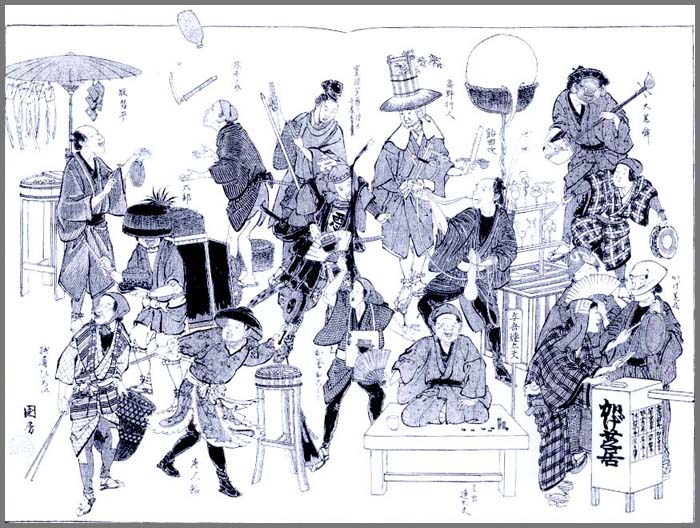
Street performers were quite popular in an age without television . . .
Especially during the holiday season of the New Year they entertained the townspeople.


CLICK for more illustrations.

:::::::::::::::::::::::::::::::::::::::::::::::::::::::::::::::::::::::::::::::::::::::::::::::::::::::::::::::::::::::::::::::::::::::::::::::::::::::::::::::::::::::::::::::::::::


source : log.goo.ne.jp/htshumei

居合抜きの長井兵助 
樽の曲ざし / 青蛙房 / 芝居、新狂言 / 鎌倉節の飴売り / 乞食芝居 / 栗餅の曲つき 

:::::::::::::::::::::::::::::::::::::::::::::::::::::::::::::::::::::::::::::::::::::::::::::::::::::::::::::::::::::::::::::::::::::::::::::::::::::::::::::::::::::::::::::::::::::


. dengaku mai 田楽舞 Dengaku dance and performance .
Performers on sticks, with poles and wooden swords

..............................................................................................................................................

hariki 歯力 (はりき)lifting heavy things with the teeth
kuchichikara (kooriki) 口力 "strong mouth"


- source : 江戸は大道芸 -


歯力鬼右衛門の見世物 Oni Uemon with the strong teeth
this photo shows what he could do, in the form of a sugoroku game with 11 fields.
Oni Uemon was born in Kishu Wakayama 紀州和歌山 and soon became a favorite of the street performers in Edo.
He could also break a pottery plate by just biting into it. He could dance while keeping a barrel with two children in his mouth and many other feats to entertain the viewers.

- source : misemono nenpyo -

..............................................................................................................................................


hitorishibai, hitori shibai 一人芝居 one-man theater
often with the left and right side of the body with different make-up and costumes, so one person could play two roles.


Also called
kojiki shibai 乞食芝居 beggar's performance, beggar's play


source : blog.goo.ne.jp/aboo-kai

ひとりふた役乞食芝居や花の下
hitori futayaku kojiki shibai ya hana no shita

one playing two roles
in a poor man's performance -
under the cherry blossoms


. kojiki 乞食 beggar .

- - - - - - and one meaning related to the many fires of Edo
- quote -
Hitsuke tōzoku aratame was a position introduced by the shogunate to target the felonies of arson, theft, and gambling.
... Contrary to the machi-bugyō, who were civil officials, hitsuke tōzoku aratame were military officials. Therefore, their interrogation strategies tended to be violent. While they had the power to arrest suspected arsonists, there was no penalty for mistaken arrests. For this reason, they often tortured the arrested suspects to force confessions, leading to a great number of false charges.
This left a notorious image on the chōnin, who nicknamed them "kojiki shibai" (乞食芝居, lowly theaters) while comparing the machi-bugyō and kanjō-bugyō (勘定奉行, financial commissioner) to "ōshibai" (大芝居, grand theaters).
- source : wikipedia - Fires in Edo -

.......................................................................


. hitorizumoo  一人相撲 / 一人角力 Hitori Sumo - one-man wrestling .

.............................................................................................................................................


hyakumanako, hyaku manako 百眼 "one hundred eyes"
using various simple paper masks (mekazura 目鬘) to represent different emotions in a funny performance.

They were also called shichihenme 七変目 "seven different eyes" (a pun with shichihenge) or nanatsume 七つ目 "seven eyes" and also often performed indoors to entertain visitors.
A favorite was the performance of cleaning teeth, hyakumanako hamigaki 百眼歯磨き.


Playing with mekazura 目鬘 "eye wigs" was also enjoyed by others.


CLICK for more photos !

..............................................................................................................................................

iainuki, iai nuki 居合い抜き sword performance
torite 捕手 / hamahoo 浜法 


Exercises with the samurai sword have become showpieces at the roadside.
Some used to sell medicine on the side.


battoojutsu 抜刀術 "the craft of drawing out the sword"
an old term for iaijutsu 居合術.
Iaijutsu (居合術), a combative quick-draw sword technique. This art of drawing the Japanese sword, katana, is one of the Japanese koryū martial art disciplines in the education of the classical warrior (bushi).
- source : wikipedia -


source : htshumei
居合抜きの長井兵助 by 菊池貴一郎著


. selling gamaabura がま油 toad grease .
while performing sword tricks

..............................................................................................................................................


kago nuke, kagonuke 籠抜け / 篭抜け crawling through a narrow bamboo basket 
while another sticks a sword into the basket


"Since a horse cannot perform such a nimble trick, "horse's basket trick" uma no kagonuke 馬の籠抜け became a proverb for doing something thought to be impossible. The word kagonuke is also used to describe the act of entering through one door and escaping through another."

quote from google books : Haruo Shirane
Early Modern Japanese Literature: An Anthology, 1600-1900


umanori kozoo no kago nuke 'The horse-riding monk's escape from the basket'

Kagonuke no Yatsushi
Kabuki role in the drama "Tanba Yosaku Tazuma Obi".

..............................................................................................................................................


. kyokugoma 曲独楽 acrobatics with spinning tops (koma) .


. kyokuhe 曲屁 "acrobatic farting" , performance like music .
With all the vegetable food and sweet potatoes, farting was very common in Edo.

..............................................................................................................................................


. makuragaeshi 枕返し juggling with pillows, pillow turner .

..............................................................................................................................................


. Nanjing Tamasudare たますだれ (玉簾/珠簾) .
performance with bamboo sticks


.......................................................................


nazotoki 謎解き/ nazokake なぞかけ making riddles
「○○とかけて××と解く。その心は」

"I call it ooo and explain it as xxx. The reason is this yyy!"
This kind of riddle story is still popular on present-day TV.


nazotoki boozu 謎解き坊主春雪の見世物 was quite popular around 1815.
謎坊主春雪 Nazotoki Bozu Shunsetsu. He worked at a mountain in the back of Asakusa Kannon in Edo.

カケル大食傷トクしろほうきみごぼうき心は立てはき居てはく
カケルはげあたまトクおとし味そ心はすらずとよい


source : misemono/archives

..............................................................................................................................................


o-chiyobune, ochiyobune お千代舟 O-Chio Boat
performed by beggars to get some money.

O-Chio was a general name for the woman who had to work as prostitutes on a boat owned by their husband.

. funamanjuu 船饅頭 "sweet buns on a boat" .

The street performers imitated this business boat and made people laugh by doing some rhythmical swinging.


source : 絵で見る江戸のユーモア

..............................................................................................................................................


. sekizoro 節季候 Year End Singers .
December Singers, Twelfth Month Singers

..... female singers, old ladies, ubara 姥等 うばら
..... hitting the breasts, mune tataki 胸敲 むねたたき

..............................................................................................................................................


taiheiki yomi 太平記読み reading the Taiheiki story
reciting the Taiheiki Saga
The origin of koza story telling.
koodan 講談  kooza 講座 kooshaku 講釈


source : supernil.web.fc2.com/rekisiga

"oral commentary on the Record of Great Peace"
Rethinking East Asian Languages, Vernaculars, and Literacies, 1000–1919
- - - - - Read more
- source : books.google.co.jp -


The Taiheiki (太平記)
is a Japanese historical epic written in the late 14th century.
It deals primarily with the Nanboku-chō, the period of war between the Northern Court of Ashikaga Takauji in Kyoto, and the Southern Court of Emperor Go-Daigo in Yoshino.
- - - More in the WIKIPEDIA !

Kōdan (講談, formerly known as kōshaku (講釈)),
is a style of traditional oral Japanese storytelling. The form evolved out of lectures on historical or literary topics given to high-ranking nobles of the Heian period, changing over the centuries to be adopted by the general samurai class and eventually by commoners, and eventually, by the end of the Edo period, declining in favor of new types of entertainment and storytelling such as naniwa-bushi. It was at this time that the term kōshaku was abandoned and kōdan adopted.
Today, after a failed attempt to revive the art in 1974, there are four schools of kōdan and only a very few performers between them.
- - - More in the WIKIPEDIA !

..............................................................................................................................................


. tori oi 鳥追 chasing away the birds .
A ceremony held on the "Small New Year", now January 14 or 15.

done by kado geinin 門芸人

..............................................................................................................................................


. yaku harai, yakuharai 厄払い / 厄はらい exorcism, driving out bad luck .
- during the Setsubun rituals at the beginning of spring

:::::::::::::::::::::::::::::::::::::::::::::::::::::::::::::::::::::::::::::::::::::::::::::::::::::::::::::::::::::::::::::::::::::::::::::::::::::::::::::::::::::::::::::::::::::

- reference -

江戸浅草奥山 - - source : misemono nenpyo -

畸人(きじん) 不具者を見世物 strange people / 珍畸鳥獣 strange beasts
- source : kappa/watashi -

:::::::::::::::::::::::::::::::::::::::::::::::::::::::::::::::::::::::::::::::::::::::::::::::::::::::::::::::::::::::::::::::::::::::::::::::::::::::::::::::::::::::::::::::::::::


- - - - - H A I K U and S E N R Y U - - - - -

大道芸炎天に置く銭の箱
daidoogei enten ni oku zeni no hako

these street performers -
under the blazing sky
a box for donations

Tr. Gabi Greve

Kashiwara Min-U 柏原眠雨

. WKD : enten 炎天 blazing sky .

..............................................................................................................................................


大道芸なべて陽炎ふ自由席 高澤良一
大道芸にどつと声湧く半夏生 守谷順子
大道芸の鞄開けば小鳥来る 一 民江
に置く銭の箱 柏原眠雨
大道芸祭囃すやオッペケペー 高澤良一 素抱
大道芸蒸す日を火噴き男かな 高澤良一 寒暑

もみづる樹下大道芸の下準備 高澤良一 素抱
冬帽子大道芸の銭集む 山口超心鬼
冬眠す大道芸の帽子中 対馬康子 吾亦紅

小樽初夏大道芸も運河べり 小倉英男
島寺に大道芸やさくら満つ 中戸川朝人 星辰
永日の掏摸も輪中に大道芸 高澤良一 寒暑
沙翁忌の大道芸の紙吹雪 永澤 謙
父の日に大道芸の傘ひらく 角谷憲武
野毛山下春ともなれば大道芸 高澤良一 寒暑

- source : HAIKUreikuDB

:::::::::::::::::::::::::::::::::::::::::::::::::::::::::::::::::::::::::::::::::::::::::::::::::::::::::::::::::::::::::::::::::::::::::::::::::::::::::::::::::::::::::::::::::::::


- - - To join me on facebook, click the image !

:::::::::::::::::::::::::::::::::::::::::::::::::::::::::::::::::::::::::::::::::::::::::::::::::::::::::::::::::::::::::::::::::::::::::::::::::::::::::::::::::::::::::::::::::::::

. Japanese Architecture - cultural keywords used in haiku .

. - Doing Business in Edo - 商売 - Introduction .


[ . BACK to DARUMA MUSEUM TOP . ]
[ . BACK to WORLDKIGO . TOP . ]

::::::::::::::::::::::::::::::::::::::::::::::::::::::::::::::::::::::::::::::::::::::::::::::::::::::::::::::::::::::::::::::::::::::::::::::::::::::::::::::::::::::::::::::::::::: 

--
Posted By Gabi Greve to Edo - the EDOPEDIA - on 12/27/2013 01:57:00 p.m.

TEMPLE - Hokedake, Hokkedake Yakushi Temple

[ . BACK to DARUMA MUSEUM TOP . ]

. Yakushipedia - ABC-Index 薬師如来 .
::::::::::::::::::::::::::::::::::::::::::::::::::::::::::::::::::::::::::::::::::::::::::::::::::::::::::::::::::::::::::::::::::::::::::::::::::::::::::::::::::::::::::::::

Hokedake-Ji, Hokkedakeji 法華嶽寺 Hokedake Yakushi-Ji

宮崎県東諸県郡国富町大字深年4050 / Fukadoshi, Kunitomi, Higashimorokata District


The temple is also famous for its Japanese park 日本庭園.

法華嶽薬師寺1300年の歴史 - 1300 years of History
On the 8th day of the 8th lunar month in 718, Saint Gyoki came to the peak of "Mount Buddha" 釈迦岳 Shakaoka and placed a stone statue of Shaka Nyorai there. This is the beginning of the temple 金峯山・長喜院.
In the Heian period, priest Saicho after visiting China came here and carved the statue of Yakushi Nyorai. At this time the name was changed to 真金山・法華嶽寺 Hokedake-Ji.

The statue is of the three official important Yakushi temples (皇国 kookoku), the other two are
越後の米山薬師 - - Echigo
三河の宝来寺薬師 - - Mikawa


It is famous since olden times as the 日向の法華嶽薬師 Hokedake Yakushi from Hyuga who heals all people 病気平癒.
- source : hokedakeyakushizi


. Gyooki Bosatsu 行基菩薩 Gyoki Bosatsu .
(668-749 AD) Gyōki, Gyōgi

. Saicho, Dengyo Daishi 伝教大師最澄 .
(766-822)

..............................................................................................................................................

The Connection with Izumi Shikibu 和泉式部の由来?

Once upon a time
.......................................................................


Shikibu on her deathbed

あらざらむこの世のほかの思い出に
今ひとたびの逢うこともがな


Arazaramu Kono yo no hoka no Omoide ni
Ima hito tabi no Au koto mo gana.

My life is drawing to a close,
I cannot longer stay,
A pleasant memory of thee
I fain would take away;
So visit me, I pray.


Shikibu was the daughter of Masamine Ōye, and the wife of Michisada Tachibana, Governor of the Province of Izumi, hence her name; and also was the mother of the author of verse No. 60. She lived about the latter end of the tenth century, and was one of the lady poets who gave distinction to that period. The verse was addressed to her husband or lover just before her death, and in the illustration we see her on her deathbed, with two servants in the foreground.
- source : sacred-texts.com -

.......................................................................

When 和泉式部 Izumi Shikibu was ill with leprosy (癩病 raibyoo) she visited all the three famous Yakushi temples to seek healing. She prayed for many days here but did not get better and finally decided to go back to Kyoto. At the river 愛染川 she saw an old lady trying in vain to cross the river, asking her to put her piggyback and carry her over.
Shikibu replied that she had no intention to carry a dirty old woman and did not help her. Then she crossed the river herself. Now she realized that her own body was ill and impure after all. Turning back, she did not see the old woman any more and she realized it was an incarnation of Yakushi Nyorai.
So she went back to the temple and on her way, at the Hill to Throw herself into the river 身投げ丘 she decided to kill herself by jumping off the cliff. There in the last minute Yakushi stopped her.
"Your illness is of the mind, not the body.
If you find your gentle mind back, you will certainly be healed!"

So she prayed at the temple with more sincerity, got healed and eventually went back to Kyoto.


The lute which she held very dear is now part of the temple treasures.

- Homepage of the temple
- source : hokedakeyakushizi


Izumi Shikibu (和泉式部, b. 976) was a mid Heian period Japanese poet.
see wikipedia

..............................................................................................................................................

- Yearly Festivals -

The red Autumn colors are especially famous.

::::::::::::::::::::::::::::::::::::::::::::::::::::::::::::::::::::::::::::::::::::::::::::::::::::::::::::::::::::::::::::::::::::::::::::::::::::::::::::::::::::::::::::::

- Further Information -


. Quail on wheels amulet うずら車 - 鶉車 uzuraguruma .
a well-loved amulet from this temple.


::::::::::::::::::::::::::::::::::::::::::::::::::::::::::::::::::::::::::::::::::::::::::::::::::::::::::::::::::::::::::::::::::::::::::::::::::::::::::::::::::::::::::::::


Join the friends on facebook !


. Yakushipedia - ABC-Index 薬師如来 .

. Yakushi Nyorai - Legends from the provinces .

. Yakushi Nyorai Pilgrimages 薬師霊場巡り - Introduction .


. O-Mamori お守り Amulets and Talismans .

. Japan - Shrines and Temples - ABC List .


[ . BACK to DARUMA MUSEUM . TOP . ]
[ . BACK to WORLDKIGO . TOP . ] - - - #hokedake #hokkedakeyakushi - - -
::::::::::::::::::::::::::::::::::::::::::::::::::::::::::::::::::::::::::::::::::::::::::::::::::::::::::::::::::::::::::::::::::::::::::::::::::::::::::::::::::::::::::::::

--
Posted By Gabi Greve to Gokuraku - Jigoku on 9/12/2015 01:29:00 p.m.